Skip to Content
Merck

Skip To

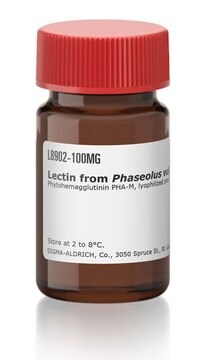
L8902

Lectin from Phaseolus vulgaris (red kidney bean)

Phytohemagglutinin PHA-M, lyophilized powder, BioReagent, suitable for cell culture

Synonym(s):

Phaseolus vulgaris agglutinin, PHA

Sign In to View Organizational & Contract Pricing.

Select a Size

Change View
Pack SizeSKUAvailabilityPrice

About This Item

UNSPSC Code:
12352202
EC Number:
232-718-7
NACRES:
NA.32
Form:
lyophilized powder
Pricing and availability is not currently available.
Technical Service
Need help? Our team of experienced scientists is here for you.
Let Us Assist


Quality Level

product line

BioReagent

form

lyophilized powder

potency

<40 μg per mL agglutination activity

technique(s)

cell culture | mammalian: suitable

impurities

salt, free

solubility

PBS: 2 mg/mL

storage temp.

2-8°C

Application

Lectin from Phaseolus vulgaris (red kidney bean) is used in Lymphocyte Transformation Assay and culture medium.[1]

Biochem/physiol Actions

PHA consists of two molecular species, an erythroagglutinin (PHA-E) which has low mitogenic activity and high erythroagglutinin activity, and leucoagglutinin (PHA-L) which has high mitogenic and leucoagglutinating activity, but very low erythroagglutinating activity.
PHA-E is not blood group specific, but agglutination can be inhibited by certain oligosaccharides. PHA-P is the protein form of PHA prior to separation and purification of erythroagglutinin and leucoagglutinin. PHA-M is the mucoprotein form. Conjugates are prepared from the corresponding purified lectins.

Analysis Note

Agglutination activity is expressed in μg/mL and is determined from serial dilutions of a 1 mg/mL solution. This activity is the lowest concentration to agglutinate a 2% suspension of human erythrocytes in phosphate buffered saline, pH 6.8, after 1 hr incubation at 25 °C.

Compare Similar Items

View Full Comparison

Show Differences

1 of 1

This Item
L1668L4144L2769
technique(s)

cell culture | mammalian: suitable

technique(s)

cell culture | mammalian: suitable

technique(s)

cell culture | mammalian: suitable

technique(s)

-

form

lyophilized powder

form

lyophilized powder (contains ~50% buffer salts as sodium phosphate and NaCl)

form

lyophilized powder

form

lyophilized powder

impurities

salt, free

impurities

-

impurities

salt, free

impurities

salt, free

solubility

PBS: 2 mg/mL

solubility

PBS: 5 mg/mL, clear to slightly hazy, colorless to faintly yellow (pH 6.8)

solubility

DPBS: 5 mg/mL, slightly hazy, colorless

solubility

-

storage temp.

2-8°C

storage temp.

2-8°C

storage temp.

2-8°C

storage temp.

2-8°C

potency

<40 μg per mL agglutination activity

potency

≤10 μg per mL mitogenic activity (Bromdeoxyuridine incorporation in human peripheral blood mononuclear cells)

potency

erythroagglutination activity (Does not agglutinate a 2% suspension of human erythrocytes at 250 μg lectin/ml.), ≤1.0 μg per mL leucoagglutination activity, ≤5 μg per mL mitogenic activity (Bromdeoxyuridine incorporation in human peripheral blood mononuclear cells)

potency

erythroagglutination activity (Does not agglutinate a 2% suspension of human erythrocytes at <62.5 μg lectin/ml.), ≤1.0 μg/mL leucoagglutination activity, ≤5 μg/mL mitogenic activity


Still not finding the right product?


Storage Class

11 - Combustible Solids

wgk

WGK 3

flash_point_f

Not applicable

flash_point_c

Not applicable


Choose from one of the most recent versions:

Certificates of Analysis (COA)

Lot/Batch Number

Don't see the Right Version?

If you require a particular version, you can look up a specific certificate by the Lot or Batch number.

Already Own This Product?

Find documentation for the products that you have recently purchased in the Document Library.

Visit the Document Library


Related Content

Instructions


J Kabeerdoss et al.
Alimentary pharmacology & therapeutics, 34(8), 923-930 (2011-08-19)
Helminths have been used to inhibit intestinal inflammation in patients with Crohn's disease. This study was undertaken to determine if there is a protective association of prior hookworm infection with Crohn's disease, in a region where there is epidemiological transition
Pinar Ozkal et al.
Mutagenesis, 20(2), 147-150 (2005-04-22)
Chronic viral hepatitis is the main cause of chronic liver disease, cirrhosis and hepatocellular carcinoma throughout the world. Hepatitis B virus (HBV) has mutagenic effects on somatic cells. HBV may be showing these mutagenic effects through its viral proteins or
Stefan Warmuth et al.
Oncoimmunology, 10(1), 2004661-2004661 (2022-07-19)
Co-stimulatory 4-1BB receptors on tumor-infiltrating T cells are a compelling target for overcoming resistance to immune checkpoint inhibitors, but initial clinical studies of 4-1BB agonist mAbs were accompanied by liver toxicity. We sought to engineer a tri-specific antibody-based molecule that


Global Trade Item Number

SKUGTIN
L8902-100MG04061833966228
L8902-5MG04061835557639
L8902-25MG04061833966242

Questions

  1. What do the designations -P, -L, -M, and -E represent in the names of PHA products?

    1 answer
    1. Generally, PHA-P or PHA-L is utilized to stimulate lymphocytes, although PHA-M will also work, but not to the same degree. The most active form is PHA-L (the mitogenic concentration is < 5μg/ml). PHA, or Phytohemagglutinin, comprises two molecular species:

      1. Erythroagglutinin (PHA-E), which demonstrates low mitogenic activity and high erythroagglutinating activity.

      2. Leucoagglutinin (PHA-L), which possesses high mitogenic and leucoagglutinating activity, accompanied by very low erythroagglutinating activity.

      PHA-P represents the protein form of PHA before the erythroagglutinin and leucoagglutinin components are separated and purified. PHA-M refers to the mucoprotein form of Phytohemagglutinin.

      Helpful?

Reviews

No rating value

Active Filters