Skip to Content
Merck

Skip To

K4769

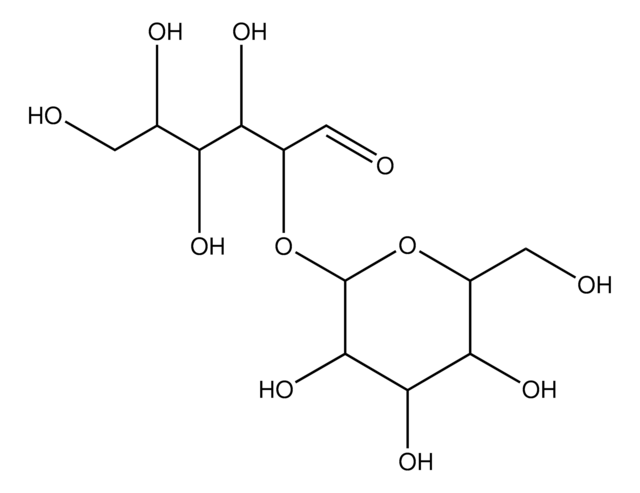
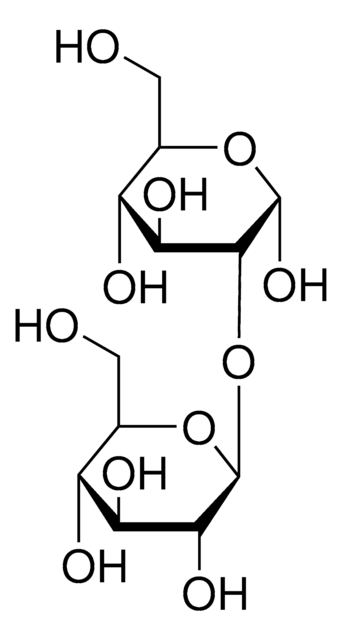
Kojibiose

≥98% (HPLC)

Synonym(s):

α-D-Glc-(1→2)-D-Glc, 2-O-α-D-Glucopyranosyl-D-glucose

Sign In to View Organizational & Contract Pricing.

Select a Size

Change View
Pack SizeSKUAvailabilityPrice

About This Item

Empirical Formula (Hill Notation):
C12H22O11
CAS Number:
Molecular Weight:
342.30
NACRES:
NA.25
PubChem Substance ID:
UNSPSC Code:
12352201
MDL number:
Pricing and availability is not currently available.
Technical Service
Need help? Our team of experienced scientists is here for you.
Let Us Assist


Quality Level

assay

≥98% (HPLC)

form

powder

technique(s)

HPLC: suitable

color

white to off-white

solubility

water: 5 mg/mL, clear, colorless

storage temp.

−20°C

SMILES string

OCC(O)C(O)C(O)C(OC1OC(CO)C(O)C(O)C1O)C=O

InChI

1S/C12H22O11/c13-1-4(16)7(17)8(18)5(2-14)22-12-11(21)10(20)9(19)6(3-15)23-12/h2,4-13,15-21H,1,3H2

InChI key

PZDOWFGHCNHPQD-UHFFFAOYSA-N

Application

Kojibiose, a disaccharide product of glucose caramelization and an inhibitor of plant glucosidase I, may be used to help identify and characterize glucosidase I enzymes involved in terminal deglycosylation of high-mannose oligosaccharides.[1] Kojibiose may be used as a substrate to study the biological species, enzymes and catabolic processes that catabolize it as an energy source. Kojibiose may be used to identify, differentiate and characterize kojibiose phosphorylase(s) (KP).[2]

Biochem/physiol Actions

Kojibiose is an inhibitor of plant glucosidase I. It inhibits the removal of terminal glucose from (Glc)3(Man)9(GlcNAc)2.
Kojibiose is an inhibitor of plant glucosidase I. It inhibits the removal of terminal glucose from the high-mannose oligosaccharide (Glc)3(Man)9(GlcNAc)2, either from the free oligosaccharide or from the oligosaccharide attached to a protein via N-linkage.

Other Notes

To gain a comprehensive understanding of our extensive range of Disaccharides for your research, we encourage you to visit our Carbohydrates Category page.

Compare Similar Items

View Full Comparison

Show Differences

1 of 1

This Item
S1404M5500S4001
technique(s)

HPLC: suitable

technique(s)

HPLC: suitable

technique(s)

HPLC: suitable

technique(s)

HPLC: suitable

assay

≥98% (HPLC)

assay

≥98% (HPLC, anhydrous)

assay

≥98% (HPLC)

assay

≥98% (HPLC)

solubility

water: 5 mg/mL, clear, colorless

solubility

water: 50 mg/mL, clear, colorless

solubility

water: 50 mg/mL, clear to very slightly hazy, colorless

solubility

water: 50 mg/mL, clear to very slightly hazy, colorless

Quality Level

200

Quality Level

100

Quality Level

200

Quality Level

200

form

powder

form

powder

form

powder

form

powder

storage temp.

−20°C

storage temp.

−20°C

storage temp.

-

storage temp.

-


Storage Class

11 - Combustible Solids

wgk

WGK 3

flash_point_f

Not applicable

flash_point_c

Not applicable


Choose from one of the most recent versions:

Certificates of Analysis (COA)

Lot/Batch Number

Don't see the Right Version?

If you require a particular version, you can look up a specific certificate by the Lot or Batch number.

Already Own This Product?

Find documentation for the products that you have recently purchased in the Document Library.

Visit the Document Library


Satoshi Okada et al.
The FEBS journal, 281(3), 778-786 (2013-11-22)
Glycoside hydrolase (GH) family 65 contains phosphorylases acting on maltose (Glc-α1,4-Glc), kojibiose (Glc-α1,2-Glc), trehalose (Glc-α1,α1,-Glc), and nigerose (Glc-α1,3-Glc). These phosphorylases can efficiently catalyze the reverse reactions with high specificities, and thus can be applied to the practical synthesis of α-glucosyl
Jong-Hyun Jung et al.
Journal of bacteriology, 196(5), 1122-1131 (2014-01-07)
A unique gene cluster responsible for kojibiose utilization was identified in the genome of Pyrococcus sp. strain ST04. The proteins it encodes hydrolyze kojibiose, a disaccharide product of glucose caramelization, and form glucose-6-phosphate (G6P) in two steps. Heterologous expression of
Ana Vila Verde et al.
The journal of physical chemistry. B, 115(21), 7069-7084 (2011-05-13)
Molecular level insight into water structure and structural dynamics near proteins, lipids, and nucleic acids is critical to the quantitative understanding of many biophysical processes. Unfortunately, understanding hydration and hydration dynamics around such large molecules is challenging because of the


Global Trade Item Number

SKUGTIN
K4769-1MG04061833944738

Questions

Reviews

No rating value

Active Filters