
C9409

Creatinine Deiminase microbial
lyophilized powder, ≥25 units/mg protein
Synonym(s):
Creatinine Deaminase
Sign In to View Organizational & Contract Pricing.
Select a Size
Change View
| Pack Size | SKU | Availability | Price |
|---|
About This Item
CAS Number:
UNSPSC Code:
12352204
NACRES:
NA.54
EC Number:
253-449-1
MDL number:
Specific activity:
≥25 units/mg protein
Pricing and availability is not currently available.
form
lyophilized powder
Quality Level
specific activity
≥25 units/mg protein
mol wt
~260 kDa
composition
Protein, ≥15% biuret
storage temp.
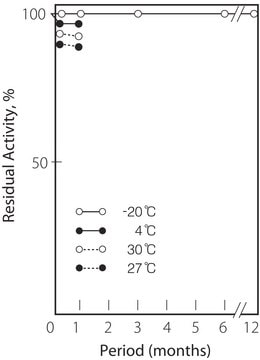
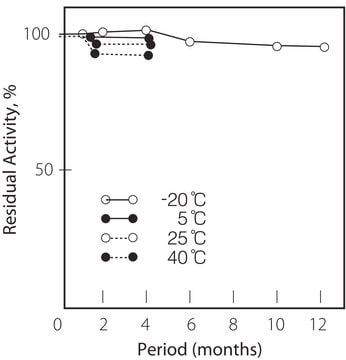
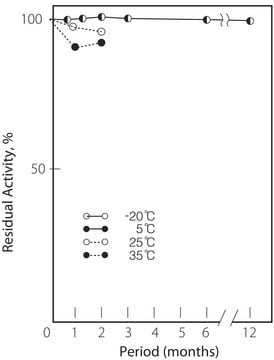
−20°C
General description
Isoelectric point : 4.4
Michaelis constant : 3.5 x 10‾3M (Creatinine)
Structure : 6 subunits per mol of enzyme
Inhibitors : Ag+,Hg++, o-phenanthroline,monoiodoacetate
Optimum pH : 8.5 – 9.5
Optimum temperature : 65 – 75°C
pH Stability : pH 7.0 – 11.0 (30°C, 20hr)
Thermal stability : Below 65°C (pH 7.5, 1hr)
Michaelis constant : 3.5 x 10‾3M (Creatinine)
Structure : 6 subunits per mol of enzyme
Inhibitors : Ag+,Hg++, o-phenanthroline,monoiodoacetate
Optimum pH : 8.5 – 9.5
Optimum temperature : 65 – 75°C
pH Stability : pH 7.0 – 11.0 (30°C, 20hr)
Thermal stability : Below 65°C (pH 7.5, 1hr)
Application
Creatinine Deiminase microbial has been used:
- to immobilize aminosilylated glass beads based biosensor for ammonia/ammonium and creatinine detection in urine[1]
- in creating creatinine-sensing membrane for biophysical studies[2]
- to investigate the bioelectronic tongue for the simultaneous determination of urea, creatinine and alkaline ions in clinical samples[3]
Creatinine deiminase has been used in a study to assess the application of a creatinine-sensitive biosensor for hemodialysis control. Creatinine deiminase has also been used in a study to investigate the bioelectronic tongue for the simultaneous determination of urea, creatinine and alkaline ions in clinical samples.
Biochem/physiol Actions
Creatinine deiminase catalyzes the hydrolysis of creatinine to methylhydantoine and ammonia.[1]
Physical form
Lyophilized powder containing mannitol as stabilizer
Other Notes
One unit will hydrolyze 1.0 μmole of creatinine to N-methylhydantoin and NH3 per min at pH 7.5 at 37 °C in a coupled system with L-glutamic dehydrogenase.
1 of 1
This Item | |||
|---|---|---|---|
| specific activity ≥25 units/mg protein | specific activity 100-300 units/mg protein | specific activity ≥4 units/mg solid | specific activity ≥150 units/mg protein |
| form lyophilized powder | form lyophilized powder | form lyophilized powder | form salt-free, lyophilized powder |
| storage temp. −20°C | storage temp. 2-8°C | storage temp. −20°C | storage temp. −20°C |
| mol wt ~260 kDa | mol wt ~175 kDa | mol wt ~100 kDa | mol wt 80-86.2 kDa |
| Quality Level 200 | Quality Level 200 | Quality Level 200 | Quality Level 200 |
| composition Protein, ≥15% biuret | composition Protein, 65-85% | composition - | composition - |

Storage Class
11 - Combustible Solids
wgk
WGK 3
flash_point_f
Not applicable
flash_point_c
Not applicable
ppe
Eyeshields, Gloves, type N95 (US)
Choose from one of the most recent versions:
Already Own This Product?
Find documentation for the products that you have recently purchased in the Document Library.
R G Washburn et al.
The Journal of antimicrobial chemotherapy, 17(5), 673-677 (1986-05-01)
Creatinine iminohydrolase (EC 3.5.4.21) quantitatively releases ammonia from flucytosine (5FC) as well as from creatinine. Using 39 sera from eight patients receiving the combination of amphotericin B with 5FC, we demonstrated that this rapid enzymatic reaction provides a valid measure
Z K He et al.
Analytical biochemistry, 283(2), 166-174 (2000-07-25)
A precise and sensitive working microflow titration procedure was developed to determine creatinine and ammonia in urine samples. This procedure is based on enzymatic conversion of creatinine, gas diffusional membrane separation of the released ammonia into an acid acceptor stream
Hong Dinh Duong et al.
Sensors (Basel, Switzerland), 17(11) (2017-11-09)
In this study, the oxazine 170 perchlorate (O17)-ethylcellulose (EC) membrane was successfully exploited for the fabrication of creatine- and creatinine-sensing membranes. The sensing membrane exhibited a double layer of O17-EC membrane and a layer of enzyme(s) entrapped in the EC
Global Trade Item Number
| SKU | GTIN |
|---|---|
| C9409-250UN | 04061832755403 |