
A8326

Anti-Beta (β)-Amyloid antibody
rabbit polyclonal
Select a Size
| Pack Size | SKU | Availability | Price |
|---|
About This Item
Product Name
Anti-β-Amyloid Protein (1-40) antibody produced in rabbit, whole antiserum
biological source
rabbit
Quality Level
conjugate
unconjugated
antibody form
whole antiserum
antibody product type
primary antibodies
clone
polyclonal
form
liquid
contains
15 mM sodium azide
species reactivity
human
enhanced validation
independent
Learn more about Antibody Enhanced Validation
technique(s)
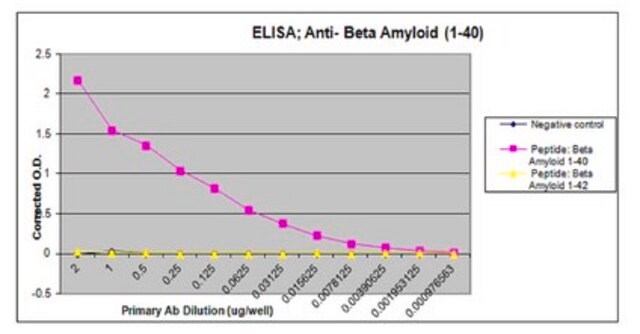
immunohistochemistry (formalin-fixed, paraffin-embedded sections): 1:100 using human Alzheimer’s disease (AD) brain tissue, indirect ELISA: 1:4000-1:8000
UniProt accession no.
shipped in
dry ice
storage temp.
−20°C
target post-translational modification
unmodified
Gene Information
human ... APP(351)
General description
Immunogen
Application
- immunocytochemical localization of Aβ peptides
- immunocytochemistry
- immunoprecipitation
- focused ultrasound-microbubble enhanced antibody delivery (FUS-MB)
Biochem/physiol Actions
Rabbit Anti-β-Amyloid Protein (1-40) antibody does not stain control sections of normal brain tissues.
Physical form
Disclaimer
1 of 1
This Item | |||
|---|---|---|---|
| conjugate unconjugated | conjugate unconjugated | conjugate unconjugated | conjugate - |
| biological source rabbit | biological source rabbit | biological source rabbit | biological source rabbit |
| antibody form whole antiserum | antibody form IgG fraction of antiserum | antibody form IgG fraction of antiserum | antibody form affinity isolated antibody |
| Quality Level 200 | Quality Level 200 | Quality Level 200 | Quality Level 100 |
| shipped in dry ice | shipped in dry ice | shipped in dry ice | shipped in wet ice |
| technique(s) immunohistochemistry (formalin-fixed, paraffin-embedded sections): 1:100 using human Alzheimer’s disease (AD) brain tissue, indirect ELISA: 1:4000-1:8000 | technique(s) immunohistochemistry (formalin-fixed, paraffin-embedded sections): 1:1000 using formic acid-treated sections of human Alzheimer′s disease (AD) brain, microarray: suitable, western blot: 1:4,000 using rat brain extract | technique(s) immunohistochemistry (formalin-fixed, paraffin-embedded sections): 1:200 using formic acid-treated sections of human Alzheimer′s disease (AD) brain, microarray: suitable, western blot: 1:1,000 using rat brain extract or supernatant of 293T cells secreting APP. | technique(s) ELISA: suitable, immunohistochemistry: suitable (paraffin), western blot: suitable |


Still not finding the right product?
Explore all of our products under Anti-β-Amyloid Protein (1-40) antibody produced in rabbit
— or —
Try our Product Selector Tool to narrow your options
Storage Class
10 - Combustible liquids
wgk
WGK 3
flash_point_f
Not applicable
flash_point_c
Not applicable
Choose from one of the most recent versions:
Already Own This Product?
Find documentation for the products that you have recently purchased in the Document Library.
Related Content
Global Trade Item Number
| SKU | GTIN |
|---|---|
| A8326-.5ML | 04061838160911 |