
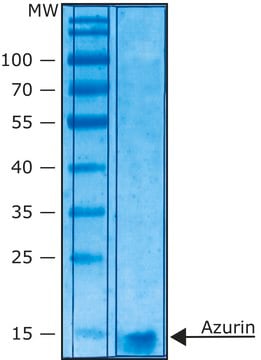


The method of preparation is considered proprietary. However, as mentioned in this properties section of the Product Detail Page, this is Azurin from Pseudomonas aeruginosa. See the links below to review a sample Certificate of Analysis and the product data sheet, respectively:
https://www.sigmaaldrich.com/certificates/sapfs/PROD/sap/certificate_pdfs/COFA/Q14/A3672-1MG0000211689.pdf
https://www.sigmaaldrich.com/deepweb/assets/sigmaaldrich/product/documents/306/100/a3672dat.pdf
A3672

Azurin
from Pseudomonas aeruginosa, lyophilized powder
Sign In to View Organizational & Contract Pricing.
Select a Size
Change View
| Pack Size | SKU | Availability | Price |
|---|
About This Item
Form:
lyophilized powder
Biological source:
Pseudomonas aeruginosa
Pricing and availability is not currently available.
biological source
Pseudomonas aeruginosa
Quality Level
form
lyophilized powder
composition
Protein, ≥65% Lowry
concentration
≥65.0% (Lowry)
technique(s)
toxicology assay: suitable
solubility
water: soluble 1—1.1 mg/mL, clear, blue (light blue to blue)
UniProt accession no.
storage temp.
−20°C
Gene Information
Pseudomonas aeruginosa ... AZU(878046)
General description
Research area: Apoptosis. Azurinis a periplasmic protein and is a homotetramer.[1]
Application
Azurin has been used:
- in the cytotoxicity and cell viability studies in human osteosarcoma cell line
- for the functionalization of silicon nitride cantilevers for interaction studies
- for coating gold surface and insulating functionalized oxide surfaces of silicon oxide and mica
Biochem/physiol Actions
Azurin acts as an electron donor for nitrite reductase in bacterial denitrification process.[1] It exhibits anticancer activity[1] as it hampers various independent signaling pathways associated with cancer progression. It binds to tumor suppressor protein p53 and induces cancer cell apoptosis or stalls cancer cell growth. Azurin disrupts angiogenesis by reducing the activity of VEGFR-2tyrosine kinase thereby inhibiting tumor growth. It has been observed to show cytotoxicity in human breast cancer cells and human melanoma cells.[2]
Azurin is a metalloprotein in the family of cupredoxins. It preferentially enters cancer cells over normal cells and induces apoptosis. Azurin has structural similarities to ephrinB2, and in fact binds the ephrin receptor tyrosine kinase EphB2 to initiate cell signaling that is involved in cancer progression. Azurin inhibits autophosphorlyation of the EphB2 tyrosine residue, interfering with upstream cell signaling and contributing to cancer cell growth inhibition.
Physical form
Lyophilized powder containing ammonium acetate buffer salts.
1 of 1
This Item | |||
|---|---|---|---|
| biological source Pseudomonas aeruginosa | biological source - | biological source plant (Silybum marianum) | biological source bovine |
| technique(s) toxicology assay: suitable | technique(s) toxicology assay: suitable | technique(s) toxicology assay: suitable | technique(s) toxicology assay: suitable |
| concentration ≥65.0% (Lowry) | concentration - | concentration - | concentration - |
| form lyophilized powder | form powder | form powder | form powder |
| storage temp. −20°C | storage temp. −20°C | storage temp. −20°C | storage temp. 2-8°C |
| Gene Information Pseudomonas aeruginosa ... AZU(878046) | Gene Information human ... CCK(885) | Gene Information - | Gene Information - |
Storage Class
11 - Combustible Solids
wgk
WGK 3
flash_point_f
Not applicable
flash_point_c
Not applicable
ppe
Eyeshields, Gloves, type N95 (US)
Choose from one of the most recent versions:
Already Own This Product?
Find documentation for the products that you have recently purchased in the Document Library.
Related Content
Instructions
Yunlei Zhang et al.
Applied and environmental microbiology, 78(21), 7603-7610 (2012-08-28)
Many studies have demonstrated that intravenously administered bacteria can target and proliferate in solid tumors and then quickly be released from other organs. Here, we employed the tumor-targeting property of Escherichia coli Nissle 1917 to inhibit mouse B16 melanoma and
Interaction of p53 with Mdm2 and azurin as studied by atomic force spectroscopy
Funari G, et al.
Journal of Molecular Recognition, 23(4), 343-351 (2010)
Marcel Swart et al.
Chemistry & biodiversity, 9(9), 1728-1738 (2012-09-15)
UV/VIS Electron excitation spectra have been computed for large, realistic model systems of the blue copper protein family. Fully quantum-chemical calculations at the density-functional theory level employing polarized triple-ζ basis sets have been performed on systems of over 120 atoms
Global Trade Item Number
| SKU | GTIN |
|---|---|
| A3672-1MG | 04061826670903 |
-
How do i know that this is azurin i mean any confirmatory test or anything else.
1 answer-
Helpful?
-