Skip to Content
Merck

Skip To

SCC034

Human Mesenchymal Stem Cells (Bone Marrow)

Human mesenchymal stem cells derived from bone marrow that have a capacity for expansion in vitro while maintaining their potential for differentiation to multiple lineages including adipocytes, osteoblasts and chondrocytes.

Synonym(s):

Human Bone Marrow MSCs, Human Bone Marrow Multipotent Stem Cells, Human MSCs

Sign In to View Organizational & Contract Pricing.

Select a Size

Change View
Pack SizeSKUAvailabilityPrice

About This Item

UNSPSC Code:
41106509
NACRES:
NA.75
eCl@ss:
32011203
Biological source:
human
Pricing and availability is not currently available.
Technical Service
Need help? Our team of experienced scientists is here for you.
Let Us Assist

biological source

human

Quality Level

technique(s)

cell culture | mammalian: suitable, cell culture | stem cell: suitable, cell differentiation: suitable

input

sample type mesenchymal stem cell(s)

shipped in

liquid nitrogen

storage temp.

-140 to -196°C

Compare Similar Items

View Full Comparison

Show Differences

1 of 1

This Item
SCM045SCC038SCR027
technique(s)

cell culture | mammalian: suitable, cell differentiation: suitable, cell culture | stem cell: suitable

technique(s)

cell culture | stem cell: suitable

technique(s)

cell culture | mammalian: suitable, cell culture | stem cell: suitable, cell differentiation: suitable

technique(s)

cell culture | stem cell: suitable

biological source

human

biological source

-

biological source

human

biological source

rat

shipped in

liquid nitrogen

shipped in

dry ice

shipped in

dry ice

shipped in

liquid nitrogen

Quality Level

100

Quality Level

300

Quality Level

100

Quality Level

100

input

sample type mesenchymal stem cell(s)

input

sample type mesenchymal stem cell(s)

input

sample type mesenchymal stem cell(s)

input

sample type mesenchymal stem cell(s)

General description

Mesenchymal stem cells, also known as marrow stromal cells, are defined as a self-renewing population of adherent, bone-marrow-derived multipotent progenitor cells with the capacity to differentiate into several mesenchymal cell lineages. In defined cultures in vitro, mesenchymal stem cells have been shown to readily differentiate into lineage-specific cells that form bone, cartilage, fat, tendon, and muscle tissues.

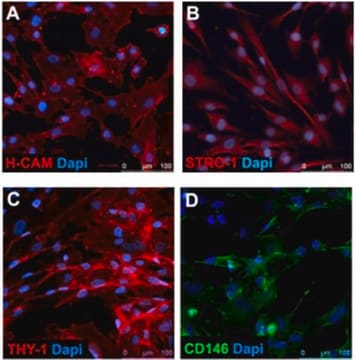
EMD Millipore’s Human Mesenchymal Stem Cells (Bone Marrow) are isolated from normal human bone marrow and are cryopreserved at P2 to ensure optimal phenotype and the highest viability and plating efficiency. These cells proliferate as an adherent cell monolayer and have shown a strong capacity for expansion in vitro while maintaining their potential for differentiation to multiple lineages including adipocytes, osteoblasts and chondrocytes..

Application

Research Category
Stem Cell Research

Biochem/physiol Actions

Mesenchymal Stem Cells

Preparation Note

Human Mesenchymal Stem Cells (Bone Marrow) should be stored in liquid nitrogen. The cells are guaranteed for at least 3 population doublings without significantly affecting cell surface marker expression and differentiation potential.

Analysis Note

- Each vial contains at least 1X10⁶ viable cells at P2.
- Cell viability is greater than 75% at thaw and cells can be cultured for at least 3 population doublings after the initial thaw.
- Bone marrow donors tested negative for HIV, hepatitis B and hepatitis C.
- Apparently normal karyotype per cytogenetic analysis.
- Cells tested negative for mycoplasma contamination.

Other Notes

1X10⁶ viable Human Bone Marrow Mesenchymal Stem Cells
Subject to local law, this product is intended to be sold for internal in vitro research use only subject to terms and conditions found here: www.sigmaaldrich.com/restrictedcelluse. This product may not be: re-engineered or copied; used to make derivatives, modifications or functional equivalents; used to obtain patents or other IP claiming use of the product; used to develop, test, or manufacturer a commercial product; used as a component in a commercial product; resold or licensed; used in any clinical applications or trials; or used in humans. A license or limited commercial use agreement is required for use by any for-profit entity, use in services, and use in sponsored academic research. For information regarding any such use, please contact [email protected].

Disclaimer

RESEARCH USE ONLY. This product is regulated in France when intended to be used for scientific purposes, including for import and export activities (Article L 1211-1 paragraph 2 of the Public Health Code). The purchaser (i.e. enduser) is required to obtain an import authorization from the France Ministry of Research referred in the Article L1245-5-1 II. of Public Health Code. By ordering this product, you are confirming that you have obtained the proper import authorization.
Unless otherwise stated in our catalog or other company documentation accompanying the product(s), our products are intended for research use only and are not to be used for any other purpose, which includes but is not limited to, unauthorized commercial uses, in vitro diagnostic uses, ex vivo or in vivo therapeutic uses or any type of consumption or application to humans or animals.

Storage Class

10 - Combustible liquids

wgk

WGK 3

flash_point_f

Not applicable

flash_point_c

Not applicable


Certificates of Analysis (COA)

Search for Certificates of Analysis (COA) by entering the products Lot/Batch Number. Lot and Batch Numbers can be found on a product’s label following the words ‘Lot’ or ‘Batch’.

Already Own This Product?

Find documentation for the products that you have recently purchased in the Document Library.

Visit the Document Library

Diego Omar Sanchez Ramirez et al.
Bioengineering (Basel, Switzerland), 8(12) (2021-12-24)
Protein-based nanofibres are commonly used in the biomedical field to support cell growth. For this study, the cell viability of wool keratin-based nanofibres was tested. Membranes were obtained by electrospinning using formic acid, hexafluoroisopropanol, and water as solvents. For aqueous
Iriczalli Cruz-Maya et al.
Journal of functional biomaterials, 14(1) (2023-01-21)
In the last decade, alginate-based microgels have gained relevant interest as three-dimensional analogues of extracellular matrix, being able to support cell growth and functions. In this study, core-shell microgels were fabricated by self-polymerization of dopamine (DA) molecules under mild oxidation
Ramona Orlacchio et al.
Molecules (Basel, Switzerland), 27(7) (2022-04-13)
Poly-L-lactic acid (PLLA) aerogel-based scaffolds were obtained from physical PLLA gels containing cyclopentanone (CPO) or methyl benzoate (BzOMe) molecules. An innovative single step method of solvent extraction, using supercritical CO2, was used to achieve cylindrical monolithic aerogels. The pore distribution
LncRNA-NEF is downregulated in postmenopausal osteoporosis and is related to course of treatment and recurrence.
Xiaoyong Ma et al.
The Journal of international medical research, 47(7), 3299-3306 (2019-06-22)
Diego O Sanchez Ramirez et al.
Journal of functional biomaterials, 12(4) (2021-12-24)
The development of asymmetric membranes-i.e., matching two fibrous layers with selected composition and morphological properties to mimic both the epidermis and dermis-currently represents one of the most promising strategies to support skin regeneration during the wound healing process. Herein, a

Global Trade Item Number

SKUGTIN
SCC03404053252609992

Questions

Reviews

No rating value

Active Filters

Our team of scientists has experience in all areas of research including Life Science, Material Science, Chemical Synthesis, Chromatography, Analytical and many others.

Contact Technical Service