Accéder au contenu
Merck

Passer à

A3981

Anti-Beta (β)-Amyloid antibody

mouse monoclonal, BAM-10

Synonyme(s) :

Anti-A-BETA, Anti-Amyloid β Precursor Protein, Clone BAM91

Se connecter pour consulter les tarifs organisationnels et contractuels.

Sélectionner une taille de conditionnement

Changer de vue
ConditionnementRéférenceDisponibilitéPrix

A propos de cet article

UNSPSC Code:
12352203
NACRES:
NA.41
MDL number:
Conjugate:
unconjugated
Clone:
BAM-10, monoclonal
Application:
ELISA (i), IHC (p), WB
Citations:
19
Le tarif et la disponibilité ne sont pas disponibles actuellement.
Service technique
Besoin d'aide ? Notre équipe de scientifiques expérimentés est là pour vous.
Laissez-nous vous aider


Nom du produit

Anti-β-Amyloid antibody, Mouse monoclonal, clone BAM-10, purified from hybridoma cell culture

biological source

mouse

Quality Level

conjugate

unconjugated

antibody form

purified immunoglobulin

antibody product type

primary antibodies

clone

BAM-10, monoclonal

form

buffered aqueous solution

species reactivity

human

packaging

antibody small pack of 25 μL

enhanced validation

independent
Learn more about Antibody Enhanced Validation

concentration

~1.5 mg/mL

technique(s)

immunohistochemistry (formalin-fixed, paraffin-embedded sections): 2.5-5 μg/mL using formic-acid treated tissue sections of human Alzheimer disease brain tissue, indirect ELISA: suitable, western blot: suitable

isotype

IgG1

UniProt accession no.

shipped in

dry ice

storage temp.

−20°C

target post-translational modification

unmodified

Gene Information

human ... APP(351)

General description

β-amyloid gene is located on human chromosome 21q21.
The β-amyloid precursor protein (APP) is cleaved sequentially by the proteolytic enzymes β-and γ-secretase to produce β-amyloid (Aβ) peptides with the Aβ1-42 and the Aβ1-40 forms being the most prevalent. Secreted Aβ peptides are degraded either via a re-uptake mechanism followed by endosomal degradation, or by an extracellular insulin degrading enzyme. Extracellular accumulation of Aβ leads to the formation of aggregates, fibrils and eventually amyloid deposits called neuritic plaques, which is the hallmark of Alzheimer′s disease (AD).
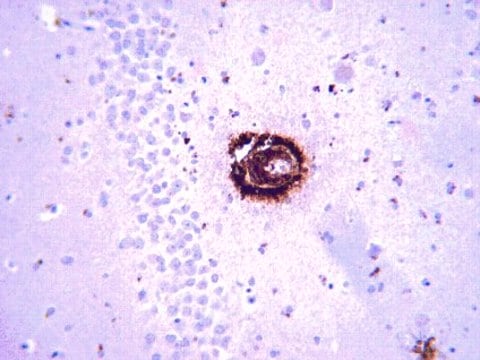
The antibody reacts specifically with β-amyloid protein. The epitope recognized by the antibody resides within amino acids 1-12 of the β-amyloid protein. It specifically stains amyloid plaques within the cortex and amyloid deposits in blood vessels using formic acid-treated, formalin-fixed, paraffin-embedded, and Methacarn-fixed sections of human Alzheimer′s disease (AD) brain tissue.

Immunogen

Synthetic β-amyloid peptide, conjugated to KLH.

Application

Monoclonal Anti-β-Amyloid antibody has been used in immunoprecipitation analysis, microarray-based immunoassay and microarray.
Mouse monoclonal anti-ABETA was used to treat old WT PDAPP mice with amyloid accumulation and learning deficits in an attempt to improve learning and decrease accumulation, however no response was observed.
The antibody is useful in immunohistochemistry, immunoblotting, ELISA, and competitive ELISA. Also, this antibody has been used to neutralize Aβ assemblies in brains of transgenic mice expressing a mutant form of amyloid precursor protein, and for in vivo deep tissue imaging using near-IR optical spectrum.

Biochem/physiol Actions

β-amyloid gene acts as the substrate of insulin-degrading enzyme (IDE). It plays a major role in the pathogenesis of Alzheimer′s disease (AD) and type 2 diabetes mellitus (DM2).

Physical form

Solution in 0.01 M phosphate buffered saline, pH 7.4, containing 15 mM sodium azide.

Disclaimer

Unless otherwise stated in our catalog or other company documentation accompanying the product(s), our products are intended for research use only and are not to be used for any other purpose, which includes but is not limited to, unauthorized commercial uses, in vitro diagnostic uses, ex vivo or in vivo therapeutic uses or any type of consumption or application to humans or animals.

Comparer avec des articles similaires

Voir la comparaison complète

Montrer les différences

1 of 1

Cet article
A8354MABN11MABN13
antibody form

purified immunoglobulin

antibody form

purified immunoglobulin

antibody form

purified antibody

antibody form

purified antibody

conjugate

unconjugated

conjugate

unconjugated

conjugate

-

conjugate

-

species reactivity

human

species reactivity

human

species reactivity

human, mouse

species reactivity

human

clone

BAM-10, monoclonal

clone

NAB 228, monoclonal

clone

G2-10, monoclonal

clone

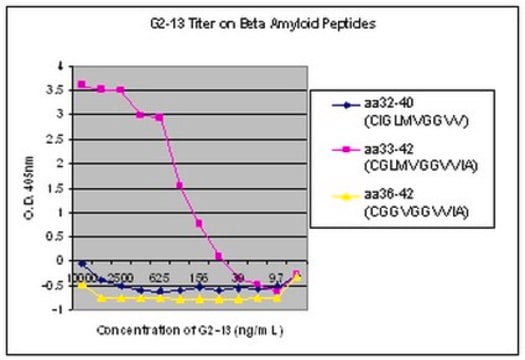
G2-13, monoclonal

Gene Information

human ... APP(351)

Gene Information

human ... APP(351)

Gene Information

human ... APP(351)

Gene Information

human ... APP(351)

biological source

mouse

biological source

mouse

biological source

mouse

biological source

mouse


Still not finding the right product?

Explore all of our products under

ou

Essayez notre Outil de sélection de produits pour affiner vos choix.


Classe de stockage

10 - Combustible liquids

wgk

WGK 3

flash_point_f

Not applicable

flash_point_c

Not applicable

ppe

Eyeshields, Gloves, multi-purpose combination respirator cartridge (US)


Faites votre choix parmi les versions les plus récentes :

Certificats d'analyse (COA)

Lot/Batch Number

Vous ne trouvez pas la bonne version ?

Si vous avez besoin d'une version particulière, vous pouvez rechercher un certificat spécifique par le numéro de lot.

Déjà en possession de ce produit ?

Retrouvez la documentation relative aux produits que vous avez récemment achetés dans la Bibliothèque de documents.

Consulter la Bibliothèque de documents


Contenu apparenté


Alexandra Petiet et al.
Methods in molecular biology (Clifton, N.J.), 771, 293-308 (2011-08-30)
Alzheimer's disease (AD) is an important social and economic issue for our societies. The development of therapeutics against this severe dementia requires assessing the effects of new drugs in animal models thanks to dedicated biomarkers. According to the amyloid cascade
Association of Antineuronal Antibody Levels with Cognitive Impairment in Older Cuban Adults.
Leonardo Cristiá-Lara et al.
MEDICC review, 19(2-3), 32-32 (2017-07-01)
Antibodies targeted to the brain with image-guided focused ultrasound reduces amyloid-β plaque load in the TgCRND8 mouse model of Alzheimer's disease.
Jord?o JF, et al.
PLoS ONE, 5(5), e10549-e10549 (2010)


Numéro d'article de commerce international

RéférenceGTIN
A3981-200UL04061833368343
A3981-100UL04061833368336

Questions

Reviews

No rating value

Active Filters