


If this product has an expiration or retest date, it will be shown on the Certificate of Analysis (COA, CofA). If there is no retest or expiration date listed on the product's COA, we do not have suitable stability data to determine a shelf life. For these products, the only date on the COA will be the release date; a retest, expiration, or use-by-date will not be displayed.
For all products, we recommend handling per defined conditions as printed in our product literature and website product descriptions. We recommend that products should be routinely inspected by customers to ensure they perform as expected.
For products without retest or expiration dates, our standard warranty of 1 year from the date of shipment is applicable.
For more information, please refer to the Product Dating Information document: https://www.sigmaaldrich.com/deepweb/assets/sigmaaldrich/marketing/global/documents/418/501/product-dating-information-06-25-mk.pdf
C5269

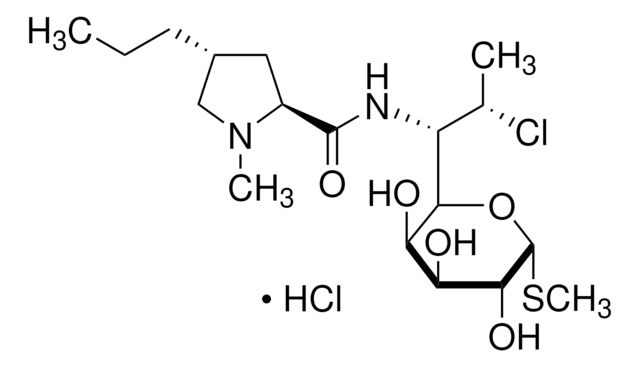
Clindamycine hydrochloride
lincosamide antibiotic
Synonyme(s) :
(7S)-7-Chloro-7-désoxylincomycine hydrochloride, Cléocine
Sélectionner une taille de conditionnement
| Conditionnement | Référence | Disponibilité | Prix |
|---|
A propos de cet article
Quality Level
form
powder or crystals
impurities
≤13%
solubility
H2O: 50 mg/mL
antibiotic activity spectrum
Gram-negative bacteria, Gram-positive bacteria
mode of action
protein synthesis | interferes
storage temp.
2-8°C
SMILES string
Cl.CCC[C@@H]1C[C@H](N(C)C1)C(=O)N[C@H]([C@H](C)Cl)C2O[C@H](SC)[C@H](O)[C@@H](O)[C@H]2O
InChI
1S/C18H33ClN2O5S.ClH/c1-5-6-10-7-11(21(3)8-10)17(25)20-12(9(2)19)16-14(23)13(22)15(24)18(26-16)27-4;/h9-16,18,22-24H,5-8H2,1-4H3,(H,20,25);1H/t9-,10+,11-,12+,13-,14+,15+,16+,18+;/m0./s1
InChI key
AUODDLQVRAJAJM-XJQDNNTCSA-N
General description
Application
Biochem/physiol Actions
Other Notes
1 of 1
Cet article | |||
|---|---|---|---|
| mode of action protein synthesis | interferes | mode of action - | mode of action - | mode of action protein synthesis | interferes |
| antibiotic activity spectrum Gram-negative bacteria, Gram-positive bacteria | antibiotic activity spectrum - | antibiotic activity spectrum - | antibiotic activity spectrum Gram-positive bacteria |
| Quality Level 200 | Quality Level - | Quality Level - | Quality Level 100 |
| form powder or crystals | form - | form - | form solid |
| storage temp. 2-8°C | storage temp. 2-8°C | storage temp. 2-8°C | storage temp. 2-8°C |
| solubility H2O: 50 mg/mL | solubility - | solubility - | solubility DMSO: 224 mg/mL at 25 °C |
Still not finding the right product?
Explore all of our products under Clindamycine hydrochloride
signalword
Warning
hcodes
Hazard Classifications
Eye Irrit. 2 - Lact. - Skin Sens. 1
Classe de stockage
11 - Combustible Solids
wgk
WGK 2
flash_point_f
Not applicable
flash_point_c
Not applicable
Faites votre choix parmi les versions les plus récentes :
Déjà en possession de ce produit ?
Retrouvez la documentation relative aux produits que vous avez récemment achetés dans la Bibliothèque de documents.
Numéro d'article de commerce international
| Référence | GTIN |
|---|---|
| C5269-50MG | 04061833501955 |
| C5269-100MG | 04061833501931 |
| C5269-10MG | 04061833501948 |
-
How can I determine the shelf life / expiration / retest date of this product?
1 answer-
Helpful?
-
-
How is shipping temperature determined? And how is it related to the product storage temperature?
1 answer-
Products may be shipped at a different temperature than the recommended long-term storage temperature. If the product quality is sensitive to short-term exposure to conditions other than the recommended long-term storage, it will be shipped on wet or dry-ice. If the product quality is NOT affected by short-term exposure to conditions other than the recommended long-term storage, it will be shipped at ambient temperature. As shipping routes are configured for minimum transit times, shipping at ambient temperature helps control shipping costs for our customers. For more information, please refer to the Storage and Transport Conditions document: https://www.sigmaaldrich.com/deepweb/assets/sigmaaldrich/marketing/global/documents/316/622/storage-transport-conditions-mk.pdf
Helpful?
-
-
What is the potency of this product?
1 answer-
The potency of Product C5269 (Clindamycin hydrochloride) exceeds 800ug of Clindamycin/mg.
Helpful?
-
-
What is the Department of Transportation shipping information for this product?
1 answer-
Transportation information can be found in Section 14 of the product's (M)SDS.To access the shipping information for this material, use the link on the product detail page for the product.
Helpful?
-
-
What is the antibiotic potency of Clindamycin hydrochloride, Product C5269?
1 answer-
We do not include the potency of the compound in our quality specifications. Please contact Sigma-Aldrich Technical Service for the availability of lot-specific potency from our supplier.
Helpful?
-
-
What is the pH of an aqueous solution of Clindamycin hydrochloride, Product C5269?
1 answer-
The expected pH of a 100 mg/ml aqueous solution is from 3.0 to 5.5, per USP 31, p. 1796.
Helpful?
-
-
You list the purity of Clindamycin hydrochloride, Product C5269, as determined by thin layer chromatography. Is it possible to determine purity by other chromatographic methods?
1 answer-
The USP 31 describes a liquid chromatographic method utilizing Clindamycin Hydrochloride and Lincomycin Hydrochloride standards. Other publications may be searched on PubMed, such as G. La Follette et al., J Chromatogr., Vol. 431 (No. 2), pp. 379-388 (1988).
Helpful?
-