



If this product has an expiration or retest date, it will be shown on the Certificate of Analysis (COA, CofA). If there is no retest or expiration date listed on the product's COA, we do not have suitable stability data to determine a shelf life. For these products, the only date on the COA will be the release date; a retest, expiration, or use-by-date will not be displayed.
For all products, we recommend handling per defined conditions as printed in our product literature and website product descriptions. We recommend that products should be routinely inspected by customers to ensure they perform as expected.
For products without retest or expiration dates, our standard warranty of 1 year from the date of shipment is applicable.
For more information, please refer to the Product Dating Information document: https://www.sigmaaldrich.com/deepweb/assets/sigmaaldrich/marketing/global/documents/418/501/product-dating-information-06-25-mk.pdf
D1156

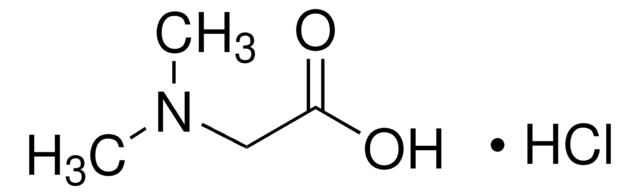
N,N-Dimethylglycine
≥99%, suitable for ligand binding assays
Synonym(s):
(Dimethylamino)acetic acid
Select a Size
| Pack Size | SKU | Availability | Price |
|---|
About This Item
Product Name
N,N-Dimethylglycine, ≥99%
Quality Level
assay
≥99%
form
powder
technique(s)
ligand binding assay: suitable
color
white to off-white
mp
178-182 °C (lit.)
application(s)
peptide synthesis
SMILES string
CN(C)CC(O)=O
InChI
1S/C4H9NO2/c1-5(2)3-4(6)7/h3H2,1-2H3,(H,6,7)
InChI key
FFDGPVCHZBVARC-UHFFFAOYSA-N
Biochem/physiol Actions
1 of 1
This Item | |||
|---|---|---|---|
| form powder | form powder | form powder | form powder |
| technique(s) ligand binding assay: suitable | technique(s) ligand binding assay: suitable | technique(s) ligand binding assay: suitable | technique(s) ligand binding assay: suitable |
| assay ≥99% | assay ≥98% | assay ≥99% (titration) | assay ≥97% (titration) |
| Quality Level 200 | Quality Level 200 | Quality Level 200 | Quality Level 100 |
| color white to off-white | color white | color white | color white |
| mp 178-182 °C (lit.) | mp 189-194 °C (lit.) | mp - | mp >300 °C (lit.) |
Still not finding the right product?
Explore all of our products under N,N-Dimethylglycine
Storage Class
11 - Combustible Solids
flash_point_f
Not applicable
flash_point_c
Not applicable
ppe
Eyeshields, Gloves, type N95 (US)
Choose from one of the most recent versions:
Already Own This Product?
Find documentation for the products that you have recently purchased in the Document Library.
Global Trade Item Number
| SKU | GTIN |
|---|---|
| D1156-10MG | 04061833558805 |
| D1156-25G | 04061832416137 |
| D1156-5G | 04061833558812 |
| D1156-10G | 04061833558799 |
-
How can I determine the shelf life / expiration / retest date of this product?
1 answer-
Helpful?
-
-
How is shipping temperature determined? And how is it related to the product storage temperature?
1 answer-
Products may be shipped at a different temperature than the recommended long-term storage temperature. If the product quality is sensitive to short-term exposure to conditions other than the recommended long-term storage, it will be shipped on wet or dry-ice. If the product quality is NOT affected by short-term exposure to conditions other than the recommended long-term storage, it will be shipped at ambient temperature. As shipping routes are configured for minimum transit times, shipping at ambient temperature helps control shipping costs for our customers. For more information, please refer to the Storage and Transport Conditions document: https://www.sigmaaldrich.com/deepweb/assets/sigmaaldrich/marketing/global/documents/316/622/storage-transport-conditions-mk.pdf
Helpful?
-