Skip to Content
Merck

Skip To

07-2273

Anti-phospho-SPAK Antibody (Ser373) / phospho-OSR1 Antibody (Ser325)

from rabbit, purified by affinity chromatography

Synonym(s):

DCHT, Serine/threonine-protein kinase 39

Sign In to View Organizational & Contract Pricing.

Select a Size

Change View
Pack SizeSKUAvailabilityPrice

About This Item

eCl@ss:
32160702
UNSPSC Code:
12352203
NACRES:
NA.41
Conjugate:
unconjugated
Clone:
polyclonal
Application:
WB
Citations:
1
Pricing and availability is not currently available.
Technical Service
Need help? Our team of experienced scientists is here for you.
Let Us Assist


biological source

rabbit

Quality Segment

conjugate

unconjugated

antibody product type

primary antibodies

clone

polyclonal

purified by

affinity chromatography

species reactivity

mouse, human

species reactivity (predicted by homology)

canine (based on 100% sequence homology), rat (based on 100% sequence homology)

technique(s)

western blot: suitable

NCBI accession no.

UniProt accession no.

shipped in

wet ice

target post-translational modification

phosphorylation (pSer373/pSer325)

Gene Information

human ... STK39(27347)

General description

As members of the (sterile 20)-like (STE20) kinase family, the oxidative-stress-responsive kinase 1 (OSR1) and the SPS1-related proline/alanine-rich kinase (SPAK) serve as key enzymes in a signaling cascade, which mediate the activity of Na+/K+/2Cl- cotransporters (NKCCs) in response to osmotic stress. Both kinases have a conserved carboxy-terminal (CCT) domain, which are 79% identical to each other at the sequence level, and are also highly conserved in orthologues of these enzymes in Caenorhabditis elegans, Drosophila, and Xenopus. The CCT domain reflects no similarity to sequences found in other proteins. This domain is known to recognize and interact with a unique peptide (Arg-Phe-Xaa-Val) motif, which is present in OSRT1- and SPAK-activating kinases (with-no-lysine-kinase 1 (WNK1 and WNK4) and also in STE20 kinase family substrates (NKCC1 and NKCC2). It is reported that phosphorylation of a Ser/Thr residue preceding the (Arg-Phe-Xaa-Val) motif results in steric clash, and subsequent dissociation from the CCT domain. Furthermore, patients suffering from Gordon syndrome carry mutated WNK1 and WNK4 genes.
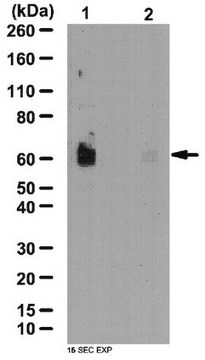
~60 kDa observed

Immunogen

Epitope: SPAK phosphorlyated at Ser373 and OSR1 phosphorlyated at Ser325.
KLH-conjugated linear peptide corresponding to human SPAK and OSR1 phosphorylated at Ser375 and Ser325, respectively.

Application

Research Category
Signaling

Inflammation & Immunology
Research Sub Category
Kinases & Phosphatases

Oxidative Stress
This phospho-SPAK antibody is validated for use in WB for the detection of the phospho-SPAK protein.

Biochem/physiol Actions

This antibody recognizes SPAK phosphorlyated at Ser373 and OSR1 phosphorlyated at Ser325.

Physical form

Affinity purified
Purified rabbit polyclonal in buffer containing 0.1 M Tris-Glycine (pH 7.4), 150 mM NaCl with 0.05% sodium azide.

Preparation Note

Stable for 1 year at 2-8°C from date of receipt.

Analysis Note

Control
Hypotonic-stimulated HEK293 cells untreated and lambda phosphatase-treated.
Evaluated by Western Blot in hypotonic-stimulated HEK293 cells untreated and lambda phosphatase-treated.

Western Blot Anlaysis: 0.5 µg/mL of this antibody detected SPAK / OSR1 in 10 µg hypotonic-stimulated HEK293 cells untreated and lambda phosphatase-treated.

Other Notes

Concentration: Please refer to the Certificate of Analysis for the lot-specific concentration.

Disclaimer

Unless otherwise stated in our catalog or other company documentation accompanying the product(s), our products are intended for research use only and are not to be used for any other purpose, which includes but is not limited to, unauthorized commercial uses, in vitro diagnostic uses, ex vivo or in vivo therapeutic uses or any type of consumption or application to humans or animals.

Compare Similar Items

View Full Comparison

Show Differences

1 of 1

This Item
05-66905-100307-2192
clone

polyclonal

clone

11E6, monoclonal

clone

6F5, monoclonal

clone

polyclonal

species reactivity

mouse, human

species reactivity

rat, canine, mouse, human

species reactivity

rat, mouse, vertebrates, human

species reactivity

mouse, human

conjugate

unconjugated

conjugate

-

conjugate

-

conjugate

unconjugated

biological source

rabbit

biological source

mouse

biological source

mouse

biological source

rabbit

UniProt accession no.

Q9UEW8

UniProt accession no.

P31749

UniProt accession no.

P31749

UniProt accession no.

Q9UHD2

Gene Information

human ... STK39(27347)

Gene Information

dog ... Akt1(490878)
human ... AKT1(207)

Gene Information

human ... AKT1(207)
rat ... Akt1S1(292887)

Gene Information

human ... TBK1(29110)


Still not finding the right product?

Try our Product Selector Tool to narrow your options


Storage Class

12 - Non Combustible Liquids

wgk

WGK 1

flash_point_f

Not applicable

flash_point_c

Not applicable


Certificates of Analysis (COA)

Search for Certificates of Analysis (COA) by entering the products Lot/Batch Number. Lot and Batch Numbers can be found on a product’s label following the words ‘Lot’ or ‘Batch’.

Already Own This Product?

Find documentation for the products that you have recently purchased in the Document Library.

Visit the Document Library


Alissa A Frame et al.
American journal of physiology. Renal physiology, 317(6), F1623-F1636 (2019-10-15)
Salt sensitivity of blood pressure is characterized by inappropriate sympathoexcitation and renal Na+ reabsorption during high salt intake. In salt-resistant animal models, exogenous norepinephrine (NE) infusion promotes salt-sensitive hypertension and prevents dietary Na+-evoked suppression of the Na+-Cl- cotransporter (NCC). Studies


Questions

Reviews

No rating value

Active Filters