


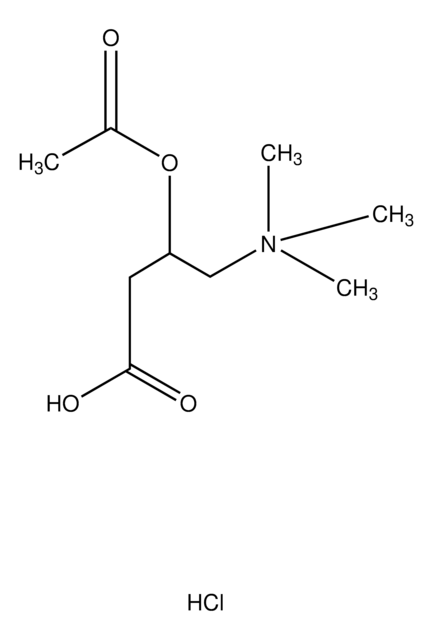

This product may be stored at room temperature.
C0283

L-Carnitine hydrochloride
≥98%, synthetic
Synonym(s):
(−)-β-Hydroxy-γ-(trimethylammonio)butyrate, Vitamin BT
Sign In to View Organizational & Contract Pricing.
Select a Size
Change View
| Pack Size | SKU | Availability | Price |
|---|
About This Item
Linear Formula:
(CH3)3N+CH2CH(OH)CH2CO2H · Cl-
CAS Number:
Molecular Weight:
197.66
NACRES:
NA.79
PubChem Substance ID:
UNSPSC Code:
12352106
EC Number:
229-663-6
MDL number:
Pricing and availability is not currently available.
Product Name
L-Carnitine hydrochloride, synthetic, ≥98%
biological source
synthetic
Quality Level
assay
≥98%
form
powder
color
white
mp
142 °C
application(s)
cell analysis
SMILES string
[Cl-].C[N+](C)(C)C[C@H](O)CC(O)=O
InChI
1S/C7H15NO3.ClH/c1-8(2,3)5-6(9)4-7(10)11;/h6,9H,4-5H2,1-3H3;1H/t6-;/m1./s1
InChI key
JXXCENBLGFBQJM-FYZOBXCZSA-N
Application
L-Carnitine hydrochloride has been used to study ergothioneine transporter SLC22A4 and carnitine transporter SLC22A5. It has also been used to allow the entry of palmitic acid into the mitochondria.
Biochem/physiol Actions
Carnitine is a quaternary amine that occurs naturally in most mammalian tissue. It is present in relatively high concentrations in skeletal muscle and heart where it is involved in regulating energy metabolism. It shifts glucose metabolism from glycolysis to glycogen storage and enhances the transport of long chain fatty acids into the mitochondria where they are oxidized for energy production.
Carnitine is biosynthesized from lysine. It might be associated with the energy production from branched chain amino acids.
1 of 1
This Item | |||
|---|---|---|---|
| form powder | form powder | form powder | form powder |
| assay ≥98% | assay ≥98% | assay ≥98% (TLC) | assay >98% (TLC) |
| mp 142 °C | mp 197-212 °C (lit.) | mp - | mp - |
| Quality Level 300 | Quality Level 200 | Quality Level 200 | Quality Level 200 |
| color white | color white | color white | color white |
| application(s) cell analysis | application(s) cell analysis | application(s) - | application(s) - |
Still not finding the right product?
Explore all of our products under L-Carnitine hydrochloride
signalword
Warning
hcodes
Hazard Classifications
Eye Irrit. 2 - Skin Irrit. 2 - STOT SE 3
target_organs
Respiratory system
Storage Class
11 - Combustible Solids
wgk
WGK 2
flash_point_f
Not applicable
flash_point_c
Not applicable
ppe
dust mask type N95 (US), Eyeshields, Gloves
Choose from one of the most recent versions:
Already Own This Product?
Find documentation for the products that you have recently purchased in the Document Library.
Isabelle Lelong-Rebel et al.
Anticancer research, 28(1A), 55-68 (2008-04-04)
Two chemosensitive cell lines, LoVo-fusoid (LoVo-f) and LoVo-small cells (LoVo-sc) were derived from the original LoVo cell line. These two variants and the multidrug-resistant (MDR) cell line LoVo-Dox were screened for various properties. In non-permeabilized cells, only LoVo-sc showed mucin-2
Substrate discrimination by ergothioneine transporter SLC22A4 and carnitine transporter SLC22A5: Gain-of-function by interchange of selected amino acids
Petra Bacher.
Biochimica et Biophysica Acta, 1788(12), 2594-2602 (2009)
Giulia Mollica et al.
Digestive and liver disease : official journal of the Italian Society of Gastroenterology and the Italian Association for the Study of the Liver, 52(3), 314-323 (2019-10-15)
Non-alcoholic fatty liver disease (NAFLD) is a common cause of chronic liver disorder. NAFLD, associated lipotoxicity, fibrosis, oxidative stress, and altered mitochondrial metabolism, is responsible for systemic inflammation, which contributes to organ dysfunction in extrahepatic tissues, including the heart. We
Global Trade Item Number
| SKU | GTIN |
|---|---|
| C0283-5G | 04061833450437 |
| C0283-100G | 04061833450406 |
| C0283-10MG | 04061833450413 |
| C0283-1G | 04061833450420 |
| C0283-25G | 04061832415840 |
-
What is the storage temp for this material? The SDS says to "Recommended storage temperature see product label." however the product label and CoA do not list the storage temp anywhere.
1 answer-
Helpful?
-
-
How can I determine the shelf life / expiration / retest date of this product?
1 answer-
If this product has an expiration or retest date, it will be shown on the Certificate of Analysis (COA, CofA). If there is no retest or expiration date listed on the product's COA, we do not have suitable stability data to determine a shelf life. For these products, the only date on the COA will be the release date; a retest, expiration, or use-by-date will not be displayed.
For all products, we recommend handling per defined conditions as printed in our product literature and website product descriptions. We recommend that products should be routinely inspected by customers to ensure they perform as expected.
For products without retest or expiration dates, our standard warranty of 1 year from the date of shipment is applicable.
For more information, please refer to the Product Dating Information document: https://www.sigmaaldrich.com/deepweb/assets/sigmaaldrich/marketing/global/documents/418/501/product-dating-information-06-25-mk.pdfHelpful?
-
-
How is shipping temperature determined? And how is it related to the product storage temperature?
1 answer-
Products may be shipped at a different temperature than the recommended long-term storage temperature. If the product quality is sensitive to short-term exposure to conditions other than the recommended long-term storage, it will be shipped on wet or dry-ice. If the product quality is NOT affected by short-term exposure to conditions other than the recommended long-term storage, it will be shipped at ambient temperature. As shipping routes are configured for minimum transit times, shipping at ambient temperature helps control shipping costs for our customers. For more information, please refer to the Storage and Transport Conditions document: https://www.sigmaaldrich.com/deepweb/assets/sigmaaldrich/marketing/global/documents/316/622/storage-transport-conditions-mk.pdf
Helpful?
-