


Unless otherwise stated, this product is intended for research use only. It is not suitable for any other purpose, which includes, but is not limited to, unauthorized commercial use, in vitro diagnostic use, or therapeutic use in humans or animals.
5154

Silk Fibroin
from domesticated Bombyx mori silkworm, liquid, 50 mg/mL, suitable for cell culture, used for 3D scaffolds
Synonym(s):
Silk Fibroin Solution
Sign In to View Organizational & Contract Pricing.
Select a Size
Change View
| Pack Size | SKU | Availability | Price |
|---|
About This Item
UNSPSC Code:
12352202
NACRES:
NA.75
Biological source:
domesticated Bombyx mori silkworm
Form:
solution
Concentration:
50 mg/mL, ~50 mg/mL
Mol wt:
avg mol wt 100 kDa
Pricing and availability is not currently available.
Product Name
Silk, Fibroin Solution, 50 mg/mL
biological source
domesticated Bombyx mori silkworm
Quality Level
form
solution
mol wt
avg mol wt 100 kDa
concentration
50 mg/mL, ~50 mg/mL
application(s)
clinical testing
shipped in
dry ice
storage temp.
−70°C
General description
This fibroin silk solution is made of 100% fibroin protein that is derived from the domesticated Bombyx mori silkworm. The product is manufactured in a manner to minimize contamination and has a low bioburden but is not considered sterile.
Fibroin protein is the major structural component of the silkworm′s cocoon fiber. Fibroin offers great potential for use in medically related applications due to the high degree of biocompatibility and lack of immune response when implanted within the body. The silk fiber is solubilized into an aqueous fibroin solution, which can then be used as an additive in culture or for producing 3D scaffolds for tissue-engineering related studies.
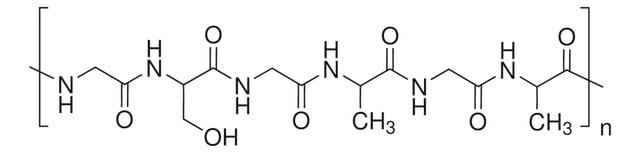
As with traditional tissue-engineering approaches, the silk scaffolds are typically seeded in vitro with a specific cell type as most cells will adhere to fibroin protein, and then cultured over time to mimic tissue architecture. It has been shown that the silk fibroin protein can be degraded a number of naturally occurring proteolytic enzymes, and is thus a biologically active scaffold unlike other synthetic materials. As a result the silk scaffold material is degraded and remodeled through similar physiological pathways in the body. Silk fibroin protein is composed of both non-essential and essential amino acids, with a particular concentration of alanine and glycine present, and these amino acids are then reabsorbed by the surrounding cells for new tissue regeneration. This is important as silk degradation products do not collect in the local environment to induce a toxicity which is commonly associated with other synthetic and naturally occurring biomaterials.
The ability to produce a variety of forms and formats scaffold types (e.g. coatings, films, sponges, hydrogels, electro-spun fibers, micro/nanospheres, etc.) offers a number of advantages over other biopolymer systems like collagen, chitosan, and alginate that have less variety in processing choices. The silk material properties can then be modified through a variety of processing techniques to change degradation rate, hydrophobicity/hydrophilicity, transparency, mechanical strength, porosity, oxygen permeability, and thermal stability. In this regard, silk proteins represent a class of biopolymers with definable material properties for a given application.
If culturing cells using this product, measures should be taken to maintain sterility of cultures such as use of antibiotics.
Fibroin protein is the major structural component of the silkworm′s cocoon fiber. Fibroin offers great potential for use in medically related applications due to the high degree of biocompatibility and lack of immune response when implanted within the body. The silk fiber is solubilized into an aqueous fibroin solution, which can then be used as an additive in culture or for producing 3D scaffolds for tissue-engineering related studies.
As with traditional tissue-engineering approaches, the silk scaffolds are typically seeded in vitro with a specific cell type as most cells will adhere to fibroin protein, and then cultured over time to mimic tissue architecture. It has been shown that the silk fibroin protein can be degraded a number of naturally occurring proteolytic enzymes, and is thus a biologically active scaffold unlike other synthetic materials. As a result the silk scaffold material is degraded and remodeled through similar physiological pathways in the body. Silk fibroin protein is composed of both non-essential and essential amino acids, with a particular concentration of alanine and glycine present, and these amino acids are then reabsorbed by the surrounding cells for new tissue regeneration. This is important as silk degradation products do not collect in the local environment to induce a toxicity which is commonly associated with other synthetic and naturally occurring biomaterials.
The ability to produce a variety of forms and formats scaffold types (e.g. coatings, films, sponges, hydrogels, electro-spun fibers, micro/nanospheres, etc.) offers a number of advantages over other biopolymer systems like collagen, chitosan, and alginate that have less variety in processing choices. The silk material properties can then be modified through a variety of processing techniques to change degradation rate, hydrophobicity/hydrophilicity, transparency, mechanical strength, porosity, oxygen permeability, and thermal stability. In this regard, silk proteins represent a class of biopolymers with definable material properties for a given application.
If culturing cells using this product, measures should be taken to maintain sterility of cultures such as use of antibiotics.
Preparation Note
Thaw slowly at 2-10 °C. Gently swirl contents to mix. Do not vortex or pipet vigorously. If the entire contents of the 20 ml bottle are not used upon thawing, aliquot into smaller volumes and freeze at -70°C. Minimize freezing and thawing of product. Do not allow product to be thawed for more than a week since protein aggregation will likely occur.
1 of 1
This Item | |||
|---|---|---|---|
| biological source domesticated Bombyx mori silkworm | biological source human plasma | biological source bovine milk | biological source bovine milk |
| concentration 50 mg/mL, ~50 mg/mL | concentration - | concentration - | concentration 5% in water |
| Quality Level 100 | Quality Level 200 | Quality Level 200 | Quality Level 200 |
| mol wt avg mol wt 100 kDa | mol wt - | mol wt - | mol wt - |
| form solution | form powder | form powder | form liquid |
| shipped in dry ice | shipped in - | shipped in - | shipped in - |
Still not finding the right product?
Explore all of our products under Silk, Fibroin Solution
Storage Class
12 - Non Combustible Liquids
wgk
WGK 3
flash_point_f
Not applicable
flash_point_c
Not applicable
Choose from one of the most recent versions:
Already Own This Product?
Find documentation for the products that you have recently purchased in the Document Library.
Hasan Baysal et al.
British journal of cancer, 123(5), 752-761 (2020-06-17)
The epidermal growth factor receptor (EGFR) is overexpressed by 80-90% of squamous cell carcinoma of head and neck (HNSCC). In addition to inhibiting EGFR signal transduction, cetuximab, a monoclonal antibody targeting EGFR can also bind to fragment crystallisable domain of
Global Trade Item Number
| SKU | GTIN |
|---|---|
| 377171-100G | 04061831835519 |
| 377171-25G | 04061831835533 |
| 05154-50MG | 04061834079217 |
| 5154-20ML | 04061832493343 |
| GE17-5154-01 | 04061837621857 |
-
silk fibroin solution is a consumable?
1 answer-
Helpful?
-
-
silk fibroin solution이 녹아있는 solvent의 조성을 확인 가능할까요?
1 answer-
Following extraction and purification, this product is diafiltered against purified water. The primary solvent is water, however some residual salts remain. The pH range of this solution is 8-10. The identity and concentration of the remaining salts are not determined.
Helpful?
-