



The immunogen for Monoclonal Anti-α-Tubulin antibody produced in mouse, clone DM1A is microtubules from chicken embryo brain. This antibody recognizes an epitope located at the C-terminal end of the α-tubulin isoform (amino acids 426-430) as noted in the following references:Breitling, F., and Little, M., J. Molec. Biol., 189, 367-370 (1986).Wolff, A., et al., Biol. Cell, 63, 319-326 (1988).Serrano, L., et al., Anal. Biochem., 159, 253-259 (1986).
T6199

Anti-TUBA4A (TUBA1) Antibody
mouse monoclonal, DM1A
Synonym(s):
Monoclonal Anti-α-Tubulin
Sign In to View Organizational & Contract Pricing.
Select a Size
Change View
| Pack Size | SKU | Availability | Price |
|---|
About This Item
UNSPSC Code:
12352203
NACRES:
NA.41
Conjugate:
unconjugated
Clone:
DM1A, monoclonal
Application:
ARR, ICC, IHC, IP, WB
Citations:
2351
Pricing and availability is not currently available.
Product Name
Anti-α-Tubulin antibody, Mouse monoclonal, clone DM1A, purified from hybridoma cell culture
biological source
mouse
Quality Segment
conjugate
unconjugated
antibody form
purified immunoglobulin
antibody product type
primary antibodies
clone
DM1A, monoclonal
form
buffered aqueous solution
mol wt
antigen ~50 kDa
species reactivity
yeast, mouse, amphibian, human, rat, chicken, fungi, bovine
packaging
antibody small pack of 25 μL
enhanced validation
independent ( Antibodies)
Learn more about Antibody Enhanced Validation
concentration
~1 mg/mL
technique(s)
immunocytochemistry: 0.5-1 μg/mL using cultured chicken fibroblasts (CFB), immunohistochemistry: suitable, immunoprecipitation (IP): suitable, microarray: suitable, western blot: 0.5-1 μg/mL using total tissue extract from chicken gizzard
isotype
IgG1
UniProt accession no.
application(s)
research pathology
shipped in
dry ice
storage temp.
−20°C
target post-translational modification
unmodified
Gene Information
human ... TUBA4A(7277)
mouse ... Tuba1a(22142)
rat ... Tuba1a(64158)
General description
Anti-α-Tubulin antibody, Mouse monoclonal (mouse IgG1 isotype) is derived from the hybridoma DM1A produced by the fusion of mouse myeloma cells (NS1) and splenocytes from BALB/c mice immunized with purified chick brain tubulin. The isotype is determined by a double diffusion immunoassay using Mouse Monoclonal Antibody Isotyping Reagents, Product Number ISO2.
Tubulin is the major building block of microtubules. This intracellular, cylindrical, filamentous structure is present in almost all eukaryotic cells. Microtubules function as structural and mobile elements in mitosis, intracellular transport, flagellar movement, and the cytoskeleton. Tubulin is a heterodimer that consists of α-tubulin and β-tubulin. Both subunits have a molecular weight of approx. 50 kDa and share considerable homology. In addition to α- and β-tubulin, several other tubulins have been identified, bringing the number of distinct tubulin classes to seven. Most of these tubulins have distinct subcellular localization and an emerging diverse set of functions. Out of the seven different tubulins four new members of the tubulin family were identified recently, which consist of δ, ξ, η and ε-tubulin. η and ε-tubulins were discovered by database searches. Microtubular systems contain at least three α-tubulin isoforms. Two isoforms are coded by two α-tubulin genes, which are both transcribed and code for extremely similar proteins. The third isoform is generated by post-translational modification. At least three modifications of tubulin subunits have been described: the phosphorylation of β-tubulin from brain, the removal of the carboxy terminal tyrosine form a-tubulin in vertebrate tissues, and the acetylation of the amino group of lysine(s) in α-tubulin.
α -tubulin, also called tubulin α 4a (TUBA4A), is mapped to human chromosome 2q35.[1] The gene codes for a member of the α -tubulin family, and contains 448 amino acids.[1] α-subunit of tubulin has molecular weight of 50,000.
Monoclonal antibodies recognizing α-tubulin, together with monoclonal antibodies to other tubulin types (β, β-tubulin isotype I +II, β-tubulin isotype III, tyrosine tubulin, and the acetylated form of α-tubulin) provide a specific and useful tool in studying the intracellular distribution of tubulin and the static and dynamic aspects of cytoskeleton.
Tubulin is the major building block of microtubules. This intracellular, cylindrical, filamentous structure is present in almost all eukaryotic cells. Microtubules function as structural and mobile elements in mitosis, intracellular transport, flagellar movement, and the cytoskeleton. Tubulin is a heterodimer that consists of α-tubulin and β-tubulin. Both subunits have a molecular weight of approx. 50 kDa and share considerable homology. In addition to α- and β-tubulin, several other tubulins have been identified, bringing the number of distinct tubulin classes to seven. Most of these tubulins have distinct subcellular localization and an emerging diverse set of functions. Out of the seven different tubulins four new members of the tubulin family were identified recently, which consist of δ, ξ, η and ε-tubulin. η and ε-tubulins were discovered by database searches. Microtubular systems contain at least three α-tubulin isoforms. Two isoforms are coded by two α-tubulin genes, which are both transcribed and code for extremely similar proteins. The third isoform is generated by post-translational modification. At least three modifications of tubulin subunits have been described: the phosphorylation of β-tubulin from brain, the removal of the carboxy terminal tyrosine form a-tubulin in vertebrate tissues, and the acetylation of the amino group of lysine(s) in α-tubulin.
α -tubulin, also called tubulin α 4a (TUBA4A), is mapped to human chromosome 2q35.[1] The gene codes for a member of the α -tubulin family, and contains 448 amino acids.[1] α-subunit of tubulin has molecular weight of 50,000.
Monoclonal antibodies recognizing α-tubulin, together with monoclonal antibodies to other tubulin types (β, β-tubulin isotype I +II, β-tubulin isotype III, tyrosine tubulin, and the acetylated form of α-tubulin) provide a specific and useful tool in studying the intracellular distribution of tubulin and the static and dynamic aspects of cytoskeleton.
Immunogen
microtubules from chicken embryo brain.
Application
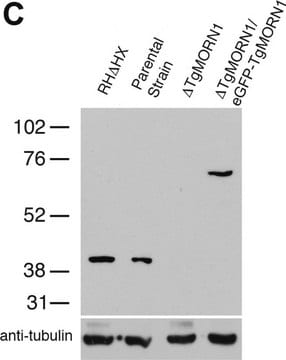
Anti-α-Tubulin antibody, Mouse monoclonal has been used in immunocytofluorescence and western blot analysis.[2]
Biochem/physiol Actions
Anti-α-Tubulin antibody, Mouse monoclonal recognizes an epitope located at the C-terminal end of the α-tubulin isoform (amino acids 426-430) in a variety of organisms (e.g., human, bovine, mouse, and chicken).
The antibody is specific for α-tubulin in immunoblotting assays and may be used for localization of α-tubulin in cultured cells or tissue sections. The antibody reacts best with chicken fibroblasts.
Tubulin α 4a (TUBA4A) mutation is associated with amyotrophic lateral sclerosis (ALS).
α-Tubulin or tubulin α 4A (TUBA4A) plays an essential role in cell growth and division. It is also implicated in various cellular processes, such as cell motility, signaling development and cell shape maintenance. Mutation in TUBA4A is associated with the development of various types of cancers, such as oral cancer, breast cancer, rectal cancer, lung cancer and prostate cancer. In addition, variation in the TUBA4A leads to sporadic amyotrophic lateral sclerosis (ALS).
α-Tubulin or tubulin α 4A (TUBA4A) plays an essential role in cell growth and division. It is also implicated in various cellular processes, such as cell motility, signaling development and cell shape maintenance. Mutation in TUBA4A is associated with the development of various types of cancers, such as oral cancer, breast cancer, rectal cancer, lung cancer and prostate cancer. In addition, variation in the TUBA4A leads to sporadic amyotrophic lateral sclerosis (ALS).
Physical form
Solution in 0.01 M phosphate buffered saline, pH 7.4, containing 1% BSA and 15 mM sodium azide.
Preparation Note
Storage and Stability: Store at 2-8°C for up to one month. For prolonged storage, freeze in working aliquots at -20°C. Repeated freezing and thawing, or storage in frost-free freezers, is not recommended. If slight turbidity occurs upon prolonged storage, clarify the solution by centrifugation before use. Working dilutions should be discarded if not used within 12 hours.
Other Notes
In order to obtain the best results using various techniques and preparations, we recommend determining optimal working dilutions by titration.
Disclaimer
Unless otherwise stated in our catalog or other company documentation accompanying the product(s), our products are intended for research use only and are not to be used for any other purpose, which includes but is not limited to, unauthorized commercial uses, in vitro diagnostic uses, ex vivo or in vivo therapeutic uses or any type of consumption or application to humans or animals.
1 of 1
This Item | |||
|---|---|---|---|
| biological source mouse | biological source mouse | biological source mouse | biological source mouse |
| species reactivity yeast, mouse, amphibian, human, rat, chicken, fungi, bovine | species reactivity mouse, chicken, Chlamydomonas, African green monkey, human, rat, bovine, sea urchin, kangaroo rat | species reactivity mouse, chicken, Chlamydomonas, African green monkey, human, rat, bovine, sea urchin, kangaroo rat | species reactivity Ciona intestinalis, rat, chicken, Caenorhabditis elegans, Strongylocentrotus purpuratus, bovine, human |
| antibody form purified immunoglobulin | antibody form purified from hybridoma cell culture | antibody form ascites fluid | antibody form ascites fluid |
| clone DM1A, monoclonal | clone B-5-1-2, monoclonal | clone B-5-1-2, monoclonal | clone 2-28-33, monoclonal |
| Gene Information human ... TUBA4A(7277) | Gene Information human ... TUBA4A(7277) | Gene Information human ... TUBA4A(7277) | Gene Information human ... TUBB1(81027), TUBB2A(7280), TUBB2C(10383) |
| conjugate unconjugated | conjugate unconjugated | conjugate unconjugated | conjugate unconjugated |
Still not finding the right product?
Explore all of our products under Anti-α-Tubulin antibody, Mouse monoclonal
— or —
Try our Product Selector Tool to narrow your options
Storage Class
10 - Combustible liquids
wgk
WGK 2
flash_point_f
Not applicable
flash_point_c
Not applicable
Choose from one of the most recent versions:
Already Own This Product?
Find documentation for the products that you have recently purchased in the Document Library.
Related Content
Instructions
Global Trade Item Number
| SKU | GTIN |
|---|---|
| T6199-25UL | 04061838511300 |
| T6199-100UL | 04061837358432 |
| T6199-200UL | 04061837358449 |
-
What is the immunogen for Monoclonal Anti-α-Tubulin antibody, clone DM1A?
1 answer-
Helpful?
-
-
What is the Department of Transportation shipping information for this product?
1 answer-
Transportation information can be found in Section 14 of the product's (M)SDS.To access the shipping information for this material, use the link on the product detail page for the product.
Helpful?
-