Sign In to View Organizational & Contract Pricing.
Select a Size
Change View
| Pack Size | SKU | Availability | Price |
|---|
About This Item
Empirical Formula (Hill Notation):
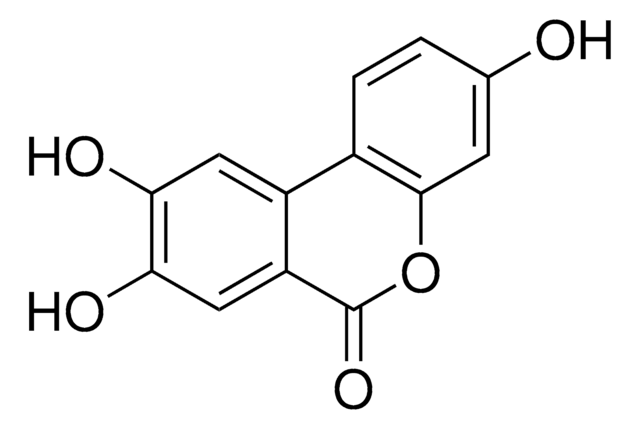
C13H8O4
CAS Number:
Molecular Weight:
228.20
NACRES:
NA.77
UNSPSC Code:
12352200
MDL number:
Pricing and availability is not currently available.
Product Name
Urolithin A, ≥97% (HPLC)
Quality Level
assay
≥97% (HPLC)
form
powder
color
white to beige
solubility
DMSO: 20 mg/mL, clear
storage temp.
2-8°C
SMILES string
OC1=CC=C(C(C=CC(O)=C2)=C2C(O3)=O)C3=C1
InChI
1S/C13H8O4/c14-7-1-3-9-10-4-2-8(15)6-12(10)17-13(16)11(9)5-7/h1-6,14-15H
InChI key
RIUPLDUFZCXCHM-UHFFFAOYSA-N
Application
Urolithin A has been used:
- to test its antileukemic activities on leukemic cell lines by in vitro cell proliferation assay
- as a mitophagy activator to study the effect of phosphoglycerate mutase 5 (PGAM5) expression on mitophagic cell death during ischemia-reperfusion (I/R) injury
- to study its inhibitory effect on epithelial-to-mesenchymal transition (EMT) in lung cancer cells via P53-Mdm2-Snail pathway
- to study its effects on streptozotocin-induced diabetic cardiomyopathy in rats by activating sirtuin 1/silent mating type information regulation 2 homolog 1 (SIRT1) signaling
Biochem/physiol Actions
Urolithin A is a natural product with antiproliferative and antioxidant activity.
Urolithin A is a natural product with antiproliferative and antioxidant activity. Urolithin A is formed by metabolism from polyphenols found in some nuts and fruits, particularly pomegranates. Urolithin A has been shown to cross the blood brain barrier, and may have neuroprotective effects against Alzheimer′s Disease.
Urolithin A is the most studied urolithin with anti-inflammatory and anti-obesity properties. It may also prevent the progression of various cancer types including colon, prostate, and bladder cancer by downregulating several oncogenes such as the mammalian target of rapamycin (mTOR) and Kirsten rat sarcoma viral oncogene(K-Ras), upregulating tumor suppressor genes such as p53 and epidermal growth factor receptor (EGFR) in various tumor pathways.
1 of 1
This Item | |||
|---|---|---|---|
| assay ≥97% (HPLC) | assay ≥95% (HPLC) | assay ≥97% (HPLC) | assay ≥98% (HPLC) |
| form powder | form powder | form powder | form solid |
| Quality Level 100 | Quality Level 100 | Quality Level 100 | Quality Level 100 |
| storage temp. 2-8°C | storage temp. 2-8°C | storage temp. −20°C | storage temp. 2-8°C |
| solubility DMSO: 20 mg/mL, clear | solubility DMSO: 5 mg/mL, clear (warmed) | solubility DMSO: 2 mg/mL, clear | solubility DMSO: soluble 3 mg/mL at 60 °C, H2O: insoluble |
| color white to beige | color white to beige | color white to beige | color tan |
signalword
Warning
hcodes
Hazard Classifications
Eye Irrit. 2 - Skin Irrit. 2
Storage Class
11 - Combustible Solids
wgk
WGK 3
flash_point_f
Not applicable
flash_point_c
Not applicable
Choose from one of the most recent versions:
Already Own This Product?
Find documentation for the products that you have recently purchased in the Document Library.
Abdulaziz Musa Alzahrani et al.
International journal of molecular sciences, 22(11) (2021-06-03)
Leukemia is persistently a significant cause of illness and mortality worldwide. Urolithins, metabolites of ellagic acid and ellagitannins produced by gut microbiota, showed better bioactive compounds liable for the health benefits exerted by ellagic acid and ellagitannins containing pomegranate and
Yun Wang et al.
Toxicology in vitro : an international journal published in association with BIBRA, 29(5), 1107-1115 (2015-04-26)
The intestinal metabolites of ellagic acid (EA), urolithins are known to effectively inhibit cancer cell proliferation. This study investigates antiproliferative and antioxidant effects of urolithin A (UA) on cell survival of the HepG2 hepatic carcinomas cell line. The antiproliferative effects
Antonio González-Sarrías et al.
European journal of nutrition, 56(2), 831-841 (2015-12-19)
Urolithins, metabolites produced by the gut microbiota from ellagic acid, have been acknowledged with cancer chemopreventive activity. Although urolithin A (Uro-A) has been reported to be the most active one, 10-50 % of humans can also produce the isomer isourolithin A
Global Trade Item Number
| SKU | GTIN |
|---|---|
| SML1791-5MG | 04061832275666 |
| SML1791-25MG | 04061832275659 |