


The stock solutions may be stored at -20 degrees C in aliquots. Long-term stability studies have not been performed. However, information found in published literature indicates that it is quite stable. Please see the link below to review one example.
https://pubmed.ncbi.nlm.nih.gov/18933/
I6504

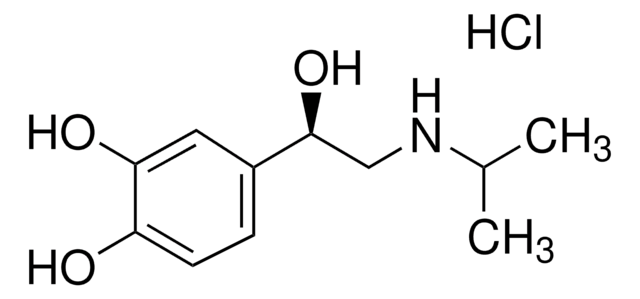
(−)-Isoproterenol hydrochloride
≥98% (TLC), powder, β-adrenoceptor agonist
Synonym(s):
(−)-Isoprenaline hydrochloride, (−)-N-Isopropyl-L-noradrenaline hydrochloride, (R)-3,4-Dihydroxy-α-(isopropylaminomethyl)benzyl alcohol hydrochloride
Sign In to View Organizational & Contract Pricing.
Select a Size
Change View
| Pack Size | SKU | Availability | Price |
|---|
About This Item
Linear Formula:
3,4-(HO)2C6H3CH(OH)CH2NHCH(CH3)2·HCl
CAS Number:
Molecular Weight:
247.72
NACRES:
NA.77
PubChem Substance ID:
UNSPSC Code:
12352200
MDL number:
Beilstein/REAXYS Number:
6077193
Quality level:
Pricing and availability is not currently available.
Product Name
(−)-Isoproterenol hydrochloride,
Quality Level
mp
175 °C (dec.) (lit.)
solubility
soluble (50 mg/ml: H2O)
storage temp.
−20°C
SMILES string
Cl[H].CC(C)NC[C@H](O)c1ccc(O)c(O)c1
InChI
1S/C11H17NO3.ClH/c1-7(2)12-6-11(15)8-3-4-9(13)10(14)5-8;/h3-5,7,11-15H,6H2,1-2H3;1H/t11-;/m0./s1
InChI key
IROWCYIEJAOFOW-MERQFXBCSA-N
Gene Information
human ... ADRB2(154)
Application
(−)-Isoproterenol hydrochloride has been used in in vitro explant culture. It has also been used in transcriptome analysis of heart.[1]
Biochem/physiol Actions
Isoproterenol hydrochloride is useful in post transplantal organ recovery. It exhibits ionotropic and chronotropic effects. With respect to donor heart recovery, isoproterenol hydrochloride decreases peripheral and systemic vascular resistance. Isoproterenol also increases the heart rate.
β-adrenoceptor agonist; increases cytosolic cAMP.
Preparation Note
This material can be dissolved in 50 mg/ml of H2O.
1 of 1
This Item | |||
|---|---|---|---|
| Quality Level 200 | Quality Level 200 | Quality Level 200 | Quality Level 200 |
| storage temp. −20°C | storage temp. 2-8°C | storage temp. - | storage temp. - |
| solubility soluble (50 mg/ml: H2O) | solubility - | solubility - | solubility - |
| mp 175 °C (dec.) (lit.) | mp 215 °C (dec.) (lit.) | mp 143-145 °C (lit.) | mp 143-145 °C (lit.) |
| Gene Information human ... ADRB2(154) | Gene Information human ... ADRA1A(148), ADRA1B(147), ADRA1D(146), ADRA2A(150), ADRA2B(151), ADRA2C(152), ADRB1(153), ADRB2(154), ADRB3(155) | Gene Information human ... ADRA1A(148), ADRA1B(147), ADRA1D(146) | Gene Information human ... ADRA1A(148), ADRA1B(147), ADRA1D(146) |
signalword
Warning
hcodes
Hazard Classifications
Eye Irrit. 2 - Skin Irrit. 2 - STOT SE 3
target_organs
Respiratory system
Storage Class
11 - Combustible Solids
wgk
WGK 3
flash_point_f
Not applicable
flash_point_c
Not applicable
ppe
dust mask type N95 (US), Eyeshields, Gloves
Choose from one of the most recent versions:
Already Own This Product?
Find documentation for the products that you have recently purchased in the Document Library.
Acute Care Handbook for Physical Therapists, 414-414 (2008)
Michael H Lai et al.
American journal of physiology. Heart and circulatory physiology, 307(9), H1327-H1338 (2014-08-31)
Large-conductance Ca(2+)- and voltage-activated K(+) (BK) channels play prominent roles in shaping muscle and neuronal excitability. In the cardiovascular system, BK channels promote vascular relaxation and protect against ischemic injury. Recently, inhibition of BK channels has been shown to lower
Seon Jin Lee et al.
Stem cells international, 2018, 7453161-7453161 (2018-12-05)
Cross talks between the renin-angiotensin system (RAS), sympathetic nervous system, and vascular homeostasis are tightly coordinated in hypertension. Angiotensin II (Ang II), a key factor in RAS, when abnormally activated, affects the number and bioactivity of circulating human endothelial progenitor
Global Trade Item Number
| SKU | GTIN |
|---|---|
| I6504-100MG | 04061833857755 |
| I6504-1G | 04061833857762 |
| I6504-500MG | 04061833857779 |
-
is product I65is product I6504 stable if reconstituted, aliquoted, and then frozen at -20C?
1 answer-
Helpful?
-
-
Wie man das Produkt Isoproterenol-hydrochlorid #I6504 am besten? Und gibt es eine Konzentrationsangabe, bei der es sich am besten löst?
1 answer-
To order this material, please navigate to the link https://www.sigmaaldrich.com/support/customer-support, click on "Pricing & Availability" under the Products Section with all the required information so that a member of the Customer Service team can reach out to assist further.
This material can be dissolved in 50 mg/ml of H2O.
Helpful?
-
-
What can be used to make a solution of (-)-Isoproterenol hydrochloride, Product I6504?
1 answer-
We test the solubility of (-)-Isoproterenol hydrochloride in water at a concentration of 50 mg/mL. Isoproterenol hydrochloride is also soluble in ethanol at 20 mg/mL.
Helpful?
-
-
What is the Department of Transportation shipping information for this product?
1 answer-
Transportation information can be found in Section 14 of the product's (M)SDS.To access the shipping information for this material, use the link on the product detail page for the product.
Helpful?
-
-
How should (-)-Isoproterenol hydrochloride, Product I6504, be stored?
1 answer-
(-)-Isoproterenol hydrochloride is a powder that needs to be stored at -20°C.
Helpful?
-
-
Can I use a brownish-pink solution of (-)-Isoproterenol hydrochloride, Product I6504?
1 answer-
Aqueous solutions become pink to brownish-pink when exposed to air, and almost immediately so when made alkaline. This color change indicates degradation.
Helpful?
-