Sign In to View Organizational & Contract Pricing.
Select a Size
Change View
About This Item
Empirical Formula (Hill Notation):
C15H20O3
CAS Number:
Molecular Weight:
248.32
NACRES:
NA.25
PubChem Substance ID:
UNSPSC Code:
12352200
MDL number:
biological source
Atractylodes macrocephala Koidz.
Quality Segment
assay
≥98% (HPLC)
form
powder or crystals
color
white to off-white
solubility
methanol: 1 mg/mL, clear, colorless
application(s)
metabolomics
vitamins, nutraceuticals, and natural products
storage temp.
2-8°C
SMILES string
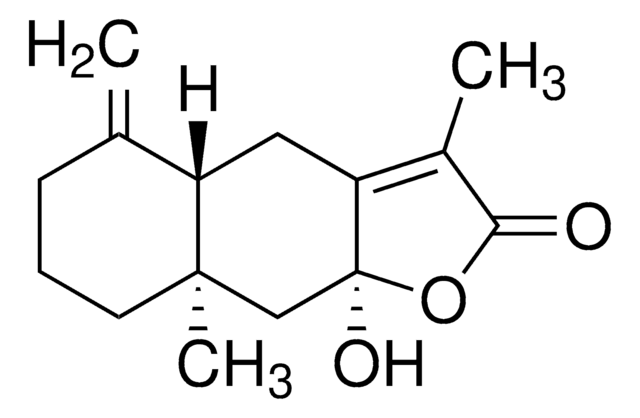
CC1=C2C[C@H]3C(=C)CCC[C@]3(C)C[C@]2(O)OC1=O
InChI
1S/C15H20O3/c1-9-5-4-6-14(3)8-15(17)12(7-11(9)14)10(2)13(16)18-15/h11,17H,1,4-8H2,2-3H3/t11-,14+,15-/m0/s1
InChI key
FBMORZZOJSDNRQ-GLQYFDAESA-N
General description
Atractylenolide III is a biologically active sesquiterpene compound, extracted from the roots of Atractylodes macrocephala Koidzumi.
Application
Atractylenolide III, a sesquiterpenoid, is a phytochemical that may be used to study its anti-inflammatory and anti-angiogenesis activities. Atractylenolide III may be used and studied as an inhibitor of aromatases and inducer of apoptosis. Atractylenolide III may be used to study its sonic hedgehog pathway dependent mechanism of action as an inducer of chondrogenic differentiation. Atractylenolide III may be used as a reference material in assays to detect its presence in plant root extracts and biological milieu such as plasma.
Atractylenolide III has been used to examine its effects on the energy metabolism in the skeletal muscles of mouse.
Biochem/physiol Actions
Atractylenolide III has been shown to possess anti-inflammatory effects and also offers gastroprotection. It also shows acaricidal properties and hence has the potential to be used as an agent for the control of dust mites. Atractylenolide III is capable of regulating the secretion and expression of Interleukin-6, thereby mediating the immune response caused by mast cells.
Atractylenolide III possesses anti-inflammatory and anticancer properties.
Still not finding the right product?
Explore all of our products under Atractylenolide III
Storage Class
11 - Combustible Solids
wgk
WGK 3
flash_point_f
Not applicable
flash_point_c
Not applicable
Choose from one of the most recent versions:
Already Own This Product?
Find documentation for the products that you have recently purchased in the Document Library.
Mi Young Song et al.
Biological & pharmaceutical bulletin, 40(3), 339-344 (2017-03-03)
Targeting energy expenditure provides a potential alternative strategy for achieving energy balance to combat obesity and the development of type 2 diabetes mellitus (T2DM). In the present study, we investigated whether atractylenolide III (AIII) regulates energy metabolism in skeletal muscle
Chia-Jui Tsai et al.
Bioorganic & medicinal chemistry letters, 22(6), 2326-2329 (2012-03-01)
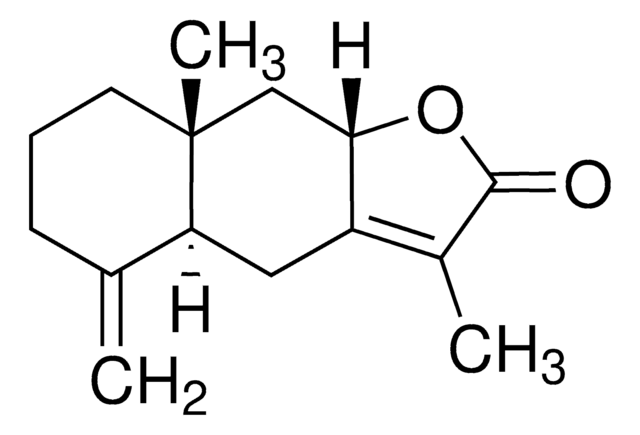
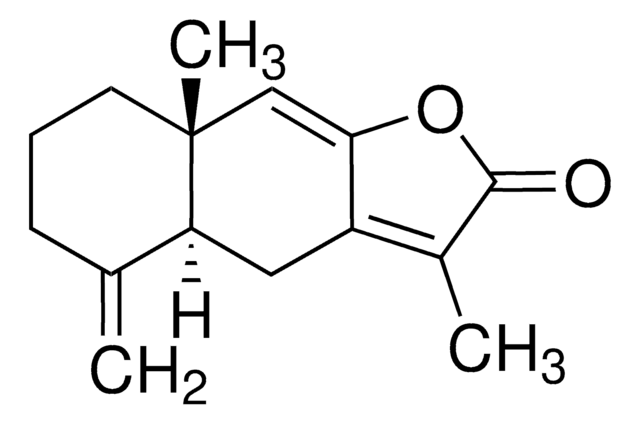
Two sesquiterpenoids, atractylenolide II and III, were isolated and identified from Atractylodes macrocephala (Asteraceae) to be subsequently evaluated for their activity against farnesoid X receptor (FXR) and progesterone receptor (PR) by transient transfection reporter assays. These sesquiterpenoids did not exert
Kun-Teng Wang et al.
The Journal of pharmacy and pharmacology, 62(3), 381-388 (2010-05-22)
The rhizome of Atractylodes ovata De Candolle is popularly used in traditional Chinese medicine to treat gastrointestinal diseases. However, the major gastroprotective compounds of A. ovata have not been identified. This study reports on the principal gastro- protective component of
Global Trade Item Number
| SKU | GTIN |
|---|---|
| A2987-50MG | 04061833046852 |
| A2987-10MG | 04061833046845 |