


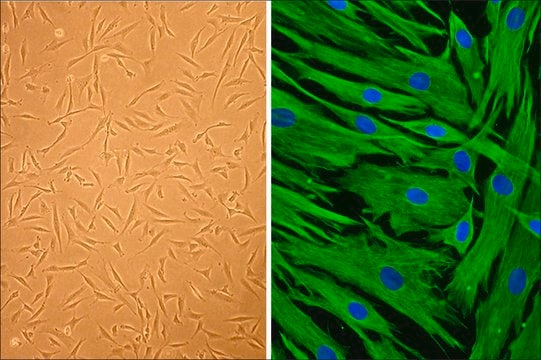
Typically, 6-10 passages are needed for these cells to reach replicative senescence, depending on the lot.
106-05A

Human Dermal Fibroblasts: HDF, adult
Synonym(s):
HDF cells
Sign In to View Organizational & Contract Pricing.
Select a Size
Change View
| Size/SKU | Availability | Price |
|---|
About This Item
NACRES:
NA.81
UNSPSC Code:
41106514
Biological source:
human neonatal foreskin or adult skin (normal)
Growth mode:
Adherent
Morphology:
Fibroblast
Pricing and availability is not currently available.
biological source
human neonatal foreskin or adult skin (normal)
Quality Segment
packaging
pkg of 500,000 cells
manufacturer/tradename
Cell Applications, Inc
growth mode
Adherent
karyotype
2n = 46
morphology
Fibroblast
technique(s)
cell culture | mammalian: suitable
shipped in
dry ice
storage temp.
−196°C
General description
Lot specific orders are not able to be placed through the web. Contact your local sales rep for more details.
Dermal Fibroblasts are responsible for producing the extracellular matrix forming the connective tissue of the skin, and play a crucial role during wound healing. HDF provide an excellent model system to study many aspects of cell physiology, and have been utilized in dozens of research publications, particularly those related to skin biology and reprogramming/induced pluripotency studies. HDF were used to create, along with human synovyocytes, induced pluripotent stem cells (iPSC) by using the now classic “Yamanaka cocktail” of Oct3/4, Sox2, Klf4, and c-Myc, the discovery for which Dr. Shinya Yamanaka was awarded the Nobel Prize in 2012 (Takanashi, 2007; 2009), and to characterize iPSC general properties, miRNA expression profiles and differentiation potential (Hayashi, 2010; Ohta, 2011; Koyanagi-Aoi, 2013; Noguchi, 20130; Razak, 2013; Sakurai, 2013; Tanaka, 2013; Yanagida, 2013)
Dermal Fibroblasts are responsible for producing the extracellular matrix forming the connective tissue of the skin, and play a crucial role during wound healing. HDF provide an excellent model system to study many aspects of cell physiology, and have been utilized in dozens of research publications, particularly those related to skin biology and reprogramming/induced pluripotency studies. HDF were used to create, along with human synovyocytes, induced pluripotent stem cells (iPSC) by using the now classic “Yamanaka cocktail” of Oct3/4, Sox2, Klf4, and c-Myc, the discovery for which Dr. Shinya Yamanaka was awarded the Nobel Prize in 2012 (Takanashi, 2007; 2009), and to characterize iPSC general properties, miRNA expression profiles and differentiation potential (Hayashi, 2010; Ohta, 2011; Koyanagi-Aoi, 2013; Noguchi, 20130; Razak, 2013; Sakurai, 2013; Tanaka, 2013; Yanagida, 2013)
Application
injury recovery, connective tissue research, laminin and fibronectin production, extracellular matrix, tissue organization, wound healing, fibroblasts growth factor response
Biochem/physiol Actions
Skin
Preparation Note
Fibroblast Growth Medium (116-500) all-in-one ready to use media
- Primary culture, >500,000 cells in Fibroblast Basal Medium containing 10% FBS & 10% DMSO.
- Can be cultured at least 16 doublings.
Please refer to the HDF Culture Protocol.
Other Notes
Fibroblast Basal Medium containing 10% FBS & 10% DMSO.
Disclaimer
RESEARCH USE ONLY. This product is regulated in France when intended to be used for scientific purposes, including for import and export activities (Article L 1211-1 paragraph 2 of the Public Health Code). The purchaser (i.e. enduser) is required to obtain an import authorization from the France Ministry of Research referred in the Article L1245-5-1 II. of Public Health Code. By ordering this product, you are confirming that you have obtained the proper import authorization.
1 of 1
This Item | |||
|---|---|---|---|
| biological source human neonatal foreskin or adult skin (normal) | biological source human neonatal foreskin or adult skin (normal) | biological source human neonatal foreskin or adult skin (normal) | biological source human scalp (hair follicle papilla) |
| technique(s) cell culture | mammalian: suitable | technique(s) cell culture | mammalian: suitable | technique(s) cell culture | mammalian: suitable | technique(s) cell culture | mammalian: suitable |
| morphology Fibroblast | morphology Fibroblast | morphology Fibroblast | morphology mesenchymal |
| growth mode Adherent | growth mode Adherent | growth mode Adherent | growth mode Adherent |
| karyotype 2n = 46 | karyotype 2n = 46 | karyotype 2n = 46 | karyotype - |
| Quality Level 100 | Quality Level 100 | Quality Level 100 | Quality Level - |
Storage Class
11 - Combustible Solids
wgk
WGK 3
flash_point_f
Not applicable
flash_point_c
Not applicable
Choose from one of the most recent versions:
Already Own This Product?
Find documentation for the products that you have recently purchased in the Document Library.
-
How many generations are needed for these cells to reach replicative senescence?
1 answer-
Helpful?
-
-
What is the estrogen receptor expression in these cells?
1 answer-
Estrogen receptor expression has not been determined for these cells.
Helpful?
-