Skip to Content
Merck

Skip To

07-330

Anti-Partitioning-defective 3 Antibody

Upstate®, from rabbit

Synonym(s):

Atypical PKC isotype-specific-interacting protein, CTCL tumor antigen se2-5, atypical PKC isotype-specific interacting protein, par-3 (partitioning defective 3, C.elegans) homolog, par-3 partitioning defective 3 homolog (C. elegans), partitioning-defecti

Sign In to View Organizational & Contract Pricing.

Select a Size

Change View
Pack SizeSKUAvailabilityPrice

About This Item

UNSPSC Code:
12352203
NACRES:
NA.41
eCl@ss:
32160702
Conjugate:
unconjugated
Clone:
polyclonal
Application:
ICC, WB
Citations:
188
Pricing and availability is not currently available.
Technical Service
Need help? Our team of experienced scientists is here for you.
Let Us Assist


biological source

rabbit

Quality Level

conjugate

unconjugated

antibody form

purified immunoglobulin

antibody product type

primary antibodies

clone

polyclonal

species reactivity

rat, canine, human, mouse, monkey

manufacturer/tradename

Upstate®

technique(s)

immunocytochemistry: suitable, western blot: suitable

isotype

IgG

NCBI accession no.

UniProt accession no.

shipped in

dry ice

target post-translational modification

unmodified

Gene Information

General description

PAR3 is an adapter protein involved in asymmetrical cell division and cell polarization processes. It seems to play a central role in the formation of epithelial tight junctions. Its association with PARD6B may prevent the interaction of PAR3 with F11R/JAM1, thereby preventing tight junction assembly. The PARD6-PAR3 complex links GTP bound Rho small GTPases to atypical protein kinase C proteins. PAR3 interacts with PARD6A and PARD6B. Isoform 2, but not at least isoform 3 interacts with PRKCZ. PAR3 interacts with PRCKI. PAR3 forms part of a complex with PARD6A or PARD6B, PRKCI or PRKCZ and CDC42 or RAC1. PAR3 interacts with F11R/JAM1. Antibodies against PAR3 are present in sera from patients with cutaneous T cell lymphomas.
~180, 150 & 100 kDa

Immunogen

GST fusion protein corresponding to residues 457-744 of mouse PAR-3 (accession number AY02657).

Application

Anti-Partitioning-defective 3 Antibody is an antibody against Partitioning-defective 3 and has been published in over 20 citations for use in IC and WB.
Immunocytochemistry:
A previous lot of this antibody showed positive immunostaining for PAR-3 in MDCK cells fixed with 3% paraformaldehyde followed by permeabilization with 0.1% Triton X-100 has been shown by an independent laboratory.
Research Category
Cell Structure
Research Sub Category
Cytoskeleton

Biochem/physiol Actions

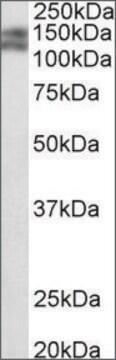
Recognizes all 3 slice isoforms of PAR-3, MW ~180, 150, 100 kDa.

Physical form

Affinity Purified
Format: Purified
Purified rabbit polyclonal in buffer containing 0.014 M phosphate buffer, pH 7.6, 0.175 M NaCl, 0.07% sodium azide and 30% glycerol.

Preparation Note

Stable for 1 year at -20ºC from date of receipt.

Analysis Note

Control
Positive Antigen Control: Catalog #12-305, 3T3/A31 lysate. Add 2.5 μL of 2-mercapto-ethanol/100 μL of lysate and boil for 5 minutes to reduce the preparation. Load 20 μg of reduced lysate per lane for minigels.
Evaluated by western blot on RIPA lysates from 3T3/A31, A431, and HeLa cells.

Western Blot Analysis:
0.5-2 µg/mL of this antibody detected PAR-3 isoforms in RIPA lysates from 3T3/A31, A431, and HeLa cells.

Other Notes

Concentration: Please refer to the Certificate of Analysis for the lot-specific concentration.
Replaces: MABS174

Legal Information

UPSTATE is a registered trademark of Merck KGaA, Darmstadt, Germany

Disclaimer

Unless otherwise stated in our catalog or other company documentation accompanying the product(s), our products are intended for research use only and are not to be used for any other purpose, which includes but is not limited to, unauthorized commercial uses, in vitro diagnostic uses, ex vivo or in vivo therapeutic uses or any type of consumption or application to humans or animals.

Compare Similar Items

View Full Comparison

Show Differences

1 of 1

This Item
07-330-AF488MABF28SAB2501880
conjugate

unconjugated

conjugate

ALEXA FLUOR 488

conjugate

unconjugated

conjugate

unconjugated

antibody form

purified immunoglobulin

antibody form

purified antibody

antibody form

purified antibody

antibody form

affinity isolated antibody

biological source

rabbit

biological source

rabbit

biological source

mouse

biological source

goat

clone

polyclonal

clone

polyclonal

clone

8E8, monoclonal

clone

polyclonal

species reactivity

rat, canine, human, mouse, monkey

species reactivity

monkey, canine, human, rat, frog, mouse

species reactivity

mouse

species reactivity

mouse, rat

technique(s)

immunocytochemistry: suitable, western blot: suitable

technique(s)

immunocytochemistry: suitable

technique(s)

activity assay: suitable, flow cytometry: suitable

technique(s)

indirect ELISA: suitable, western blot: suitable


Still not finding the right product?

Try our Product Selector Tool to narrow your options


Storage Class

10 - Combustible liquids

wgk

WGK 1


Certificates of Analysis (COA)

Search for Certificates of Analysis (COA) by entering the products Lot/Batch Number. Lot and Batch Numbers can be found on a product’s label following the words ‘Lot’ or ‘Batch’.

Already Own This Product?

Find documentation for the products that you have recently purchased in the Document Library.

Visit the Document Library


Junctional adhesion molecules (JAMs): more molecules with dual functions?
Ebnet, Klaus, et al.
Journal of Cell Science, 117, 19-29 (2004)
Cdx2 regulates endo-lysosomal function and epithelial cell polarity.
Gao N, Kaestner KH
Genes & Development null
Hippocampal neuronal polarity specified by spatially localized mPar3/mPar6 and PI 3-kinase activity.
Shi, Song-Hai, et al.
Cell, 112, 63-75 (2003)


Questions

Reviews

No rating value

Active Filters