


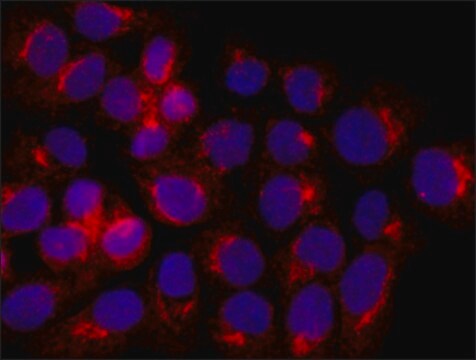
Characterizing the glycosylation pattern of this enzyme is not within the scope of product evaluation in the laboratory. Unfortunately, there is no access to the specific publication containing the details. However, based on the abstract description, the publication "Gene. 1992 Nov 16;121(2):295-304" provides information about the glycosylation patterns of both the dimeric and monomeric forms of recombinant hAChE (rehAChE) expressed in the embryonal kidney 293 cell line, which may be helpful for reference. The PMID for the publication is 1446827.
C1682

Acetylcholinesterase human
recombinant, expressed in HEK 293 cells, lyophilized powder, ≥1,000 units/mg protein (BCA)
Synonym(s):
AChE, Acetylcholine acetylhydrolase
Sign In to View Organizational & Contract Pricing.
Select a Size
Change View
| Size/SKU | Availability | Price |
|---|
About This Item
CAS Number:
UNSPSC Code:
12352204
NACRES:
NA.32
EC Number:
232-559-3
MDL number:
Specific activity:
≥1,000 units/mg protein (BCA)
Recombinant:
expressed in HEK 293 cells
Pricing and availability is not currently available.
General description
Acetylcholinesterase (AChE) is a serine hydrolase, which belongs to the carboxyl esterase family of enzymes. AChE is localised at neuromuscular junctions and cholinergic brain synapses.
Application
Acetylcholinesterase human has been used:
- as a standard protein to measure protein levels acetylcholinesterase AChE-R and AChE-S
- to stimulate human fibroblasts
- to study its in vitro catalytic activity and to determine the effects of metals, H2O2 and OH radicals on the activity
Biochem/physiol Actions
Acetylcholinesterase (AChE) is regarded as a biomarker in neurotoxicity. It is a modulator of nitric oxide signal transduction pathway and marker of membrane integrity and aging. AChE, hydrolyzes choline esters. It terminates the impulse transmission at cholinergic synapses. AChE does this by rapid hydrolysis of the neurotransmitter acetylcholine (ACh) to acetate and choline. AChE inhibitors prevent the cholinesterase enzyme from breaking down ACh and increases the level and duration of the neurotransmitter action.
Major degradative enzyme for acetylcholine in vivo. Converts acetylcholine + H2O to choline + acetic acid.
Physical form
This product is supplied as a lyophilized powder. Lyophilized from 0.22 μm filtered solution in 50mM phosphate buffer pH8.
Analysis Note
The activity obtained using acetylcholine as substrate is 30-100 times that obtained with butyrylcholine, using acetylcholinesterase from electric eel.
Other Notes
One unit will hydrolyze 1.0 μmole of acetylthiocholine to thiocholine and acetate per minute at pH 8.0 at 37 °C.
1 of 1
This Item | |||
|---|---|---|---|
| specific activity ≥1,000 units/mg protein (BCA) | specific activity ≥500 units/mg protein (BCA) | specific activity - | specific activity ≥1,000 units/mg protein |
| Gene Information human ... ACHE(43) | Gene Information human ... ACHE(43) | Gene Information human ... ACHE(43) | Gene Information - |
| recombinant expressed in HEK 293 cells | recombinant - | recombinant - | recombinant - |
| form lyophilized powder | form buffered aqueous solution | form buffered aqueous solution | form lyophilized powder |
| storage temp. −20°C | storage temp. 2-8°C | storage temp. −20°C | storage temp. −20°C |
| UniProt accession no. | UniProt accession no. | UniProt accession no. | UniProt accession no. - |
Storage Class
11 - Combustible Solids
wgk
WGK 3
flash_point_f
Not applicable
flash_point_c
Not applicable
Choose from one of the most recent versions:
Already Own This Product?
Find documentation for the products that you have recently purchased in the Document Library.
-
Is there information available about the glycosylation pattern of the recombinant human acetylcholinesterase (product number C1682) expressed in HEK 293 cells?
1 answer-
Helpful?
-