Skip to Content
Merck

Skip To

F6008

Ficin from fig tree latex

lyophilized powder

Synonym(s):

Debricin, Ficain, higueroxyl delabarre

Sign In to View Organizational & Contract Pricing.

Select a Size

Change View
Pack SizeSKUAvailabilityPrice

About This Item

CAS Number:
UNSPSC Code:
12352204
NACRES:
NA.54
EC Number:
232-599-1
MDL number:
EC Number:
Specific activity:
≥1.0 units/mg protein
Biological source:
fig tree (latex)
Pricing and availability is not currently available.
Technical Service
Need help? Our team of experienced scientists is here for you.
Let Us Assist


biological source

fig tree (latex)

Quality Level

form

lyophilized powder

specific activity

≥1.0 units/mg protein

mol wt

23.8 kDa

composition

Protein, 80-100% biuret

storage temp.

−20°C

General description

Extinction Coefficient: E1% = 21.0 (280 nm)
pI: 9.0

Application

Ficin from fig tree latex has been used:
  • in the proteolysis of tendon collagen
  • in the digestion of Chlorophyta Ulva rigida
  • to investigate it effect on protease-activated receptors 2 and 4 activation to induce itch in skin[1]

Biochem/physiol Actions

Ficin is classified as a thiol protease. It contains a single reactive cysteine at its active site. The amino acid homology of the active site is similar to that of papain. Ficin will cleave proteins at the carboxyl side of Gly, Ser, Thr, Met, Lys, Arg, Tyr, Ala, Asn, and Val. The reported Km for the chromogenic substrate pGlu-Phe-Leu-p-nitroanilide is 0.43 mM. Ficin is inhibited by iodoacetamide, iodoacetic acid, N-ethylmaleimide, mercuric chloride, DFP (diisopropyl fluorophosphate), TLCK (Na-p-Tosyl-lysine chloromethyl ketone), and TPCK (N-Tosyl-L-phenylalanine chloromethyl ketone). Ficin can be used to generate high yielding F (ab′)2 fragments from mouse IgG1.
Ficin is effective in disrupting the staphylococcal biofilms making it accessible antibiotics exposure.

Physical form

Lyophilized powder containing L-cysteine and trace EDTA

Preparation Note

This enzyme is soluble in water (10 mg/ml), yielding a clear solution.

Other Notes

One unit will produce a ΔA280 of 1.0 per min at pH 7.0 at 37°C when measuring TCA soluble products from casein in a final volume of 10 ml (1 cm light path).

Compare Similar Items

View Full Comparison

Show Differences

1 of 1

This Item
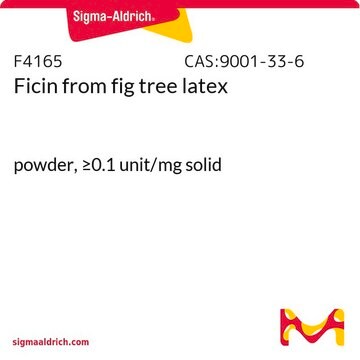
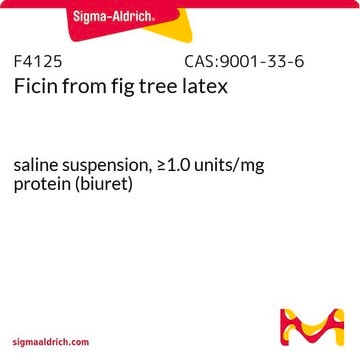
F4165P3375F4125
biological source

fig tree (latex)

biological source

fig tree (latex)

biological source

-

biological source

fig tree (latex)

specific activity

≥1.0 units/mg protein

specific activity

≥0.1 unit/mg solid

specific activity

1.5-10 units/mg solid

specific activity

≥1.0 units/mg protein (biuret)

form

lyophilized powder

form

powder

form

crude powder

form

saline suspension

storage temp.

−20°C

storage temp.

−20°C

storage temp.

2-8°C

storage temp.

2-8°C

mol wt

23.8 kDa

mol wt

23.8 kDa

mol wt

23.4 kDa

mol wt

23.8 kDa

Quality Level

300

Quality Level

200

Quality Level

200

Quality Level

200


Still not finding the right product?

Explore all of our products under Ficin from fig tree latex


pictograms

Health hazardExclamation mark

signalword

Danger

Hazard Classifications

Eye Irrit. 2 - Resp. Sens. 1 - Skin Irrit. 2 - STOT SE 3

target_organs

Respiratory system

Storage Class

11 - Combustible Solids

wgk

WGK 1

ppe

dust mask type N95 (US), Eyeshields, Faceshields, Gloves


Choose from one of the most recent versions:

Certificates of Analysis (COA)

Lot/Batch Number

Don't see the Right Version?

If you require a particular version, you can look up a specific certificate by the Lot or Batch number.

Already Own This Product?

Find documentation for the products that you have recently purchased in the Document Library.

Visit the Document Library


Generation of an artificial skin construct containing a non-degradable fiber mesh: a potential transcutaneous interface
Cahn F and Kyriakides TR
Biomedical Materials (Bristol, England), 3(3), 034110-034110 (2008)
Targeting microbial biofilms using Ficin, a nonspecific plant protease
Baidamshina DR, et al.
Scientific reports, 7, 46068-46068 (2017)
A Aktypis et al.
Journal of applied microbiology, 84(4), 568-576 (1998-06-20)
ACA-DC 0040 produced an antimicrobial agent, which was named thermophilin T, active against several lactic acid bacteria strains of different species and food spoilage bacteria, such as Clostridium sporogenes C22/10 and Cl. tyrobutyricum NCDO-1754. The crude antimicrobial compound is sensitive


Global Trade Item Number

SKUGTIN
F6008-1KU04061833618394
F6008-100UN04061833618370
F6008-200UN04061832700779

Questions

  1. What is this used for exactly? In lay terms please.

    1 answer
    1. Ficin is an enzyme that has a number of uses in several markets. As mentioned in the DESCRIPTION section of the product detail page, ficin from fig tree latex has been used:

      in the proteolysis of tendon collagen (tendons are softened in meat/muscles)
      in the digestion of Chlorophyta Ulva rigida (softens this algae which is used in 'sea salad' and animal feed)
      to investigate it's effect on protease-activated receptors 2 and 4 activation to induce itch in skin (studies indicate it can cause itching)
      in disrupting the staphylococcal biofilms, making it accessible antibiotics exposure. (Staph can be very resistant to antibiotics, particularly in 'biofilms'. Ficin digests or breaks down this film so that antibiotics are more effective.)

      It is also used in the food industry, primarily dairy products and is useful in clotting milk to aid in cheese production.
      Ficin has several medical uses, as well. This product is for research use only, however the link below describes some of the medical applications of Ficin:
      https://www.webmd.com/vitamins/ai/ingredientmono-141/ficin

      Helpful?

Reviews

No rating value

Active Filters