


The concentration in U/mL can be determined using the Enzymatic Activity and the mg protein/mL value reported on the lot specific Certificate of Analysis. For example, a lot has a reported Enzymatic Activity of 359 units/ mg protein and 13.7 mg protein/ mL will have a concentration 4918.3 units/ml. Please see the link below to review a sample or lot specific Certificate:
https://www.sigmaaldrich.com/US/en/product/sigma/p1506#product-documentation
P1506

Pyruvate Kinase from rabbit muscle
Type II, ammonium sulfate suspension, 350-600 units/mg protein
Synonym(s):
ATP:pyruvate 2-O-phosphotransferase, PK
Sign In to View Organizational & Contract Pricing.
Select a Size
Change View
| Size/SKU | Availability | Price |
|---|
About This Item
CAS Number:
UNSPSC Code:
12352204
eCl@ss:
32160410
NACRES:
NA.54
MDL number:
Specific activity:
350-600 units/mg protein
Biological source:
rabbit muscle
Pricing and availability is not currently available.
biological source
rabbit muscle
Quality Segment
type
Type II
form
ammonium sulfate suspension
specific activity
350-600 units/mg protein
mol wt
237 kDa
storage condition
(Tightly closed)
technique(s)
ligand binding assay: suitable
color
white
foreign activity
lactic dehydrogenase, creatine phosphokinase, and myokinase ≤0.01%, phosphoglucomutase ≤0.05%
storage temp.
2-8°C
General description
Research Area: Cell Signaling
Pyruvate kinase from rabbit muscle catalyzes ATP-dependent phosphorylation of glycolate to yield 2-phosphoglycolate.[1]Pyruvate kinase, an enzyme,[2] is found in a tetrameric or a dimeric form.[3] PKM1, PKM2, PKR, and PKL are the four mammalian pyruvate kinase isoforms.[2]
Pyruvate kinase from rabbit muscle catalyzes ATP-dependent phosphorylation of glycolate to yield 2-phosphoglycolate.[1]Pyruvate kinase, an enzyme,[2] is found in a tetrameric or a dimeric form.[3] PKM1, PKM2, PKR, and PKL are the four mammalian pyruvate kinase isoforms.[2]
Application
Biochem/physiol Actions
Pyruvate kinase from rabbit muscle can be activated by histidine and inhibited by low levels of zinc (Zn2+). In the glycolytic pathway, pyruvate kinase (PK) functions as a terminal enzyme, catalyzing the conversion of phosphoenolpyruvate to pyruvate and the synthesis of ATP through substrate-level phosphorylation. Tetrameric structures of PK are more active and have a high affinity for phosphoenolpyruvate (PEP), whereas dimeric structures are less active and have a low affinity for PEP.[3] PK from rabbit muscle possesses positive kinetic cooperativity (Hill coefficient> 1.35) of the phosphoenol pyruvate and adenosine diphosphate(ADP) binding sites.[5]
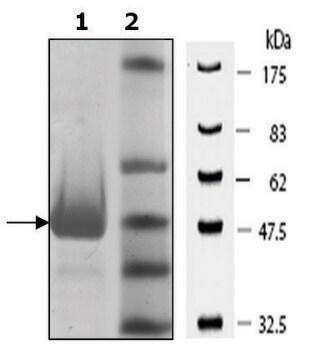
Molecular Weight: 237 kDa and exists as a tetramer of four equal subunits of molecular weight 57 kDa.
Isoelectric Point: 7.6
Optimal pH: ∼7.5
Optimal Temperature: 25°C
ΕA280 = 0.54 for 1 mg(p)/ml, 1 cm path
Reported KM values are ATP (0.86 mM), pyruvate (10 mM), ADP (0.3 mM), and PEP (0.07 mM) in Tris buffer at pH 7.4 and 30 °C. Pyruvate kinase is highly specific for phosphoenolpyruvate, but can utilize other dinucleotide triphosphates as substrates in place of ATP including GTP, ITP, dATP, UTP, and CTP.
Isoelectric Point: 7.6
Optimal pH: ∼7.5
Optimal Temperature: 25°C
ΕA280 = 0.54 for 1 mg(p)/ml, 1 cm path
Reported KM values are ATP (0.86 mM), pyruvate (10 mM), ADP (0.3 mM), and PEP (0.07 mM) in Tris buffer at pH 7.4 and 30 °C. Pyruvate kinase is highly specific for phosphoenolpyruvate, but can utilize other dinucleotide triphosphates as substrates in place of ATP including GTP, ITP, dATP, UTP, and CTP.
Physical form
Suspension in 3.2 M (NH4)2SO4 solution, pH 6
Analysis Note
Protein determined by biuret.
Other Notes
One unit will convert 1.0 μmole of phospho(enol)pyruvate to pyruvate per min at pH 7.6 at 37 °C.
1 of 1
This Item | |||
|---|---|---|---|
| biological source rabbit muscle | biological source rabbit muscle | biological source - | biological source human |
| technique(s) ligand binding assay: suitable | technique(s) - | technique(s) - | technique(s) - |
| specific activity 350-600 units/mg protein | specific activity 350-600 units/mg protein | specific activity 350-600 units/mg protein | specific activity - |
| form ammonium sulfate suspension | form lyophilized powder | form buffered aqueous glycerol solution | form aqueous solution |
| mol wt 237 kDa | mol wt 237 kDa | mol wt 237 kDa | mol wt 59 kDa |
| storage temp. 2-8°C | storage temp. −20°C | storage temp. 2-8°C | storage temp. −70°C |
Still not finding the right product?
Explore all of our products under Pyruvate Kinase from rabbit muscle
Storage Class
12 - Non Combustible Liquids
wgk
WGK 2
flash_point_f
Not applicable
flash_point_c
Not applicable
Choose from one of the most recent versions:
Already Own This Product?
Find documentation for the products that you have recently purchased in the Document Library.
-
この製品(P1506, ピルビン酸キナーゼ)についてご質問があります。 この製品の比活性は350-600 units/mg proteinと記載ありますが、濃度としてU/mLはお分かりになるのでしょうか。 Lot毎に異なることかもしれませんので、試薬の瓶そのものに記載があったりするのでしょうか(データシートには記載が見当たらない)。 ご確認のほど、よろしくお願いいたします。
1 answer-
Helpful?
-
-
Hi, How long can this be stored in the fridge?
1 answer-
This product is not assigned an expiration date or retest date. Products that are robust in nature and extremely stable, in the original unopened container, are not assigned an expiration date or retest schedule. These products will have no dating reported on either the label or the Certificate of Analysis. Products that are not assigned an expiration or retest date are covered by a warranty period of 1 year from the date of product shipment.
Helpful?
-