Skip to Content
Merck

Skip To

L2906

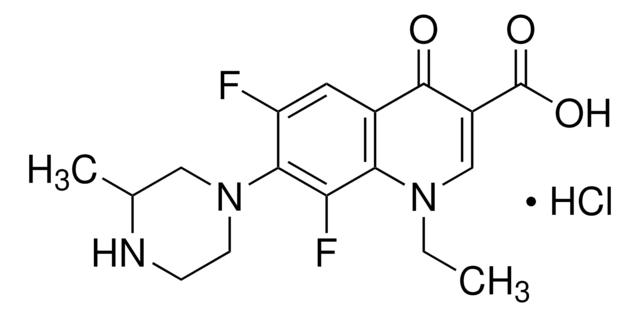
Lomefloxacin hydrochloride

Synonym(s):

1-Ethyl-6,8-difluoro-1,4-dihydro-7-(3-methyl-1-piperazinyl)-4-oxo-3-quinolinecarboxylic acid

Sign In to View Organizational & Contract Pricing.

Select a Size

Change View
Pack SizeSKUAvailabilityPrice

About This Item

Empirical Formula (Hill Notation):
C17H19F2N3O3 · HCl
CAS Number:
Molecular Weight:
387.81
NACRES:
NA.85
PubChem Substance ID:
UNSPSC Code:
51282927
MDL number:
Pricing and availability is not currently available.
Technical Service
Need help? Our team of experienced scientists is here for you.
Let Us Assist


biological source

synthetic

Quality Level

color

white to off-white

antibiotic activity spectrum

Gram-negative bacteria, Gram-positive bacteria

mode of action

DNA synthesis | interferes, enzyme | inhibits

storage temp.

−20°C

SMILES string

Cl.CCN1C=C(C(O)=O)C(=O)c2cc(F)c(N3CCNC(C)C3)c(F)c12

InChI

1S/C17H19F2N3O3.ClH/c1-3-21-8-11(17(24)25)16(23)10-6-12(18)15(13(19)14(10)21)22-5-4-20-9(2)7-22;/h6,8-9,20H,3-5,7H2,1-2H3,(H,24,25);1H

InChI key

KXEBLAPZMOQCKO-UHFFFAOYSA-N

General description

Chemical structure: fluoroquinolone

Application

Lomefloxacin is a fluoroquinolone antibiotic that is commonly used to treat bacterial infections, including bronchitis and urinary tract infections. It is used as a pre-operative prophylactic to prevent urinary tract infection caused by S. pneumoniae, H. influenzae, S. aureus, P. aeruginosa, E. cloacae, P. mirabilis, C. civersus, S. asprphyticus, E. coli, and K. pneumoniae. It is used to induce genomic instability in mice[1] and modification of the kinetics of growth of Gram-negative bacteria[2].

Biochem/physiol Actions

Lomefloxacin is a bactericidal fluoroquinolone agent that is active against gram-negative and gram-positive organisms. Lomefloxacin inhibits bacterial DNA gyrase (topoisomerase II) and topoisomerase IV, which are needed for the transcription and replication of bacterial DNA. DNA gyrase is thought to be the primary quinolone target for gram-negative bacteria. Topoisomerase IV is thought to be the primary target in gram-positive organisms. The inhibition of the topoisomerases results in strand breakage of the bacterial chromosome, supercoiling, and resealing. Therefore, DNA replication and transcription is inhibited.

Compare Similar Items

View Full Comparison

Show Differences

1 of 1

This Item
P01061785033434
antibiotic activity spectrum

Gram-negative bacteria, Gram-positive bacteria

antibiotic activity spectrum

Gram-negative bacteria, Gram-positive bacteria

antibiotic activity spectrum

Gram-negative bacteria, Gram-positive bacteria

antibiotic activity spectrum

Gram-negative bacteria, Gram-positive bacteria

mode of action

enzyme | inhibits, DNA synthesis | interferes

mode of action

DNA synthesis | interferes, enzyme | inhibits

mode of action

DNA synthesis | interferes, enzyme | inhibits

mode of action

DNA synthesis | interferes, enzyme | inhibits

Quality Level

200

Quality Level

100

Quality Level

200

Quality Level

100

storage temp.

−20°C

storage temp.

2-8°C

storage temp.

-

storage temp.

-

biological source

synthetic

biological source

-

biological source

-

biological source

-

color

white to off-white

color

-

color

-

color

-


pictograms

Exclamation mark

signalword

Warning

hcodes

Hazard Classifications

Acute Tox. 4 Oral

Storage Class

11 - Combustible Solids

wgk

WGK 3

ppe

dust mask type N95 (US), Eyeshields, Gloves


Choose from one of the most recent versions:

Certificates of Analysis (COA)

Lot/Batch Number

Don't see the Right Version?

If you require a particular version, you can look up a specific certificate by the Lot or Batch number.

Already Own This Product?

Find documentation for the products that you have recently purchased in the Document Library.

Visit the Document Library


H Vahedian-Movahed et al.
Journal of biomolecular structure & dynamics, 28(4), 483-502 (2010-12-15)
The interaction between lomefloxacin (LMF) and two drug carrier proteins, human serum albumin (HSA) and serum transferrin (TF), were studied and compared by fluorescence quenching, resonance light scattering (RLS), and circular dichroism (CD) spectroscopic along with molecular modeling. Fluorescence data
Sabry M Attia
Mutagenesis, 23(6), 515-521 (2008-08-30)
Lomefloxacin is a difluorinated quinolone antibacterial drug. It is widely used against infectious diseases including meningitis, those of the genitourinary and upper respiratory tracts, and skin infections. Lomefloxacin, like other fluoroquinolones, is mutagenic and the formation of reactive oxygen species
Yiruhan et al.
Environmental pollution (Barking, Essex : 1987), 158(7), 2350-2358 (2010-05-04)
Four fluoroquinolone antibiotics (norfloxacin, ciprofloxacin, lomefloxacin, and enrofloxacin) in tap water in Guangzhou and Macao were analyzed using high performance liquid chromatography fluorescence detection. The results showed that all target antibiotics were detected in high rate both in Guangzhou (77.5%)


Global Trade Item Number

SKUGTIN
L2906-10G04061833611692
L2906-1G04061833950579

Questions

Reviews

No rating value

Active Filters