


The product has been evaluated for the conversion of ethyl butyrate to butyric acid and ethanol. However, there has been no evaluation for the hydrolysis of ethyl hexanoate into hexanoic acid, and there are no known citations of this product for ethyl hexanoate hydrolysis. Due to the structural similarity between ethyl hexanoate and ethyl butyrate, both containing an ester bond, it's possible that this product could hydrolyze ethyl hexanoate, as esterases typically accommodate a wide range of ester substrates. However, the rate and efficiency of the hydrolysis may differ from the enzyme activity tested using ethyl butyrate as a substrate.
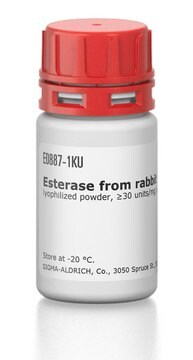
E0887

Esterase from rabbit liver
lyophilized powder, ≥30 units/mg protein
Synonym(s):
Carboxyl esterase, Carboxylic-ester hydrolase
Sign In to View Organizational & Contract Pricing.
Select a Size
Change View
| Pack Size | SKU | Availability | Price |
|---|
About This Item
CAS Number:
UNSPSC Code:
12352204
NACRES:
NA.54
EC Number:
232-773-7
MDL number:
Specific activity:
≥30 units/mg protein
Pricing and availability is not currently available.
form
lyophilized powder
Quality Level
specific activity
≥30 units/mg protein
mol wt
60 kDa
composition
Protein, ≥85% biuret
storage temp.
−20°C
General description
Application
Esterase from rabbit liver has been used in a study to investigate a toxic effect of carbamate insecticides. Esterase from rabbit liver has also been used in a study to investigate the effect of simvastatin on expression and activity of a lipoprotein-associated phospholipase A(2).
Esterase from rabbit liver has been used:
- in comparative biophysical studies with bovine bile-salt-activated lipase in the assays with vinyl acetate, triacylglycerols, p-nitrophenyl esters and serine enzyme inhibitors[1]
- in the catalysis and kinetic profiling studies of peptidic compounds[3]
- in in vitro stability assays of prodrug compounds (BMS-292655 and BMS300043)[4]
- in the hydrolysis of oleuropein aglycone (Ole-AG)[5]
The enzyme from Sigma has been used to study the effect of divalent metal ions on the activity of esterase.[6]
Biochem/physiol Actions
Esterase enzyme catalyzes hydrolysis of carboxylic ester to carboxylate and alcohol in the presence of water. Rabbit liver carboxylesterase catalyzes enantioselective hydrolysis of cineol derivatives.[7]
Physical form
Lyophilized powder containing Tris buffer salts
Other Notes
One unit will hydrolyze 1.0 μmole of ethyl butyrate to butyric acid and ethanol per min at pH 8.0 at 25 °C.
1 of 1
This Item | |||
|---|---|---|---|
| specific activity ≥30 units/mg protein | specific activity ≥150 units/mg protein (biuret) | specific activity ≥30.0 U/g | specific activity ≥0.2 U/mg |
| form lyophilized powder | form ammonium sulfate suspension | form crystalline, crystals, powder or flakes | form lyophilized |
| storage temp. −20°C | storage temp. 2-8°C | storage temp. −20°C | storage temp. 2-8°C |
| mol wt 60 kDa | mol wt 168 kDa | mol wt - | mol wt - |
| Quality Level 200 | Quality Level 300 | Quality Level 100 | Quality Level - |
| composition Protein, ≥85% biuret | composition - | composition - | composition - |
signalword
Danger
hcodes
pcodes
Hazard Classifications
Resp. Sens. 1
Storage Class
11 - Combustible Solids
wgk
WGK 1
flash_point_f
Not applicable
flash_point_c
Not applicable
ppe
Eyeshields, Gloves, type N95 (US)
Choose from one of the most recent versions:
Already Own This Product?
Find documentation for the products that you have recently purchased in the Document Library.
Henri Chahinian et al.
Biochimica et biophysica acta, 1801(11), 1195-1204 (2010-07-27)
To differentiate esterases from lipases at the structure-function level, we have compared the kinetic properties and structural features of sequence-related esterase 1 from rabbit liver (rLE) and bile-salt-activated lipase from bovine pancreas (bBAL). In contrast to rLE, bBAL hydrolyses water-insoluble
Shijin Zhang et al.
Langmuir : the ACS journal of surfaces and colloids, 36(22), 6261-6267 (2020-05-19)
To explore the potential of step-by-step assembly in the fabrication of biological materials, we designed and synthesized two peptide-based molecules for enzyme-instructed hierarchical assembly. Upon the treatment of alkaline phosphatase, one molecule undergoes enzyme-instructed self-assembly forming uniformed nanofibers. The other
Hansjörg Schwertz et al.
Journal of cardiovascular pharmacology, 52(2), 151-160 (2008-08-02)
Animal data strongly support a role for inflammation in myocardial ischemia reperfusion injury. Attempts at cardioprotection by immunomodulation (such as with the specific C5 antibody pexelizumab) in humans have been disappointing. We hypothesized that a broader spectrum antiinflammatory agent might
Global Trade Item Number
| SKU | GTIN |
|---|---|
| E0887-500UN | 04061832755540 |
| E0887-1KU | 04061833601297 |
-
Is it possible for the esterase from rabbit liver (E0887) to hydrolyze ethyl hexanoate into hexanoic acid?
1 answer-
Helpful?
-