

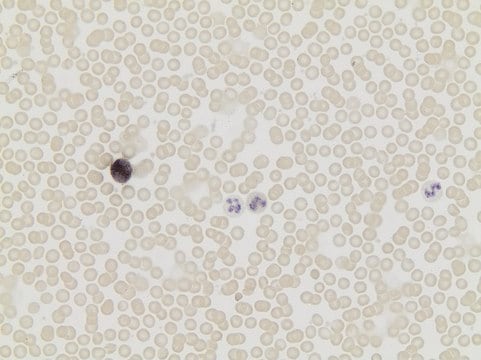


The 91A kit is formulated for 10 uses. The Instructions For Use direct the user to prepare 48 mL of staining solution, which is enough to fill a standard Coplin jar. It is possible to stain just 1 slide per run, or up to 10 slides per run for a standard Coplin jar that holds 5 slides, if the slides are placed back to back. The number of slides that can be stained should fall between 10 slides per kit to 100 slides per kit. If the Coplin jar holds more than 5 slides, the number of slides stained per kit would be two times the number of slides the Coplin jar can hold.
91A

Leukocyte α-Naphthyl Acetate (Non-Specific Esterase) Kit
Kit formulated with all liquid reagents.
Sign In to View Organizational & Contract Pricing.
Select a Size
Change View
| Pack Size | SKU | Availability | Price |
|---|
About This Item
Pricing and availability is not currently available.
Quality Level
form
liquid
shelf life
Expiry date on the label.
IVD
for in vitro diagnostic use
technique(s)
microbe id | staining: suitable
application(s)
hematology
histology
shipped in
wet ice
storage temp.
2-8°C
Application
Esterases are ubiquitous in nature and encompass a series of different enzymes acting upon select substrates. According to the methodology, α-naphthyl acetate is enzymatically hydrolyzed, liberating a free naphthol compound. This then couples with a diazonium compound, forming black colored deposits at sites of non-specific esterase activity. This enzyme is detected primarily in monocytes, macrophages and histocytes, and is normally absent in granulocytes. Lymphocytes may occasionally exhibit enzyme activity. A sodium fluoride inhibition procedure may be run to demonstrate monocyte inhibition. The procedure is run at 37 °C and may be utilized with blood, bone marrow films, tissue-touch preparations, cytocentrifuge preparations and frozen sections. The enzyme does not survive paraffin processing.
Intended for the cytologic demonstration of a-naphthyl acetate esterase in blood, bone marrow films or tissue touch preparations.
1 of 1
This Item | |||
|---|---|---|---|
| technique(s) microbe id | staining: suitable | technique(s) - | technique(s) - | technique(s) - |
| application(s) hematology | application(s) hematology | application(s) hematology | application(s) hematology |
| form liquid | form liquid | form solution | form solution |
| shelf life Expiry date on the label. | shelf life Expiry date on the label. | shelf life Expiry date on the label. | shelf life Expiry date on the label. |
| IVD for in vitro diagnostic use | IVD for in vitro diagnostic use | IVD for in vitro diagnostic use | IVD for in vitro diagnostic use |
| shipped in wet ice | shipped in wet ice | shipped in wet ice | shipped in wet ice |
Still not finding the right product?
Explore all of our products under Leukocyte α-Naphthyl Acetate (Non-Specific Esterase) Kit
Kit Components Only
Product No.
Description
- TRIZMAL™ 7.6 Concentrate 50 mL
- Hematoxylin solution gill no. 3 50 mL
signalword
Danger
Hazard Classifications
Acute Tox. 3 Oral - Acute Tox. 4 Dermal - Acute Tox. 4 Inhalation - Eye Irrit. 2 - Flam. Liq. 3 - Met. Corr. 1 - STOT SE 1
target_organs
Eyes,Central nervous system
Storage Class
3 - Flammable liquids
flash_point_f
98.1 °F
flash_point_c
36.7 °C
wgk
WGK 2
Choose from one of the most recent versions:
Already Own This Product?
Find documentation for the products that you have recently purchased in the Document Library.
S A Kuznetsov et al.
The Journal of cell biology, 153(5), 1133-1140 (2001-05-31)
We report the isolation of adherent, clonogenic, fibroblast-like cells with osteogenic and adipogenic potential from the blood of four mammalian species. These cells phenotypically resemble but are distinguishable from skeletal stem cells found in bone marrow (stromal stem cells, "mesenchymal
Gabrielle S Le Provost et al.
The Journal of investigative dermatology, 135(1), 279-288 (2014-07-23)
During wound healing, excessive inflammation, angiogenesis, and differentiated human dermal fibroblast (HDF ) function contribute to scarring, whereas hyperpigmentation negatively affects scar quality. Over 100 million patients heal with a scar every year. To investigate the role of the beta 2
Global Trade Item Number
| SKU | GTIN |
|---|---|
| 91A-1KT | 04061833264577 |
| SAB5201756-100UG | 04061832160726 |
| SAB5201753-100UG | 04061832160696 |
| SAB5201767-100UG | 04061832160832 |
| SAB5201768-100UG | 04061832160849 |
| SAB5201754-100UG | 04061832160702 |
| SAB5201752-100UG | 04061832160689 |
| SAB5201764-100UG | 04061832160801 |
| SAB5201762-100UG | 04061832160788 |
| SAB5201763-100UG | 04061832160795 |
| SAB5201765-100UG | 04061832160818 |
-
How many tests can be run with the 91A kit (α-Naphthyl Acetate (Non-Specific Esterase)?
1 answer-
Helpful?
-