
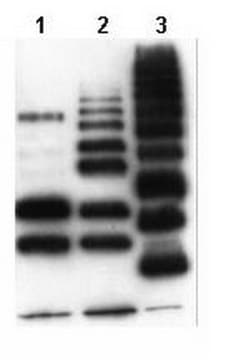


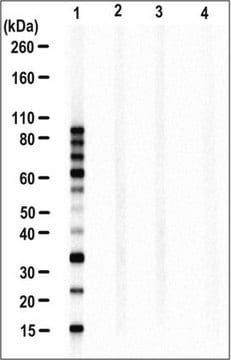
This product cross-reacts with all species. It recognizes mono- and poly-Ubiquitinylated proteins, but not free ubiquitin.
04-263

Anti-Ubiquitinylated proteins Antibody, clone FK2
clone FK2, Upstate®, from mouse
Anti-Ubiquitinylated proteins Antibody, clone FK2
1 of 1 reviewers received a sample product or took part in a promotion
Synonym(s):
Anti-ubiquitin antibody, FK2 ubiquitin antibody
Sign In to View Organizational & Contract Pricing.
Select a Size
Change View
| Pack Size | SKU | Availability | Price |
|---|
About This Item
UNSPSC Code:
12352203
NACRES:
NA.41
eCl@ss:
32160702
Clone:
FK2, monoclonal
Technique(s):
ELISA: suitable, immunofluorescence: suitable, immunoprecipitation (IP): suitable, western blot: suitable
Application:
ELISA, IF, IP, WB
Citations:
165
Pricing and availability is not currently available.
biological source
mouse
Quality Level
antibody form
purified immunoglobulin
antibody product type
primary antibodies
clone
FK2, monoclonal
species reactivity (predicted by homology)
all
manufacturer/tradename
Upstate®
technique(s)
ELISA: suitable, immunofluorescence: suitable, immunoprecipitation (IP): suitable, western blot: suitable
isotype
IgG1
shipped in
dry ice
target post-translational modification
unmodified
General description
Ubiquitin exists either covalently attached to another protein, or free (unanchored). When covalently bound, it is conjugated to target proteins via an isopeptide bond either as a monomer (monoubiquitin), a polymer linked via different Lys residues of the ubiquitin (polyubiquitin chains) or a linear polymer linked via the initiator Met of the ubiquitin (linear polyubiquitin chains). Polyubiquitin chains, when attached to a target protein, have different functions depending on the Lys residue of the ubiquitin that is linked: Lys-6-linked may be involved in DNA repair; Lys-11-linked is involved in ERAD (endoplasmic reticulum-associated degradation) and in cell-cycle regulation; Lys-29-linked is involved in lysosomal degradation; Lys-33-linked is involved in kinase modification; Lys-48-linked is involved in protein degradation via the proteasome; Lys-63-linked is involved in endocytosis, DNA-damage responses as well as in signaling processes leading to activation of the transcription factor NF-kappa-B. Linear polymer chains formed via attachment by the initiator Met lead to cell signaling. Ubiquitin is usually conjugated to Lys residues of target proteins, however, in rare cases, conjugation to Cys or Ser residues has been observed. When polyubiquitin is free (unanchored-polyubiquitin), it also has distinct roles, such as in activation of protein kinases, and in signaling. Similarity: Belongs to the ubiquitin family. Contains 3 ubiquitin-like domains.
Immunogen
Poly-ubiquitinylated-lysozyme.
Application
Research Category
Protein Trafficking
Protein Trafficking
Research Sub Category
Ubiquitin & Ubiquitin Metabolism
Ubiquitin & Ubiquitin Metabolism
This Anti-Ubiquitinylated proteins Antibody, clone FK2 has been published and validated for use in ELISA, Immunofluorescence (IF), Immunoprecipitation (IP) and Western Blotting (WB) for the detection of Ubiquitinylated proteins.
Biochem/physiol Actions
Recognizes mono- and poly ubiquitinylated proteins, but not free ubiquitin.
Physical form
100 µL of purified immunoglobulin in PBS, pH 7.4 containing 50% glycerol and 0.09% sodium azide. Dilute to working strength with phosphate buffered saline pH 7.2-7.4.
Format: Purified
Preparation Note
Stable for 1 year at -20°C from date of shipment for up to 12 months.
Other Notes
Concentration: Please refer to the Certificate of Analysis for the lot-specific concentration.
Legal Information
UPSTATE is a registered trademark of Merck KGaA, Darmstadt, Germany
Disclaimer
Unless otherwise stated in our catalog or other company documentation accompanying the product(s), our products are intended for research use only and are not to be used for any other purpose, which includes but is not limited to, unauthorized commercial uses, in vitro diagnostic uses, ex vivo or in vivo therapeutic uses or any type of consumption or application to humans or animals.
1 of 1
This Item | |||
|---|---|---|---|
| antibody form purified immunoglobulin | antibody form purified immunoglobulin | antibody form - | antibody form purified immunoglobulin |
| biological source mouse | biological source mouse | biological source rabbit | biological source mouse |
| clone FK2, monoclonal | clone FK1, monoclonal | clone polyclonal | clone LUB9, monoclonal |
| shipped in dry ice | shipped in wet ice | shipped in wet ice | shipped in wet ice |
| technique(s) ELISA: suitable, immunoprecipitation (IP): suitable, immunofluorescence: suitable, western blot: suitable | technique(s) immunohistochemistry: suitable, western blot: suitable | technique(s) immunoprecipitation (IP): suitable, western blot: suitable | technique(s) western blot: suitable |
| manufacturer/tradename Upstate® | manufacturer/tradename Upstate® | manufacturer/tradename - | manufacturer/tradename - |
Still not finding the right product?
Try our Product Selector Tool to narrow your options
Storage Class
12 - Non Combustible Liquids
wgk
WGK 2
flash_point_f
Not applicable
flash_point_c
Not applicable
Certificates of Analysis (COA)
Search for Certificates of Analysis (COA) by entering the products Lot/Batch Number. Lot and Batch Numbers can be found on a product’s label following the words ‘Lot’ or ‘Batch’.
Already Own This Product?
Find documentation for the products that you have recently purchased in the Document Library.
Production and characterization of monoclonal antibodies specific to multi-ubiquitin chains of polyubiquitinated proteins.
Fujimuro, M, et al.
Febs Letters, 349, 173-180 (1994)
Autophagy promotes T-cell survival through degradation of proteins of the cell death machinery.
Kovacs, JR; Li, C; Yang, Q; Li, G; Garcia, IG; Ju, S; Roodman, DG; Windle, JJ; Zhang, X; Lu, B
Cell Death and Differentiation null
Dynamics of ubiquitin conjugation during heat-shock response revealed by using a monoclonal antibody specific to multi-ubiquitin chains
Fujimuro, M, et al
European Journal of Biochemistry, 249, 427-433 (1997)
Global Trade Item Number
| SKU | GTIN |
|---|---|
| 04-263 | 04053252627774 |
-
What is the species reactivity of this antibody? Does this antibody recognize ubiquitinated proteins in rat cells?
1 answer-
Helpful?
-
-
Can you provide the concentration for the item Anti-Ubiquitinylated proteins Antibody, clone FK2, Product Number 04-263, Lot/Batch Number 3927968?
1 answer-
The concentration of this product is 1.0 mg/mL. This information is reported in the lot specific Certificate of Analysis.
Helpful?
-
-
What is the antibody dilution (Anti-Ubiquitin Mouse mAb) (FK2) for immunofluorescence . There is no information. The reference is wrong
1 answer-
A dilution factor ranging from 1:200 to 1:500 would be an ideal starting point for immunofluorescence titration. The following citation may be of interest for reference:
Budzik, Jonathan M., et al. "Dynamic post-translational modification profiling of Mycobacterium tuberculosis-infected primary macrophages." Elife 9 (2020): e51461.
Helpful?
-