


All donors undergo a risk assessment process in which they are specifically asked if they were potentially exposed to COVID19. After this, the actual testing varies by donor stream.
300-05A

Human Coronary Artery Endothelial Cells: HCAEC, adult
Synonym(s):
HCAEC cells
Sign In to View Organizational & Contract Pricing.
Select a Size
Change View
| Size/SKU | Availability | Price |
|---|
About This Item
NACRES:
NA.81
UNSPSC Code:
41106514
Biological source:
human coronary artery (normal)
Growth mode:
Adherent
Morphology:
Endothelial
Relevant disease(s):
cardiovascular diseases
Pricing and availability is not currently available.
biological source
human coronary artery (normal)
Quality Segment
packaging
pkg of 500,000 cells
manufacturer/tradename
Cell Applications, Inc
growth mode
Adherent
karyotype
2n = 46
morphology
Endothelial
technique(s)
cell culture | mammalian: suitable
relevant disease(s)
cardiovascular diseases
shipped in
dry ice
storage temp.
−196°C
General description
Lot specific orders are not able to be placed through the web. Contact your local sales rep for more details.
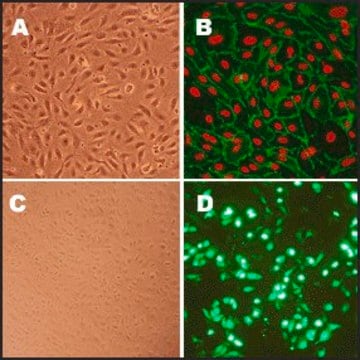
HCAEC provides an excellent model system to study all aspects of cardiovascular function and disease, and they have been utilized in dozens of research publications, for example to:
Additionally, HCAEC, along with human aortic (HAOEC), carotid artery (HCtAEC), subclavian artery (HScAEC) and brachiocephalic artery (HBcAEC) have been used to demonstrate that not only blood vessels from different tissues are highly heterogeneous, they also interact differently with leukocytes during the inflammation response (Scott, 2013). The authors further showed that differential N-glycosylation of commonly expressed vascular adhesion molecules may be responsible for this heterogeneity, as well as for modulation of signaling under resting and activated inflammatory conditions. This also explains why specific vascular beds may be more or less susceptible to particular diseases or stimuli. Importantly, if cells from different sources were used, these results could not be convincingly validated due to a number of uncontrolled variables, such as age, race, genetic variability or life style choices of the donors.
Because of the complex heterogeneity that exists not only between different donors, but even between different vascular beds in the same individual, it would be prudent to confirm any new findings on primary cell lots coming from several different origins.
HCAEC provides an excellent model system to study all aspects of cardiovascular function and disease, and they have been utilized in dozens of research publications, for example to:
- Understand the mechanism of the anti-inflammatory properties of HDL, and demonstrate for the first time that mature miRNA can control gene expression in a cell where it is neither transcribed nor processed (Tabet, 2014)
- Study mechanisms of angiogenesis, as well as oxidative stress and inflammation related pathways in endothelia (Ji, 2009; Wang, 2011; Quinn, 2011; Hung, 2010; Rajesh, 2010; Riegel, 2011; Lin, 2013; Lloid, 2013Baley-Downs, 2012; Kapur, 2012; Melchior, 2012; Castanares-Zapatero, 2013; Hankins, 2013; Lord, 2013; dela Paz, 2013; Takai, 2013), including gender and race specific differences in patients with peripheral artery disease (Gardner, 2014)
- Elucidate molecular mechanisms of various cardiovascular risk factors, including those associated with diabetes (Vladik, 2011; Kapur, 2011; Dunn, 2013; Leucker, 2013; Liu, 2013, 2014; Morgan, 2014; Torella, 2014)
- Understand the mode of action and cardiovascular protection effects of various natural compounds, vitamins and drug candidates (Candelario, 2013; Ramirez-Sanchez, 2010, 2013; Lee, 2013; Nsimba, 2013; Di Bartolo, 2011; Baotic, 2013; Murphy, 2013; Tan, 2013; Wu, 2012), as well as caloric restriction (Csiszar, 2009, 2013)
- Develop and evaluate scaffolds and hydrogels for cardiac tissue engineering (Singelyn, 2009, 2011; Seif-Naraghi, 2010; Johnson, 2014), and new treatment strategies to prevent stent restenosis (O’Neill, 2009; O’Brien, 2010; Crowder, 2011, 2012; Eppihimer, 2013; Hiob, 2013)
- Compare effects of BMP-4 on HCAEC and Human Pulmonary Artery Endothelial Cells (HPAEC) and show that only in HCAEC BMP-4 treatment induced ROS, activated NF-kB, ICAM-1 and increased monocyte adhesiveness, explaining why its upregulation leads to atherosclerosis and hypertension in the systemic, but not pulmonary circulation (Csiszar, 2008)
Additionally, HCAEC, along with human aortic (HAOEC), carotid artery (HCtAEC), subclavian artery (HScAEC) and brachiocephalic artery (HBcAEC) have been used to demonstrate that not only blood vessels from different tissues are highly heterogeneous, they also interact differently with leukocytes during the inflammation response (Scott, 2013). The authors further showed that differential N-glycosylation of commonly expressed vascular adhesion molecules may be responsible for this heterogeneity, as well as for modulation of signaling under resting and activated inflammatory conditions. This also explains why specific vascular beds may be more or less susceptible to particular diseases or stimuli. Importantly, if cells from different sources were used, these results could not be convincingly validated due to a number of uncontrolled variables, such as age, race, genetic variability or life style choices of the donors.
Because of the complex heterogeneity that exists not only between different donors, but even between different vascular beds in the same individual, it would be prudent to confirm any new findings on primary cell lots coming from several different origins.
Application
cardiovascular function, angiogenesis, vascular biology, regulation of coronary blood flow, cardiac functions, effects of vaso-dilators, coagulation, fibrinolysis, vessel wall tone, cytokine production
Biochem/physiol Actions
Artery
Preparation Note
- 2nd passage, >500,000 cells in Basal Medium containing 10% FBS & 10% DMSO
- Can be cultured at least 15 doublings
Please refer to the HCAEC Culture Protocol.
Other Notes
Basal Medium containing 10% FBS & 10% DMSO
Disclaimer
RESEARCH USE ONLY. This product is regulated in France when intended to be used for scientific purposes, including for import and export activities (Article L 1211-1 paragraph 2 of the Public Health Code). The purchaser (i.e. enduser) is required to obtain an import authorization from the France Ministry of Research referred in the Article L1245-5-1 II. of Public Health Code. By ordering this product, you are confirming that you have obtained the proper import authorization.
1 of 1
This Item | |||
|---|---|---|---|
| biological source human coronary artery (normal) | biological source human aorta | biological source human coronary artery (normal, tunica intima and media) | biological source human bronchi (normal surface epithelium) |
| morphology Endothelial | morphology Endothelial | morphology smooth muscle | morphology epithelial |
| growth mode Adherent | growth mode Adherent | growth mode Adherent | growth mode Adherent |
| relevant disease(s) cardiovascular diseases | relevant disease(s) diabetes; cardiovascular diseases | relevant disease(s) diabetes; stroke; cardiovascular diseases | relevant disease(s) asthma; autoimmune diseases; cardiovascular diseases |
| technique(s) cell culture | mammalian: suitable | technique(s) cell culture | mammalian: suitable | technique(s) cell culture | mammalian: suitable | technique(s) cell culture | mammalian: suitable |
| karyotype 2n = 46 | karyotype 2n = 46 | karyotype 2n = 46 | karyotype 2n = 46 |
Storage Class
10 - Combustible liquids
wgk
WGK 3
flash_point_f
Not applicable
flash_point_c
Not applicable
Choose from one of the most recent versions:
Already Own This Product?
Find documentation for the products that you have recently purchased in the Document Library.
-
Is the product 300-05A, Human Coronary Artery Endothelial Cells, tested for Covid Sars2?
1 answer-
Helpful?
-