Skip to Content
Merck

Skip To

A7986

Atovaquone

≥98% (HPLC), powder, anti-protozoal agent

Synonym(s):

Mepron, trans-2-[4-(4-Chlorophenyl)cyclohexyl]-3-hydroxy-1,4-naphthalenedione

Sign In to View Organizational & Contract Pricing.

Select a Size

Change View
Pack SizeSKUAvailabilityPrice

About This Item

Empirical Formula (Hill Notation):
C22H19ClO3
CAS Number:
Molecular Weight:
366.84
MDL number:
UNSPSC Code:
12352200
PubChem Substance ID:
NACRES:
NA.77
Assay:
≥98% (HPLC)
Form:
powder
Quality level:
Pricing and availability is not currently available.
Technical Service
Need help? Our team of experienced scientists is here for you.
Let Us Assist

Product Name

Atovaquone, ≥98% (HPLC)

Quality Level

assay

≥98% (HPLC)

form

powder

color

yellow

solubility

DMSO: >10 mg/mL

originator

GlaxoSmithKline

storage temp.

−20°C

SMILES string

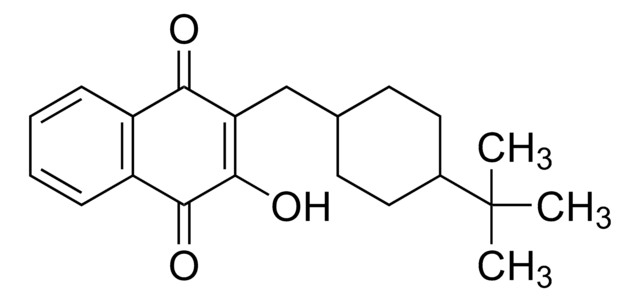
OC1=C([C@H]2CC[C@@H](CC2)c3ccc(Cl)cc3)C(=O)c4ccccc4C1=O

InChI

1S/C22H19ClO3/c23-16-11-9-14(10-12-16)13-5-7-15(8-6-13)19-20(24)17-3-1-2-4-18(17)21(25)22(19)26/h1-4,9-13,15,26H,5-8H2/t13-,15-

Looking for similar products? Visit Product Comparison Guide

Compare Similar Items

View Full Comparison

Show Differences

1 of 1

This Item
SML1662SML1337SML1804
form

powder

form

powder

form

powder

form

powder

assay

≥98% (HPLC)

assay

≥98% (HPLC)

assay

≥98% (HPLC)

assay

≥98% (HPLC)

Quality Level

100

Quality Level

200

Quality Level

100

Quality Level

100

storage temp.

−20°C

storage temp.

2-8°C

storage temp.

2-8°C

storage temp.

2-8°C

solubility

DMSO: >10 mg/mL

solubility

DMSO: soluble, chloroform: soluble

solubility

DMSO: 10 mg/mL, clear

solubility

DMSO: 2 mg/mL, clear (warmed)

color

yellow

color

-

color

, faint red to dark red

color

white to brown

Application

Atovaquone inhibits the cytochrome bc(1) complex via interactions with the Rieske iron-sulfur protein and cytochrome b in the ubiquinol oxidation pocket. In addition to its use as a treatment for toxoplasmosis, atovaquone has antimalarial properties and prevents pneumocystis pneumonia post-renal transplant.

Biochem/physiol Actions

Atovaquone in an anti-protozoal mitochondrial electron transport inhibitor. It also functions as an antimalarial and antipneumocystic agent.
Atovaquone is an anti-protozoal mitochondrial electron transport inhibitor; Antimalarial; Antipneumocystic, and has also been used to treat toxoplasmosis. It is an analog of protozoan mitochondrial protein ubiquinone, and acts by inhibiting the cytochrome bc(1) complex via interactions with the Rieske iron-sulfur protein and cytochrome b in the ubiquinol oxidation pocket.

Features and Benefits

This compound was developed by GlaxoSmithKline. To browse the list of other pharma-developed compounds and Approved Drugs/Drug Candidates, click here.

Storage Class

11 - Combustible Solids

wgk

WGK 3

flash_point_f

Not applicable

flash_point_c

Not applicable


Choose from one of the most recent versions:

Certificates of Analysis (COA)

Lot/Batch Number

Don't see the Right Version?

If you require a particular version, you can look up a specific certificate by the Lot or Batch number.

Already Own This Product?

Find documentation for the products that you have recently purchased in the Document Library.

Visit the Document Library

Kai J Rogers et al.
Cell reports, 30(12), 4041-4051 (2020-03-27)
During the 2013-2016 Ebola virus (EBOV) epidemic, a significant number of patients admitted to Ebola treatment units were co-infected with Plasmodium falciparum, a predominant agent of malaria. However, there is no consensus on how malaria impacts EBOV infection. The effect
Steven Gabardi et al.
Clinical transplantation, 26(3), E184-E190 (2012-04-11)
Pneumocystis pneumonia (PCP) is associated with significant morbidity and mortality in renal transplant recipients (RTR). Trimethoprim-sulfamethoxazole (TMP-SMZ) is considered the prophylactic agent-of-choice. Some patients require an alternative owing to TMP-SMZ intolerance. This is the first evaluation of full-dose atovaquone vs.
Mikio Kimura et al.
Parasitology international, 61(3), 466-469 (2012-04-10)
Malaria remains an important health risk among travelers to tropical/subtropical regions. However, in Japan, only 2 antimalarials are licensed for clinical use - oral quinine and mefloquine. The Research Group on Chemotherapy of Tropical Diseases introduced atovaquone-proguanil in 1999, and
Zehua Song et al.
Biochimica et biophysica acta, 1847(12), 1487-1494 (2015-08-25)
The respiratory chain bc1 complex is central to mitochondrial bioenergetics and the target of antiprotozoals. We characterized a modified yeast bc1 complex that more closely resemble Plasmodium falciparum enzyme. The mutant version was generated by replacing ten cytochrome b Qo
Zehua Song et al.
Antimicrobial agents and chemotherapy, 59(7), 4053-4058 (2015-04-29)
The bc1 complex is central to mitochondrial bioenergetics and the target of the antimalarial drug atovaquone that binds in the quinol oxidation (Qo) site of the complex. Structural analysis has shown that the Qo site residue Y279 (Y268 in Plasmodium

Global Trade Item Number

SKUGTIN
A7986-10MG04061833390894
A7986-50MG04061833390900

Questions

Reviews

No rating value

Active Filters

Our team of scientists has experience in all areas of research including Life Science, Material Science, Chemical Synthesis, Chromatography, Analytical and many others.

Contact Technical Service