
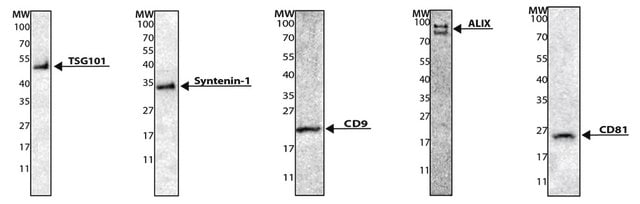
The requested information is available in the following reference: Geeurickx E, et al. The generation and use of recombinant extracellular vesicles as biological reference material. Nat Commun. 2019;10(1):3288.
SAE0193

Exosome standards, fluorescent
recombinant, expressed in human cells
Sinónimos:
Extracellular vesicles (EVs), Intraluminal vesicles (ILVs), Microvesicles, exosome-like vesicles
Iniciar sesión para ver los precios por organización y contrato.
Seleccione un Tamaño
Cambiar Vistas
| Tamaño de envase | SKU | Disponibilidad | Precio |
|---|
Acerca de este artículo
NACRES:
NA.24
UNSPSC Code:
41116100
En este momento no podemos mostrarle ni los precios ni la disponibilidad
Servicio técnico
¿Necesita ayuda? Nuestro equipo de científicos experimentados está aquí para ayudarle.
Permítanos ayudarlerecombinant
expressed in human cells
Quality Segment
assay
≥70% (fluorimetric)
form
solid
shipped in
dry ice
storage temp.
−70°C
General description
These recombinant EV express green fluorescent protein (GFP) on their membrane surface, making them fluorescent. Their fluorescence enables sensitive and differential trackability and thus allowing them to be used as a biological reference material, to be implemented in EV separation methods and measurement instruments. These recombinant EV share equivalent physicochemical and biochemical properties to sample EV. They may be used for quality control, data normalization, method development and accurate calibration of optical and nonoptical EV measurement.
Biochem/physiol Actions
Extracellular vesicles (Evs) are populations of cell-secreted membranous structures typically 30–150 nm in diameter.
In multicellular organisms, Evs are found in biological fluids and body tissues and involved in different physiological processes. They are also released to growth medium by cultured cells.
Evs carry markers of their cells of origin. Therefore there is a growing interest in clinical applications of EVs as biomarkers and therapies alike.
In multicellular organisms, Evs are found in biological fluids and body tissues and involved in different physiological processes. They are also released to growth medium by cultured cells.
Evs carry markers of their cells of origin. Therefore there is a growing interest in clinical applications of EVs as biomarkers and therapies alike.
Other Notes
Vial content: >= 1 x 10e9 particles
1 of 1
Este artículo | |||
|---|---|---|---|
| form solid | form liquid | form liquid | form liquid |
| assay ≥70% (fluorimetric) | assay - | assay - | assay - |
| recombinant expressed in human cells | recombinant expressed in HEK 293 cells | recombinant expressed in HEK 293 cells | recombinant expressed in HEK 293 cells |
| storage temp. −70°C | storage temp. −70°C | storage temp. −70°C | storage temp. −70°C |
| Quality Level 200 | Quality Level - | Quality Level - | Quality Level - |
| shipped in dry ice | shipped in dry ice | shipped in dry ice | shipped in dry ice |
Clase de almacenamiento
11 - Combustible Solids
wgk
WGK 1
Elija entre una de las versiones más recientes:
¿Ya tiene este producto?
Encuentre la documentación para los productos que ha comprado recientemente en la Biblioteca de documentos.
Contenido relacionado
-
Could you please supply the exact sequence of GFP (plasmid) - best as a UniProt ID that was used to transfect HEK293T?
1 answer-
Helpful?
-
-
What is the purity of the samples? Are there any lipid particle contaminants? (any particles with phosphatidylserine besides the EV's themselves) - was FBS used in the medium culture of the cell line?
1 answer-
For Product No. SAE0193, Exosome Standards, the purity can be found on the Certificate of Analysis as % Fluorescence. Unfortunately, this product is not tested for impurities. The initial growth medium of HEK293T cells contains FBS, but in the next stages, it changes to a medium without FBS.
Please navigate to the DOCUMENTATION section of the Product Detail Page to access a Certificate under ‘Certificate of Analysis’:https://www.sigmaaldrich.com/product/sigma/sae0193#product-documentation
Helpful?
-
-
How is the GFP expressed at the exosomes' surface?
1 answer-
The mechanism of expression of GFP at the exosome surface is currently not available. The public data sheet describes that the exosomes express the fluorescent protein GFP on the surface of their membrane, to allow their detection by instruments equipped with green fluorescence detectors, e.g. 488 nm laser. Please see the link below to review the product datasheet:
https://www.sigmaaldrich.com/deepweb/assets/sigmaaldrich/product/documents/351/804/sae0193pis-ms.pdf
In addition, the following references may also be of interest:
Extracellular vesicles: exosomes, microparticles, their parts, and their targets to enable their biomanufacturing and clinical applications
https://www.sciencedirect.com/science/article/pii/S095816691830140X?via%3DihubShedding light on the cell biology of extracellular vesicles
https://pubmed.ncbi.nlm.nih.gov/29339798/The biology and function of exosomes in cancer
https://www.ncbi.nlm.nih.gov/pmc/articles/PMC4811149/EV-TRACK: transparent reporting and centralizing knowledge in extracellular vesicle research
https://www.nature.com/articles/nmeth.4185The generation and use of recombinant extracellular vesicles as biological reference material
https://www.nature.com/articles/s41467-019-11182-0Helpful?
-
-
How is the particle number measured and is there any reference we can look into?
1 answer-
The size distribution of recombinant exosomes are measured by nanoparticle tracking analysis. Please see the product data sheet: https://www.sigmaaldrich.com/deepweb/assets/sigmaaldrich/product/documents/351/804/sae0193pis-ms.pdf
Helpful?
-
-
Hello ! How long do you think this product (powder) can hold at -20°C ? Will it last for a month or a week ? Thanks !
1 answer-
We have no information regarding stability at -20deg C. We know that working solutions can be stored at 2-4 deg C for one day.
Helpful?
-