


As indicated above, under 'Physical form': Suspension in 3.2 M (NH4)2SO4, pH 8
E2884

Esterase from porcine liver
ammonium sulfate suspension, ≥150 units/mg protein (biuret)
Synonym(s):
Carboxyl esterase, Carboxylic-ester hydrolase, PLE
Sign In to View Organizational & Contract Pricing.
Select a Size
Change View
| Pack Size | SKU | Availability | Price |
|---|
About This Item
CAS Number:
UNSPSC Code:
12352204
NACRES:
NA.54
MDL number:
Specific activity:
≥150 units/mg protein (biuret)
Biological source:
Porcine liver
Pricing and availability is not currently available.
biological source
Porcine liver
Quality Segment
form
ammonium sulfate suspension
specific activity
≥150 units/mg protein (biuret)
mol wt
168 kDa
storage temp.
2-8°C
General description
Esterase, also known as carboxyl ester hydrolase is a member of the hydrolase superfamily of enzymes.
Application
Porcine liver esterase is used to catalyze the hydrolysis of pentaacetyl catechin and epicatechin for use in pharmaceutical and industrial applications.
Pig liver esterase is commonly used for kinetic resolutions and assymetric synthesis in organic chemistry.
Pig liver esterase is commonly used for kinetic resolutions and assymetric synthesis in organic chemistry.
The enzyme from Sigma has been used to develop an alternative gel-based protocol for screening for bead-bound catalytic activity in aqueous media.[1] The product has also been used to investigate the properties of the compound L-valine-3-{8-[(E)-2-[3-methoxyphenyl)ethenyl]-7-methyl-1-propargylxanthine-3-yl}propyl ester hydrochloride (MSX-4, an aminoacid ester prodrug of the adenosine A2A receptor antagonist MSX-2).[2]
Esterase from porcine liver has been used to unmask the fluorescence in ultraviolet-visible spectroscopy.
Biochem/physiol Actions
Esterase acts on water-soluble carboxyl esters containing short chain fatty acids. Its functionality is attributed to the catalytic triad of Ser, His and Asp/Glu.
Pig liver esterase catalyzes enantioselective conversion of an ester to a carboxylic acid. The molecular weight is found to be 168 kDa. It is a serine enzyme with two active sites on each molecule, which dissociates into active half-molecules in the presence of dilute acid or concentrated salts.[3]
Esterase enzyme of bacteria and fungi seems to have several industrial applications. It is capable of catalyzing the hydrolysis and synthesis of ester bonds.
Physical form
Suspension in 3.2 M (NH4)2SO4, pH 8
Other Notes
One unit will hydrolyze 1.0 μmole of ethyl butyrate to butyric acid and ethanol per min at pH 8.0 at 25 °C.
1 of 1
This Item | |||
|---|---|---|---|
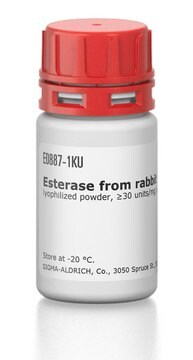
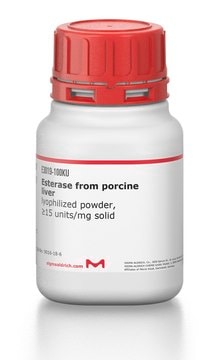
| specific activity ≥150 units/mg protein (biuret) | specific activity ≥30 units/mg protein | specific activity ≥50 U/mg | specific activity ≥15 units/mg solid |
| biological source Porcine liver | biological source - | biological source Porcine liver | biological source - |
| form ammonium sulfate suspension | form lyophilized powder | form lyophilized solid, powder | form lyophilized powder |
| storage temp. 2-8°C | storage temp. −20°C | storage temp. −20°C | storage temp. −20°C |
| mol wt 168 kDa | mol wt 60 kDa | mol wt Mr ~162000 | mol wt 168 kDa |
| Quality Level 300 | Quality Level 200 | Quality Level 100 | Quality Level 300 |
Still not finding the right product?
Explore all of our products under Esterase from porcine liver
Storage Class
12 - Non Combustible Liquids
wgk
WGK 1
flash_point_f
Not applicable
flash_point_c
Not applicable
ppe
Eyeshields, Gloves, multi-purpose combination respirator cartridge (US)
Choose from one of the most recent versions:
Already Own This Product?
Find documentation for the products that you have recently purchased in the Document Library.
Related Content
Global Trade Item Number
| SKU | GTIN |
|---|---|
| E2884-20KU | 04061833602980 |
| E2884-200UN | 04061832755564 |
| E2884-1KU | 04061833602973 |
| E2884-5KU | 04061832755588 |
-
What is the concentration of ammonium sulfate?
1 answer-
Helpful?
-