


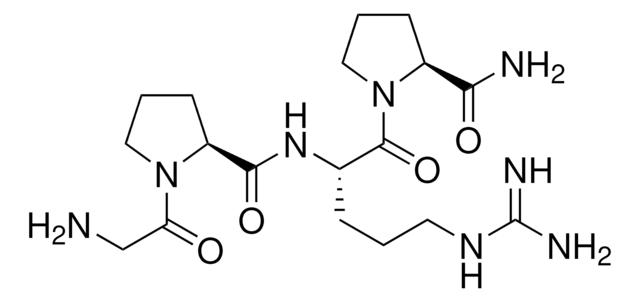
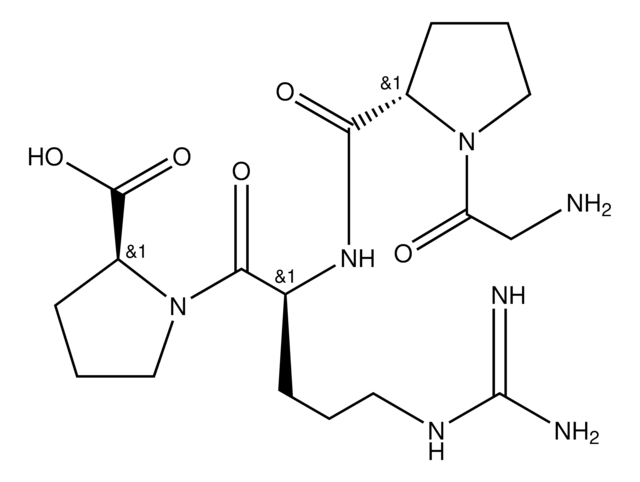
This product is soluble in water (20 to 50 mg/ml) and in 0.1 N acetic acid (20 mg/ml). The filter used was CA (cellulose acetate, PES, Nylon, and PVDF). It is recommended to use low protein binding filter. Here are the protein binding characteristics for syringe filter materials:
A8052

Arg-Gly-Asp
≥97% (TLC)
Synonym(s):
L-arginyl-glycyl-L-aspartic acid
Sign In to View Organizational & Contract Pricing.
Select a Size
Change View
| Pack Size | SKU | Availability | Price |
|---|
About This Item
Empirical Formula (Hill Notation):
C12H22N6O6
CAS Number:
Molecular Weight:
346.34
NACRES:
NA.32
PubChem Substance ID:
UNSPSC Code:
12352209
MDL number:
Form:
powder
Assay:
≥97% (TLC)
Biological source:
synthetic
Pricing and availability is not currently available.
biological source
synthetic
Quality Level
assay
≥97% (TLC)
form
powder
technique(s)
cell culture | stem cell: suitable
UniProt accession no.
storage temp.
−20°C
SMILES string
N[C@@H](CCCNC(N)=N)C(=O)NCC(=O)N[C@@H](CC(O)=O)C(O)=O
InChI
1S/C12H22N6O6/c13-6(2-1-3-16-12(14)15)10(22)17-5-8(19)18-7(11(23)24)4-9(20)21/h6-7H,1-5,13H2,(H,17,22)(H,18,19)(H,20,21)(H,23,24)(H4,14,15,16)/t6-,7-/m0/s1
InChI key
IYMAXBFPHPZYIK-BQBZGAKWSA-N
Gene Information
human ... FN1(2335)
General description
Arg-Gly-Asp (RGD) is an integrin binding site, which belongs to the class of adhesive proteins. It functions as a brain tumor targeting ligand.
Application
Arg-Gly-Asp has been used:
- to saturate the cell surface Arg-Gly-Asp (RGD) receptors and inhibit marrow stromal cell (MSC) attachment to peptide modified hydrogel
- in adhesion assay
- in inhibition assay to confirm the β1-integrin-dependency of cell adhesion
- in textile fabrication and RGD textile functionalization
- to engineer a population of human dermal fibroblasts with impaired migration
- to modify glass substrate and evaluate the behavior of human bone marrow mesenchymal stem cells (hBM-MSCs)
- in the cell culture of human mammary epithelial cells
Biochem/physiol Actions
Primary sequence involved with the binding of proteins to cell surfaces
Packaging
Bottomless glass bottle. Contents are inside inserted fused cone.
Preparation Note
Tripeptide from the cell-attachment domain of fibronectin
1 of 1
This Item | |||
|---|---|---|---|
| biological source synthetic | biological source synthetic (organic | biological source - | biological source - |
| technique(s) cell culture | stem cell: suitable | technique(s) - | technique(s) - | technique(s) - |
| assay ≥97% (TLC) | assay ≥97% (HPLC) | assay ≥97% (HPLC) | assay ≥95% (HPLC) |
| form powder | form powder | form - | form - |
| Gene Information human ... FN1(2335) | Gene Information human ... FN1(2335) | Gene Information human ... FN1(2335) | Gene Information human ... FN1(2335) |
| storage temp. −20°C | storage temp. −20°C | storage temp. −20°C | storage temp. −20°C |
Storage Class
11 - Combustible Solids
wgk
WGK 3
flash_point_f
Not applicable
flash_point_c
Not applicable
ppe
Eyeshields, Gloves, type N95 (US)
Choose from one of the most recent versions:
Already Own This Product?
Find documentation for the products that you have recently purchased in the Document Library.
Related Content
Functional role of Arg-Gly-Asp (RGD)-binding sites on beta1 integrin in embryo implantation using mouse blastocysts and human decidua
Shiokawa S, et al.
Biology of Reproduction, 60(6), 1468-1474 (1999)
Bio-active molecules modified surfaces enhanced mesenchymal stem cell adhesion and proliferation
Mobasseri R, et al.
Biochemical and biophysical research communications, 483(1), 312-317 (2017)
Cell attachment to thrombospondin: the role of ARG-GLY-ASP, calcium, and integrin receptors.
Lawler J, et al.
The Journal of cell biology, 107(6), 2351-2361 (1988)
Global Trade Item Number
| SKU | GTIN |
|---|---|
| A8052-5MG | 04061833391099 |
| A8052-1MG | 04061826671061 |
| A8052-10MG | 04061833391082 |
-
Can this peptide be filtered through a 0.2 um filter?
1 answer-
Helpful?
-
-
Stability of RGD in DNAase-free water and stored at -80 up to what time it remain stable?
1 answer-
The solution stability of this product has not been evaluated. Several commercial sources have reported that RGD peptides are stable up to 3 months at 4 deg. C. Other sources note that solutions are only stable for 24 hours. No information is available on storage at -80 C. The solution storage of this product would have to be determined by the end user.
Helpful?
-