
E5144

Enterokinase from bovine intestine
powder
Synonym(s):
Enteropeptidase
Sign In to View Organizational & Contract Pricing.
Select a Size
Change View
| Pack Size | SKU | Availability | Price |
|---|
About This Item
CAS Number:
UNSPSC Code:
12352204
eCl@ss:
32160410
EC Number:
232-761-1
NACRES:
NA.56
MDL number:
Biological source:
bovine intestine
Pricing and availability is not currently available.
biological source
bovine intestine
Quality Level
form
powder
mol wt
150 kDa (consisting of 115kDa and 35kDa subunits.)
color
white
shipped in
dry ice
storage temp.
−20°C
General description
Enterokinase also referred to as enteropeptidase, is a transmembrane protein. This intestinal protease contains a heavy chain and a light chain linked by a disulfide bond. The amino-terminal sequence of the bovine enteropeptidase is homologous to trypsin-like serine proteases.[1] Enterokinase is a highly specific serine protease that is used for the removal of the FLAG peptide from N-terminal and Met-N-terminal fusion proteins. It does not remove the C-terminal FLAG.
Application
Enterokinase from bovine intestine has been used to remove S-Tag and N-terminal His-tag from recombinant glutathione peroxidase 1 (Gpx1).[2] It has also been used to cleave interleukin-2 (IL-2) protein from the granules[3]
Enterokinase is a member of the S1 peptidase family. In vivo, it is responsble for the proteolytic activation of trypsin from trypsinogen. Enterokinase is used for site specific cleavage of recombinant fusion proteins containing an accessible enterokinase recognition site for removal of affinity tags.
Biochem/physiol Actions
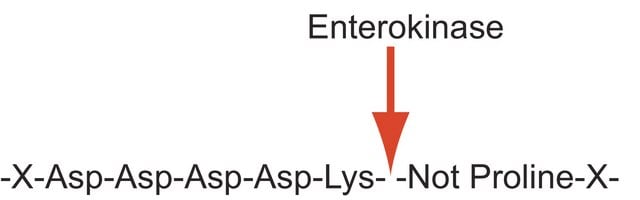
Enterokinase catalyzes the proteolytic activation of pancreatic proteases. This action prevents the harmful tissue damage produced by the autoactivation of pancreatic proteases in the pancreas. Enterokinase recognizes Lys or Arg residues in the peptide. Lack of enterokinase can harm food digestion and absorption mechanism.[1] Enterokinase is a highly specific serine protease that is used for the removal of the FLAG peptide from N-terminal and Met-N-terminal fusion proteins. It does not remove the C-terminal FLAG.[2]
Packaging
Supplied with optimized enterokinase buffer
Other Notes
Do not used PVDF since free FLAG peptide will bind to the PVDF membrane.
One unit is that amount of enterokinase which results in >95% cleavage of 1 µg of purified FLAG-BAP fusion protein in 18 hours at 37 °C. One FLAG-BAP unit is equal to 10x the activity of a standard trypsinogen unit.
1 of 1
This Item | |||
|---|---|---|---|
| biological source bovine intestine | biological source - | biological source - | biological source human |
| form powder | form lyophilized powder | form salt-free, lyophilized powder | form lyophilized |
| mol wt 150 kDa (consisting of 115kDa and 35kDa subunits.) | mol wt 150 kDa | mol wt 150 kDa | mol wt 108.7 kDa |
| storage temp. −20°C | storage temp. −20°C | storage temp. −20°C | storage temp. −20°C |
| shipped in dry ice | shipped in - | shipped in - | shipped in wet ice |
| Quality Level 200 | Quality Level 200 | Quality Level 200 | Quality Level - |

wgk
WGK 3
Storage Class
11 - Combustible Solids
flash_point_f
Not applicable
flash_point_c
Not applicable
ppe
Eyeshields, Gloves, type N95 (US)
Choose from one of the most recent versions:
Already Own This Product?
Find documentation for the products that you have recently purchased in the Document Library.
Related Content
Instructions
B Thomas Bäckström et al.
BMC biotechnology, 7, 3-3 (2007-01-06)
Fluorescence activated cell sorting (FACS) is a powerful technique for the qualitative and quantitative detection of biomolecules used widely in both basic research and clinical diagnostic applications. Beads displaying a specific antigen are used to bind antibodies which are then
Toni M Antalis et al.
Progress in molecular biology and translational science, 99, 1-50 (2011-01-18)
Serine proteases of the trypsin-like family have long been recognized to be critical effectors of biological processes as diverse as digestion, blood coagulation, fibrinolysis, and immunity. In recent years, a subgroup of these enzymes has been identified that are anchored
Thomas Zauner et al.
Analytical chemistry, 83(19), 7356-7363 (2011-09-07)
Proteases are widely used in analytical sciences and play a central role in several widespread diseases. Thus, there is an immense need for highly adaptable and sensitive assays for the detection and monitoring of various proteolytic enzymes. We established a
Global Trade Item Number
| SKU | GTIN |
|---|---|
| E5144-50UN | 04061835572939 |