
B0271

Monoclonal Anti-β-Galactosidase−Biotin Conjugate antibody produced in mouse
clone GAL-13, purified immunoglobulin, buffered aqueous solution
Synonym(s):
Monoclonal Anti-β-Galactosidase
Sign In to View Organizational & Contract Pricing.
Select a Size
Change View
| Pack Size | SKU | Availability | Price |
|---|
About This Item
NACRES:
NA.46
UNSPSC Code:
12352203
Conjugate:
biotin conjugate
Clone:
GAL-13, monoclonal
Application:
DB
Citations:
7
Pricing and availability is not currently available.
biological source
mouse
Quality Level
conjugate
biotin conjugate
antibody form
purified immunoglobulin
antibody product type
primary antibodies
clone
GAL-13, monoclonal
form
buffered aqueous solution
species reactivity
bacteria
technique(s)
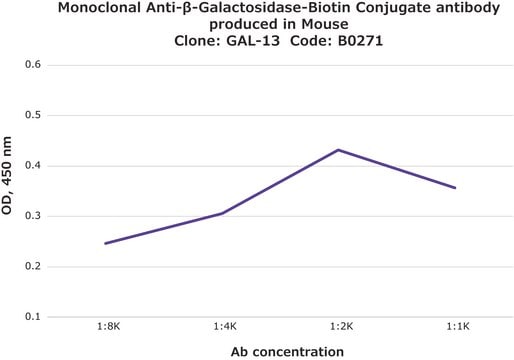
dot blot: 1:2,000
isotype
IgG1
shipped in
dry ice
storage temp.
−20°C
target post-translational modification
unmodified
General description
Monoclonal Anti-b-Galactosidase (mouse IgG1 isotype) is derived from the hybridoma produced by the fusion of mouse myeloma cells and splenocytes from an immunized mouse. β-Galactosidase enzyme is encoded by lacZ gene of E. coli.
Immunogen
β-galactosidase from E. coli
Application
Monoclonal Anti-β-Galactosidase-Biotin Conjugate antibody produced in mouse may be used with ExtrAvidin-Peroxidase in the dot blot technique on native, purified, or crude β-galactosidase. The antibody was used to detect β-galactosidase by immunofluorescence in paraffin-embedded adult mouse kidney sections. It was used in ELISPOT assays at a dilution of 1:1000.
Biochem/physiol Actions
β-galactosidase enzyme is encoded by lacZ gene of E. coli; it acts on lactose and cleaves it to glucose and galactose. Monoclonal Anti-β-Galactosidase-Biotin Conjugate antibody binds with soluble enzyme even when bound to a surface without causing any loss of enzymatic activity. It is used as readout for promoter activity in lacZ transfected cells.
The antibody may be used for amplification in immunoenzymatic staining by preparing a β-galactosidase anti-β-galactosidase (BGABG) soluble complex. It is not recommended for immunoblotting; it does not recognize denatured or reduced β-galactosidase.
Physical form
Solution in 0.01 M phosphate buffered saline, pH 7.4, containing 1% BSA and 15 mM sodium azide.
Preparation Note
Prepared by conjugation with ε-aminocaproyl biotin.
Disclaimer
Unless otherwise stated in our catalog or other company documentation accompanying the product(s), our products are intended for research use only and are not to be used for any other purpose, which includes but is not limited to, unauthorized commercial uses, in vitro diagnostic uses, ex vivo or in vivo therapeutic uses or any type of consumption or application to humans or animals.
1 of 1
This Item | |||
|---|---|---|---|
| biological source mouse | biological source mouse | biological source mouse | biological source mouse |
| conjugate biotin conjugate | conjugate unconjugated | conjugate biotin conjugate | conjugate unconjugated |
| species reactivity bacteria | species reactivity bacteria | species reactivity - | species reactivity - |
| clone GAL-13, monoclonal | clone GAL-40, monoclonal | clone FL-D6, monoclonal | clone DI-22, monoclonal |
| antibody form purified immunoglobulin | antibody form ascites fluid | antibody form purified immunoglobulin | antibody form ascites fluid |
| Quality Level 200 | Quality Level 200 | Quality Level 200 | Quality Level 200 |


Still not finding the right product?
Try our Product Selector Tool to narrow your options
Storage Class
10 - Combustible liquids
flash_point_f
Not applicable
flash_point_c
Not applicable
Choose from one of the most recent versions:
Already Own This Product?
Find documentation for the products that you have recently purchased in the Document Library.
G M Weinstock et al.
Proceedings of the National Academy of Sciences of the United States of America, 80(14), 4432-4436 (1983-07-01)
We have developed an Escherichia coli plasmid vector for the identification and expression of foreign DNA segments that are open reading frames (ORFs). The 5' end of ompF, an E. coli gene encoding an abundant outer membrane protein, is used
U Rüther et al.
The EMBO journal, 2(10), 1791-1794 (1983-01-01)
A set of six cloning vectors, pUR 278, 288, 289, 290, 291, 292 is presented. These vectors have the cloning sites, BamHI, SalI, PstI, XbaI and HindIII, in all frames at the 3' end of the lacZ gene. Insertion of
A Roth et al.
The EMBO journal, 14(9), 2106-2111 (1995-05-01)
The 94 C-terminal amino acids of the initiator protein DnaA of Escherichia coli are required and sufficient for specific binding to the cognate DNA binding site. The binding domain contains two potential amphipathic alpha-helices and a third alpha-helix. It represents
Global Trade Item Number
| SKU | GTIN |
|---|---|
| B0271-.2ML | 04061837856280 |