Skip to Content
Merck

Skip To

A2612

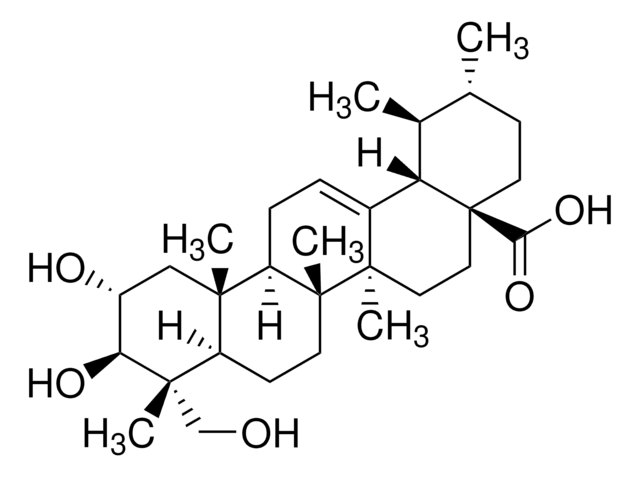
Asiatic acid

≥98% (HPLC), from Centella asiatica

Synonym(s):

2α,23-Dihydroxyursolic acid, Dammarolic acid, NSC 166063

Sign In to View Organizational & Contract Pricing.

Select a Size

Change View
Pack SizeSKUAvailabilityPrice

About This Item

Empirical Formula (Hill Notation):
C30H48O5
CAS Number:
Molecular Weight:
488.70
NACRES:
NA.25
PubChem Substance ID:
UNSPSC Code:
12352212
EC Number:
482-720-9
MDL number:
Pricing and availability is not currently available.
Technical Service
Need help? Our team of experienced scientists is here for you.
Let Us Assist


biological source

Centella asiatica

Quality Segment

assay

≥98% (HPLC)

form

powder

storage condition

protect from light

color

white

mp

325-330 °C (lit.)

solubility

methanol: 1 mg/mL, clear, colorless

application(s)

metabolomics
vitamins, nutraceuticals, and natural products

storage temp.

2-8°C

SMILES string

C[C@@H]1CC[C@@]2(CC[C@]3(C)C(=CC[C@@H]4[C@@]5(C)C[C@@H](O)[C@H](O)[C@@](C)(CO)[C@@H]5CC[C@@]34C)[C@@H]2[C@H]1C)C(O)=O

InChI

1S/C30H48O5/c1-17-9-12-30(25(34)35)14-13-28(5)19(23(30)18(17)2)7-8-22-26(3)15-20(32)24(33)27(4,16-31)21(26)10-11-29(22,28)6/h7,17-18,20-24,31-33H,8-16H2,1-6H3,(H,34,35)/t17-,18+,20-,21-,22-,23+,24+,26+,27+,28-,29-,30+/m1/s1

InChI key

JXSVIVRDWWRQRT-UYDOISQJSA-N

General description

Asiatic acid is a naturally occurring pentacyclic triterpenoid, obtained from Centella asiatica.[1]

Application

Starting material for asiatic acid derivative synthesis for use as:
  • Anticancer agents
  • Glycogen phosphorylase inhibitors
  • Hepatoprotectants
Asiatic acid has been used in the in vitro study of its cytotoxic potential in glioblastoma cells[1]. It has also been used for the in vivo quantitative analysis of asiatic acid in Centella asiatica L. and in vitro study of enhancement of asiatic acid yield upon using organic elicitors.

Biochem/physiol Actions

Asiatic acid has been reported to exhibit a pernicious effect on glioblastoma, breast, liver, melanoma, and colon cancers and anti-angiogenic activity. Additionally, it can cross the blood-brain barrier and cause apoptosis in human malignant glioma and hepatoma cells.[1][2] Asiatic acid also effectively inhibits the Ultraviolet A modulated signal transduction pathways and thereby can be used against UVA-induced photoaging of the skin.[3] It has been noted to show antinociceptive and anti-inflammatory properties plus inhibitory effect on neurotoxicity induced by β-amyloid and glutamate.[4]
Asiatic acid is commonly used in wound healing. Asiatic acid has antioxidant, anti-inflammatory and neuroprotective properties.

Compare Similar Items

View Full Comparison

Show Differences

1 of 1

This Item
546712PHL89569M6699
assay

≥98% (HPLC)

assay

97%

assay

≥90.0% (HPLC)

assay

≥98% (HPLC)

form

powder

form

-

form

powder

form

powder

biological source

Centella asiatica

biological source

-

biological source

-

biological source

-

Quality Level

200

Quality Level

100

Quality Level

-

Quality Level

200

application(s)

metabolomics
vitamins, nutraceuticals, and natural products

application(s)

-

application(s)

-

application(s)

metabolomics
vitamins, nutraceuticals, and natural products

storage temp.

2-8°C

storage temp.

-

storage temp.

-

storage temp.

2-8°C


Still not finding the right product?

Explore all of our products under Asiatic acid


Storage Class

11 - Combustible Solids

flash_point_f

Not applicable

flash_point_c

Not applicable


Choose from one of the most recent versions:

Certificates of Analysis (COA)

Lot/Batch Number

Don't see the Right Version?

If you require a particular version, you can look up a specific certificate by the Lot or Batch number.

Already Own This Product?

Find documentation for the products that you have recently purchased in the Document Library.

Visit the Document Library


Quantification of asiatic acid from plant parts of Centella asiatica L. and enhancement of its synthesis through organic elicitors in in vitro
Mohammadparast B, et al.,
Horticulture, Environment, and Biotechnology, 55(6), 578-582 (2014)
Byung Chul Park et al.
Cancer letters, 218(1), 81-90 (2005-01-11)
Asiatic acid (AA) is a pentacyclic triterpene found in Centella asiatica. In the present study, the mechanism of anticancer effect of AA on skin cancer was investigated. AA decreased viability and induced apoptosis in human melanoma SK-MEL-2 cells in a
Flourina Kumar Thakor et al.
Molecular and cellular biochemistry, 430(1-2), 179-190 (2017-02-17)
Glioblastoma multiforme is the most common and malignant primary brain tumor in adults. Despite current treatment options including surgery followed by radiation and chemotherapy with temozolomide and cisplatin, the median survival rate remains low (<16 months). Combined with increasing drug


Global Trade Item Number

SKUGTIN
A2612-10MG04061833359402
A2612-50MG04061833046814

Questions

Reviews

No rating value

Active Filters