

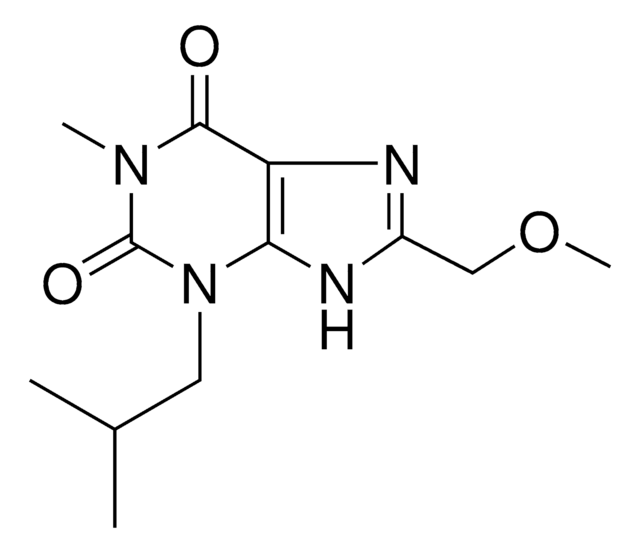


This product may be stored at room temperature.
C101

8-Cyclopentyl-1,3-dipropylxanthine
A1 adenosine receptor antagonist, solid
Synonym(s):
1,3-Dipropyl-8-cyclopentylxanthine, DPCPX, PD 116,948
Sign In to View Organizational & Contract Pricing.
Select a Size
Change View
| Pack Size | SKU | Availability | Price |
|---|
About This Item
Empirical Formula (Hill Notation):
C16H24N4O2
CAS Number:
Molecular Weight:
304.39
UNSPSC Code:
12352202
PubChem Substance ID:
NACRES:
NA.77
MDL number:
Form:
solid
Quality level:
Pricing and availability is not currently available.
Product Name
8-Cyclopentyl-1,3-dipropylxanthine, solid
form
solid
Quality Level
color
white
solubility
DMSO: >10 mg/mL, 0.1 M NaOH: 2 mg/mL, ethanol: 4 mg/mL, H2O: insoluble
εmax
14,800 at 276 nm in ethanol
SMILES string
CCCN1C(=O)N(CCC)c2nc([nH]c2C1=O)C3CCCC3
InChI
1S/C16H24N4O2/c1-3-9-19-14-12(15(21)20(10-4-2)16(19)22)17-13(18-14)11-7-5-6-8-11/h11H,3-10H2,1-2H3,(H,17,18)
InChI key
FFBDFADSZUINTG-UHFFFAOYSA-N
Gene Information
human ... ADORA1(134), ADORA2A(135), ADORA2B(136), ADORA3(140)
rat ... Adora1(29290), Adora2a(25369), Adora2b(29316), Adora3(25370)
Application
Biochem/physiol Actions
Features and Benefits
This compound is featured on the Adenosine Receptors page of the Handbook of Receptor Classification and Signal Transduction. To browse other handbook pages, click here.
1 of 1
This Item | |||
|---|---|---|---|
| form solid | form solid | form solid | form powder |
| Quality Level 100 | Quality Level 200 | Quality Level 100 | Quality Level 100 |
| solubility DMSO: >10 mg/mL, ethanol: 4 mg/mL, H2O: insoluble, 0.1 M NaOH: 2 mg/mL | solubility ethanol: 10 mg/mL | solubility ethanol: 2 mg/mL, DMSO: 5 mg/mL | solubility H2O: slightly soluble <0.28 mg/mL, 45% (w/v) aq 2-hydroxypropyl-β-cyclodextrin: 0.77 mg/mL, DMSO: ~16 mg/mL at 60 °C, 0.1 M NaOH: soluble |
| color white | color - | color white | color white to off-white |
| Gene Information human ... ADORA1(134), ADORA2A(135), ADORA2B(136), ADORA3(140) | Gene Information human ... PDE1A(5136), PDE1B(5153) | Gene Information - | Gene Information human ... ADORA1(134) |
| εmax 14,800 at 276 nm in ethanol | εmax - | εmax - | εmax - |
signalword
Warning
hcodes
Hazard Classifications
Eye Irrit. 2 - Skin Irrit. 2 - STOT SE 3
target_organs
Respiratory system
Storage Class
11 - Combustible Solids
wgk
WGK 3
flash_point_f
Not applicable
flash_point_c
Not applicable
ppe
dust mask type N95 (US), Eyeshields, Gloves
Choose from one of the most recent versions:
Already Own This Product?
Find documentation for the products that you have recently purchased in the Document Library.
Lindsay Silva et al.
Neurotoxicology and teratology, 58, 88-100 (2016-02-24)
Adolescents who use marijuana are more likely to exhibit anxiety, depression, and other mood disorders, including psychotic-like symptoms. Additionally, the age at onset of use and the stress history of the individual can affect responses to cannabis. To examine the
Daniela Patinha et al.
American journal of physiology. Renal physiology, 304(5), F614-F622 (2013-01-04)
Increased angiotensin II (ANG II) or adenosine can potentiate each other in the regulation of renal hemodynamics and tubular function. Diabetes is characterized by hyperfiltration, yet the roles of ANG II and adenosine receptors for controlling baseline renal blood flow
Flavia Varano et al.
Journal of medicinal chemistry, 59(23), 10564-10576 (2016-12-10)
In this study, we describe the design and synthesis of new N5-substituted-2-(2-furanyl) thiazolo[5,4-d]pyrimidine-5,7-diamines (2-18) and their pharmacological characterization as A2A adenosine receptor (AR) antagonists by using in vitro and in vivo assays. In competition binding experiments two derivatives (13 and
Global Trade Item Number
| SKU | GTIN |
|---|---|
| 791423-250MG | 04061832939445 |
| C101-25MG | 04061833460269 |
| C101-25G | 04061832283579 |
| C101-100MG | 04061832089508 |
-
Qual a temperatura de armazenamento do C101?
1 answer-
Helpful?
-