Skip to Content
Merck

Skip To

C8145

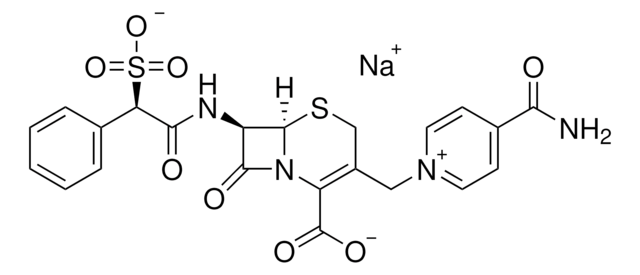
Cefsulodin sodium salt hydrate

third-generation cephalosporin antibiotic

Synonym(s):

7-(D-α-Sulfophenylacetamido)ceph-3-em-3-(4′-carbamoylpyridinium)methyl-4-carboxylate sodium salt

Sign In to View Organizational & Contract Pricing.

Select a Size

Change View
Pack SizeSKUAvailabilityPrice

About This Item

Empirical Formula (Hill Notation):
C22H19N4NaO8S2 · xH2O
CAS Number:
Molecular Weight:
554.53 (anhydrous basis)
NACRES:
NA.85
PubChem Substance ID:
UNSPSC Code:
51284140
EC Number:
257-692-4
MDL number:
Pricing and availability is not currently available.
Technical Service
Need help? Our team of experienced scientists is here for you.
Let Us Assist


Quality Level

form

powder or crystals

antibiotic activity spectrum

Gram-negative bacteria, Gram-positive bacteria

mode of action

cell wall synthesis | interferes

storage temp.

2-8°C

SMILES string

[Na+].NC(=O)c1cc[n+](CC2=C(N3[C@H](SC2)[C@H](NC(=O)[C@@H](c4ccccc4)S([O-])(=O)=O)C3=O)C([O-])=O)cc1

InChI

1S/C22H20N4O8S2.Na/c23-18(27)13-6-8-25(9-7-13)10-14-11-35-21-15(20(29)26(21)16(14)22(30)31)24-19(28)17(36(32,33)34)12-4-2-1-3-5-12;/h1-9,15,17,21H,10-11H2,(H4-,23,24,27,28,30,31,32,33,34);/q;+1/p-1/t15-,17-,21-;/m1./s1

InChI key

REACMANCWHKJSM-DWBVFMGKSA-M

General description

Chemical structure: β-lactam

Application

Cefsulodin is a third generation cephalosporin antibiotic that has very specific activity against Pseudomonas aeruginosa. Cefuslodin is used in CIN (cefsulodin-Irgasan-novobiocin) agar to select for microorganisms such as E. coli. Cefsulodin is a substrate for rat Oatp1a4. It has been used to study multidrug resistance-associated protein 4 in efflux transport of prostaglandin E2 across the mouse blood-brain barrier[1].
Cefsulodin is used to study the effect of expression, binding, and inhibition of PBP1 and other penicillin-binding proteins (PBPs) on bacterial cell wall mucopeptide synthesis.

Biochem/physiol Actions

Cefsulodin is a cephalosporin. Cephalosporins disrupt cell wall synthesis by inhibiting PBP crosslinking of peptidoglycan.

Other Notes

Keep container tightly closed in a dry and well-ventilated place.

Compare Similar Items

View Full Comparison

Show Differences

1 of 1

This Item
C5020C5793C7912
antibiotic activity spectrum

Gram-negative bacteria, Gram-positive bacteria

antibiotic activity spectrum

Gram-negative bacteria, Gram-positive bacteria

antibiotic activity spectrum

Gram-negative bacteria, Gram-positive bacteria

antibiotic activity spectrum

Gram-negative bacteria, Gram-positive bacteria

Quality Level

200

Quality Level

200

Quality Level

200

Quality Level

200

form

powder or crystals

form

powder

form

powder or crystals

form

powder

storage temp.

2-8°C

storage temp.

2-8°C

storage temp.

2-8°C

storage temp.

2-8°C

mode of action

cell wall synthesis | interferes

mode of action

cell wall synthesis | interferes

mode of action

cell wall synthesis | interferes

mode of action

cell wall synthesis | interferes


Storage Class

11 - Combustible Solids

wgk

WGK 3

flash_point_f

Not applicable

flash_point_c

Not applicable

ppe

dust mask type N95 (US), Eyeshields, Faceshields, Gloves


Choose from one of the most recent versions:

Certificates of Analysis (COA)

Lot/Batch Number

Don't see the Right Version?

If you require a particular version, you can look up a specific certificate by the Lot or Batch number.

Already Own This Product?

Find documentation for the products that you have recently purchased in the Document Library.

Visit the Document Library


Danièle Joseleau-Petit et al.
Journal of bacteriology, 189(18), 6512-6520 (2007-06-26)
Growing bacterial L forms are reputed to lack peptidoglycan, although cell division is normally inseparable from septal peptidoglycan synthesis. To explore which cell division functions L forms use, we established a protocol for quantitatively converting a culture of a wild-type
A Lehmacher et al.
Applied and environmental microbiology, 64(7), 2449-2453 (1998-07-02)
The presence of a hemolysin-encoding gene, elyA or hlyA, from Shiga toxin-producing Escherichia coli (STEC) was detected by PCR in each of 95 strains tested. PCR products of elyA from human STEC isolates of serovars frequently detected in Germany, such
Bianca A Amézquita-López et al.
PloS one, 7(12), e51565-e51565 (2012-12-20)
Shiga toxin-producing Escherichia coli (STEC) are zoonotic enteric pathogens associated with human gastroenteritis worldwide. Cattle and small ruminants are important animal reservoirs of STEC. The present study investigated animal reservoirs for STEC in small rural farms in the Culiacan Valley


Global Trade Item Number

SKUGTIN
C8145-250MG04061833521861
C8145-100MG04061838820433
C8145-1G04061833521854

Questions

Reviews

No rating value

Active Filters