


Upon verification, this antibody has not been validated in flow cytometry to warrant an application recommendation. However, regarding flow cytometry, the following publication may be of interest: Elife. 2020 Aug 11;9:e57763. doi: 10.7554/eLife.57763. MARCH8 inhibits viral infection by two different mechanisms.
V5507

Monoclonal Anti-VSV Glycoprotein antibody produced in mouse
clone P5D4, ascites fluid
Synonym(s):
Monoclonal Anti-VSV Glycoprotein
Sign In to View Organizational & Contract Pricing.
Select a Size
Change View
| Pack Size | SKU | Availability | Price |
|---|
About This Item
NACRES:
NA.41
UNSPSC Code:
12352203
Conjugate:
unconjugated
Clone:
P5D4, monoclonal
Application:
ICC, IP, WB
Citations:
96
Pricing and availability is not currently available.
biological source
mouse
Quality Segment
conjugate
unconjugated
antibody form
ascites fluid
antibody product type
primary antibodies
clone
P5D4, monoclonal
contains
15 mM sodium azide
technique(s)
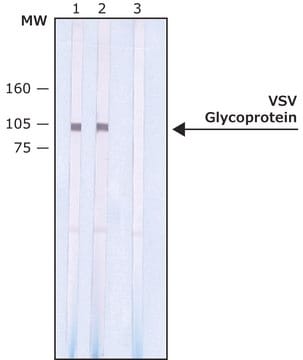
immunocytochemistry: suitable, immunoprecipitation (IP): suitable, western blot: 1:100,000 using whole cell extracts expressing VSV-G tagged fusion protein
isotype
IgG1
shipped in
dry ice
storage temp.
−20°C
target post-translational modification
unmodified
Immunogen
synthetic peptide containing the 15 carboxy-terminal amino acids (497-511) of Vesicular Stomatitis Virus Glycoprotein (VSV-G), conjugated to KLH.
Application
Applications in which this antibody has been used successfully, and the associated peer-reviewed papers, are given below.
Flow cytometry/Cell sorting (1 paper)
Flow cytometry/Cell sorting (1 paper)
Biochem/physiol Actions
The antibody recognizes an epitope containing the five carboxy-terminal amino acids of VSV Glycoprotein. In infected cells, the antibody localizes the immature forms of VSV-G in the rough endoplasmic reticulum (RER) and in the cisternae of Golgi complex, as well as mature VSV-G at the cell surface and in the budding virus. The antibody does not stain the secreted form of VSV-G which lacks the membrane and the cytoplasmic domain. This antibody has been used for studies on the role of the cytoplasmic domain on newly-synthesized VSV-G during transfer to the plasma membrane and cell surface, using micro-injected antibody, immunoblotting, immunoprecipitation, immunocytochemistry and immunoelectron microscopy. The antibody has been used for the detection, immunoprecipitation and immunocytochemical staining of exogenously introduced constructs tagged with the carboxyl-terminus of VSV-G. This tag does not interfere with the function of the studied protein and can be specifically recognized by the P5D4 antibody without cross-reaction with any endogenous protein.
Preparation Note
For continuous use, store at 2 °C to 8 °C for up to one month. For extended storage, freeze in working aliquots. Repeated freezing and thawing is not recommended. Storage in "frost-free" freezers is not recommended. If slight turbidity occurs upon prolonged storage, clarify the solution by centrifugation before use. Solutions at working dilution should be discarded if not used within 12 hours.
Disclaimer
Unless otherwise stated in our catalog or other company documentation accompanying the product(s), our products are intended for research use only and are not to be used for any other purpose, which includes but is not limited to, unauthorized commercial uses, in vitro diagnostic uses, ex vivo or in vivo therapeutic uses or any type of consumption or application to humans or animals.
1 of 1
This Item | |||
|---|---|---|---|
| conjugate unconjugated | conjugate unconjugated | conjugate - | conjugate agarose conjugate |
| biological source mouse | biological source mouse | biological source mouse | biological source mouse |
| clone P5D4, monoclonal | clone HIS-1, monoclonal | clone P5D4, monoclonal | clone P5D4, monoclonal |
| antibody form ascites fluid | antibody form ascites fluid | antibody form purified immunoglobulin | antibody form purified immunoglobulin |
| isotype IgG1 | isotype IgG2a | isotype IgG1 | isotype IgG1 |
| technique(s) immunocytochemistry: suitable, western blot: 1:100,000 using whole cell extracts expressing VSV-G tagged fusion protein, immunoprecipitation (IP): suitable | technique(s) dot blot: suitable, immunoprecipitation (IP): suitable, indirect ELISA: suitable, western blot: 1:3,000 using lysates of Escherichia coli induced to express a 6xHis tagged protein | technique(s) immunoblotting: 0.5-1 μg/mL using whole extract of human HEK-293T cells over-expressing Vinculin with VSV-G tagged fusion protein., immunocytochemistry: suitable, immunofluorescence: 5-10 μg/mL using COS7 cells over-expressing Vinculin with VSV-G tagged fusion protein., immunoprecipitation (IP): suitable | technique(s) immunoprecipitation (IP): suitable, protein purification: suitable |
Still not finding the right product?
Try our Product Selector Tool to narrow your options
Storage Class
10 - Combustible liquids
wgk
nwg
flash_point_f
Not applicable
flash_point_c
Not applicable
Choose from one of the most recent versions:
Already Own This Product?
Find documentation for the products that you have recently purchased in the Document Library.
Related Content
-
What is the working dilution of that antibody in flow cytometry? The link "Flow cytometry/Cell sorting (1 paper)" in the section "Application" doesn't work. Thank you in advance for your response.
1 answer-
Helpful?
-