
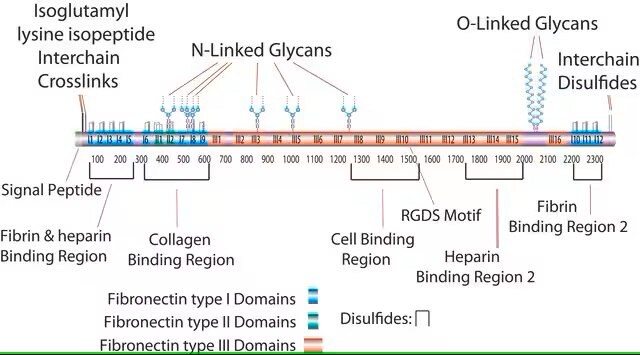


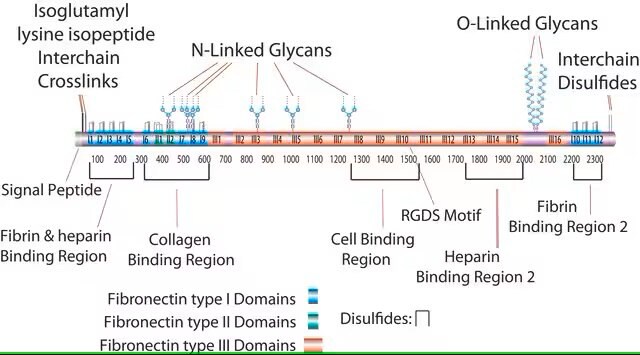
Human fibronectin is composed of two nearly identical disulfide bound peptides. Each has a molecular weight of 220 kDa for a combined total of 440 kDa.
F1056

Human Fibronectin
from human plasma, powder, suitable for cell culture
Synonym(s):
Fibronectin
Sign In to View Organizational & Contract Pricing.
Select a Size
Change View
| Pack Size | SKU | Availability | Price |
|---|
About This Item
Biological source:
human plasma
Form:
lyophilized powder
Technique(s):
cell culture | mammalian: suitable
Assay:
≥95% (SDS-PAGE)
Pricing and availability is not currently available.
Product Name
Fibronectin human plasma, lyophilized powder, BioReagent, suitable for cell culture, ≥95% (SDS-PAGE)
biological source
human plasma
Quality Level
sterility
sterile
product line
BioReagent
assay
≥95% (SDS-PAGE)
form
lyophilized powder
packaging
pkg of 1 mg, pkg of 2 mg, pkg of 5 mg
technique(s)
cell culture | mammalian: suitable
surface coverage
1‑5 μg/cm2
solubility
H2O: 1 mg/mL at 37 °C
UniProt accession no.
binding specificity
Peptide Source: Collagen
shipped in
dry ice
storage temp.
−20°C
Gene Information
human ... FN1(2335)
General description
Fibronectin is a class of high-molecular-weight adhesive glycoprotein, predominant in extracellular matrix (ECM) and is widely distributed in tissue and blood. The FN gene, which is highly conserved, gives rise to a minimum of 20 isoforms through alternative splicing in humans. These isoforms include notable variants such as cellular FN and plasma FN. Plasma FN is primarily synthesized in the liver, whereas cellular FN which represents only 5% of the circulating fibronectins is locally produced by various cell types.
Application
Biochem/physiol Actions
Fibronectin plays a major role in biological processes. It interacts with surface receptors and other major ECM proteins like collagen to mediate cellular signals. Fibronectin is involved in a variety of cellular functions, including adhesion, cytoskeletal organization, oncogenic transformation, cell migration, phagocytosis, hemostasis, and embryonic differentiation. This glycoprotein can bind to integrins, collagens, fibrins and glycosaminoglycans (GAGs). FN plays a crucial role in promoting cell cycle progression and proliferation. This interaction influences cyclins and immediate early response genes, contributing to cellular processes related to cell division and growth. FN is also involved in cell survival and protection from apoptosis in various cell types, including epithelial and endothelial cells and leukocytes. FN serves as a critical factor in promoting cell survival and preventing programmed cell death in these cellular contexts. Mutations in the FN gene are associated with FN glomerulopathy and spondylometaphyseal dysplasia. Fibronectin plays a significant role in the wound healing process, and in extracellular matrix (ECM) assembly, hence is considered suitable for tissue engineering applications.
Preparation Note
This product is lyophilized from 0.05 M Tris buffered saline at pH 7.5. It is soluble at 1 mg/mL in water, and should be allowed to dissolve for at least 30 minutes at 37°C. A small amount of undissolved material may remain, but it will not affect performance. The protein homogeneity is evaluated by immunoelectrophoresis, is endotoxin tested, and the source material was tested negative for HIV, hepatitis B and hepatitis C.
In coating culture surfaces, fibronectin should be diluted in sterile balanced sterile salt solution and coated with minimal volume. Surface should then be air dried for 45 minutes at room temp and can be stored for 2-4 weeks at 2-8°C.
In coating culture surfaces, fibronectin should be diluted in sterile balanced sterile salt solution and coated with minimal volume. Surface should then be air dried for 45 minutes at room temp and can be stored for 2-4 weeks at 2-8°C.
Disclaimer
RESEARCH USE ONLY. This product is regulated in France when intended to be used for scientific purposes, including for import and export activities (Article L 1211-1 paragraph 2 of the Public Health Code). The purchaser (i.e. enduser) is required to obtain an import authorization from the France Ministry of Research referred in the Article L1245-5-1 II. of Public Health Code. By ordering this product, you are confirming that you have obtained the proper import authorization.
The reconstituted solution should be stored in working aliquots at -20°C or lower. Vortexing, excessive agitation, or additoinal freezing and thawing of reconstituted fibronectin are not recommended.
1 of 1
This Item | |||
|---|---|---|---|
| technique(s) cell culture | mammalian: suitable | technique(s) cell culture | mammalian: suitable | technique(s) cell culture | mammalian: suitable | technique(s) cell culture | mammalian: suitable |
| biological source human plasma | biological source rat plasma | biological source human | biological source human fibroblasts |
| sterility sterile | sterility sterile | sterility - | sterility sterile-filtered |
| assay ≥95% (SDS-PAGE) | assay - | assay - | assay - |
| Quality Level 200 | Quality Level 200 | Quality Level 100 | Quality Level 200 |
| form lyophilized powder | form powder | form lyophilized | form solution |
Still not finding the right product?
Explore all of our products under Fibronectin human plasma
Storage Class
11 - Combustible Solids
wgk
WGK 3
flash_point_f
Not applicable
flash_point_c
Not applicable
ppe
Eyeshields, Gloves, type N95 (US)
Choose from one of the most recent versions:
Already Own This Product?
Find documentation for the products that you have recently purchased in the Document Library.
Fibronectin
Fabrizio M and Angela S
Encyclopedia of Immunology, 909-913 (1998)
Vivek V Thacker et al.
eLife, 9 (2020-11-25)
We establish a murine lung-on-chip infection model and use time-lapse imaging to reveal the dynamics of host-Mycobacterium tuberculosis interactions at an air-liquid interface with a spatiotemporal resolution unattainable in animal models and to probe the direct role of pulmonary surfactant
Artificial biomaterials for urological tissue engineering
Farhat WA and Geutjes, PJ
Journal of Separation Science (2009)
Global Trade Item Number
| SKU | GTIN |
|---|---|
| F1056-5MG | 04061833611623 |
| F1056-2MG | 04061833611616 |
| F1056-1MG | 04061833611609 |
-
What is the molecular weight of this product?
1 answer-
Helpful?
-
-
This is to ask a question regarding coating flasks with the human freeze-dried fibronectin (F1056). After dissolving it in sterile water and diluting to the desired concentration should I incubate the flasks at 4 or 37 degrees overnight? Many thanks!
1 answer-
As noted in the DESCRIPTION section of the Product Detail Page, fibronectin should be diluted in a sterile balanced sterile salt solution and coated with minimal volume. The surface should then be air dried for 45 minutes at room temp and can be stored for 2-4 weeks at 2-8°C. See the information below for a brief protocol:
To coat culture surfaces:
1. Dilute fibronectin in a sterile balanced salt solution
and coat the culture surface (1-5 mg/cm2) with a
minimal volume.
2. Allow to air dry for at least 45 minutes at room
temperature, Excess fibronectin may be removed
by aspiration, but this is not necessary.
3. Fibronectin coated cultureware can be stored for
2-4 weeks at 2-8 °C in a closed sterile container or
sterile sealable bags.Helpful?
-
-
How long can I store fibronectin coated plates, etc?
1 answer-
Fibronectin coated cultureware can be stored for 2-4 weeks at 2-8 °C in a closed sterile container, or in sterile sealable bags.
Helpful?
-
-
What is the procedure for coating culture surfaces with fibronectin?
1 answer-
To coat culture surfaces: 1. Dilute fibronectin in sterile balanced salt solution and coat the culture surface (1-5 μg/cm2) with a minimal volume. 2. Allow to air dry for at least 45 minutes at room temperature. Excess fibronectin may be removed by aspiration, but this is not necessary.
Helpful?
-
-
How do I choose which fibronectin product to use to coat culture surfaces for cell growth?
1 answer-
The species source for the fibronectin used when coating culture surfaces is not important. It is the presence of the RGD binding site that is present in all fibronectins that promotes binding.
Helpful?
-
-
How long can I store the fibronectin solution?
1 answer-
The product is good for at least a year at 2-8 °C if kept sterile.
Helpful?
-
-
How do I test the wells/flasks that have been coated with fibronectin?
1 answer-
We test the coated culture surface by culturing cells. We compare the adherence of the cells to wells that have been coated with media containing BSA (negative) and media containing 10% FBS (positive). The cell growth should be not less than 50% of the positive control and greater than 50% of the negative control.
Helpful?
-
-
How do I solubilized Fibronectin?
1 answer-
Dissolve at 1 mg/mL in water. Allow to dissolve for at least 30 minutes at 37 °C. A small amount of undissolved material may remain. This will not affect product performance.
Helpful?
-
-
What is the difference between Fibronectin Products F2006 and F1056?
1 answer-
The difference between Product Nos. F2006 and F1056 is in the purity specifications and endotoxin testing. Product No. F2006 has a purity specification of ≥90% and is not tested for endotoxin contamination. Product No. F1056 has a purity specification of ≥95% and is tested for endotoxin contamination with a specification of ≤100 EU/mg.
Helpful?
-
-
What is the Department of Transportation shipping information for this product?
1 answer-
Transportation information can be found in Section 14 of the product's (M)SDS.To access the shipping information for this material, use the link on the product detail page for the product.
Helpful?
-