


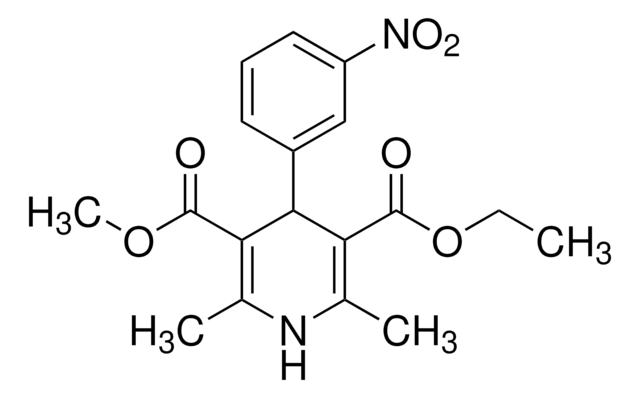

After administration by the mouth, the half-life is 2 to 5 hours 1. In plasma, about 92-98% binds to plasma proteins. Nifedipine is completely metabolized. About 70% of a dose is excreted in the urine in 24 hours as metabolites including 5-methoxycarbonyl-2,6-dimethyl-4-(2-nitrophenyl) pyridine-3-carboxylic acid; dimethyl 2,6-dimethyl-4-(2-nitrophenyl pyridine-3,5-dicarboxylate and 2-hydroxymethyl-5-methoxycarbonyl-6-methyl-4-(2-nitrophenyl) pyridine-3-carboxylic acid and its lactone derivative. Up to 15% of a dose is eliminated in the feces as metabolites in 4 days 2. References: 1. Martindale, 29th ed., pgs. 1509-1513. 2. Clarke's Isolation and Identification of Drugs., 2nd ed., p. 811.
N7634

Nifedipine
≥98% (HPLC), powder, L-type Ca²⁺ channel blocker
Synonym(s):
1,4-Dihydro-2,6-dimethyl-4-(2-nitrophenyl)-3,5-pyridinedicarboxylic acid dimethyl ester
Sign In to View Organizational & Contract Pricing.
Select a Size
Change View
| Pack Size | SKU | Availability | Price |
|---|
About This Item
Empirical Formula (Hill Notation):
C17H18N2O6
CAS Number:
Molecular Weight:
346.33
NACRES:
NA.77
PubChem Substance ID:
UNSPSC Code:
12352200
EC Number:
244-598-3
MDL number:
Assay:
≥98% (HPLC)
Form:
powder
Pricing and availability is not currently available.
Product Name
Nifedipine, ≥98% (HPLC), powder
Quality Segment
assay
≥98% (HPLC)
form
powder
color
yellow
solubility
DMSO: soluble, ethanol: soluble
originator
Bayer
storage temp.
2-8°C
SMILES string
COC(=O)C1=C(C)NC(C)=C(C1c2ccccc2[N+]([O-])=O)C(=O)OC
InChI
1S/C17H18N2O6/c1-9-13(16(20)24-3)15(14(10(2)18-9)17(21)25-4)11-7-5-6-8-12(11)19(22)23/h5-8,15,18H,1-4H3
InChI key
HYIMSNHJOBLJNT-UHFFFAOYSA-N
Gene Information
human ... ADORA2A(135), ADORA3(140), CACNA1C(775), CACNA1D(776), CACNA1F(778), CACNA1S(779), CACNA2D1(781), CYP1A2(1544), KCNH1(3756), TTR(7276)
mouse ... Cacna1c(12288)
rat ... Adora1(29290), Adora2a(25369), Cacna1c(24239), Cacna1d(29716), Kcnj1(24521), Kcnn4(65206), Tbxas1(24886)
Application
Nifedipine has been used:
- to evaluate its effect on myenteric neuronal calcium current through R-type calcium channel in guinea pig small intestine
- to evaluate the neuroprotective effect of L-type calcium channel blockers in cholinergic and dopaminergic neurons
- to identify the effect of co-administration of nifedipine (anti-hypertensive drug) along with hypoglycemic drug on human umbilical vein cells (HUVECs)
Biochem/physiol Actions
Nifedipine is a L-type Ca2+ channel blocker; and induces apoptosis in human glioblastoma cells. Nifedipine has neuroprotection activity and protects substantia nigra. Nifedipine has antioxidant potential. Nifedipine downregulates inflammatory cytokines like macrophage inflammatory protein-2 (MIP-2), tumor necrosis factor-α (TNF-α). Nifedipine has antihypertensive properties. Nifedipine inhibits extracellular region of adenosine A2a receptor (ADORA2A) gene.
Features and Benefits
This compound is a featured product for ADME Tox and Cyclic Nucleotide research. Discover more featured ADME Tox and Cyclic Nucleotide products. Learn more about bioactive small molecules for other areas of research at sigma.com/discover-bsm.
This compound is featured on the Calcium Channels and Cyclic Nucleotide-Gated (CNG) and Hyperpolarization Activated Cyclic Nucleotide-Gated (HCN) Channels pages of the Handbook of Receptor Classification and Signal Transduction. To browse other handbook pages, click here.
This compound was developed by Bayer. To browse the list of other pharma-developed compounds and Approved Drugs/Drug Candidates, click here.
1 of 1
This Item | |||
|---|---|---|---|
| form powder | form powder | form powder | form powder |
| assay ≥98% (HPLC) | assay ~95% (HPLC) | assay ≥98% | assay >95% |
| Quality Level 200 | Quality Level 200 | Quality Level 100 | Quality Level 200 |
| storage temp. 2-8°C | storage temp. 2-8°C | storage temp. 2-8°C | storage temp. - |
| solubility DMSO: soluble, ethanol: soluble | solubility - | solubility DMSO: ~1 mg/mL, 0.1 M NaOH: insoluble, H2O: slightly soluble, methanol: soluble | solubility methanol: 15 mg/mL, DMSO: 17.5 mg/mL, H2O: insoluble |
| color yellow | color yellow | color yellow | color yellow to green |
Still not finding the right product?
Explore all of our products under Nifedipine
signalword
Warning
hcodes
Hazard Classifications
Acute Tox. 4 Oral
Storage Class
11 - Combustible Solids
wgk
WGK 1
flash_point_f
Not applicable
flash_point_c
Not applicable
ppe
dust mask type N95 (US), Eyeshields, Gloves
Choose from one of the most recent versions:
Already Own This Product?
Find documentation for the products that you have recently purchased in the Document Library.
Related Content
Product Information Sheet
Global Trade Item Number
| SKU | GTIN |
|---|---|
| N7634-10G | 04061834118121 |
| N7634-25G | 04061834118138 |
| N7634-5G | 04061834118145 |
| N7634-1G | 04061835516186 |
-
What is the half life of Product N7634, Nifidipine, in vivo?
1 answer-
Helpful?
-
-
Are there any recommended dosages for Product N7634, Nifidipine, in vivo and in vitro?
1 answer-
Nifedipine is reported to inhibit Ca2+-sensitive K+ channels at 100 μM1. Doses for different animals have been reported2,3. In randomly growing cultures of aortic cells of rats, nifedipine at 10 μM inhibited cell proliferation. References: 1. Thomas-Young, R.J. et al. Biochim. Biophys. Acta, 1146, 81, (1993). 2. Drug Dosages In Laboratory Animals: A Handbook, 3rd ed., Telford Press. and 3. Borchard, R.E. et al. Drug Dosage in Laboratory Animals, A Handbook, Third Edition, p. 315, The Telford Press, (1990).
Helpful?
-
-
What is the Department of Transportation shipping information for this product?
1 answer-
Transportation information can be found in Section 14 of the product's (M)SDS.To access the shipping information for this material, use the link on the product detail page for the product.
Helpful?
-
-
What is the solubility of Product N7634, Nifidipine?
1 answer-
Nifedipine can be dissolved in DMSO at 50 mg/ml1. It is sparingly soluble in absolute ethanol2. Herembert, T. et al., dissolved nifedipine in absolute ethanol (no concentration reported); the maximum ethanol concentration in cultures was 0.2% without any effect of solvent on the cells3. Nifedipine is soluble (g/L, at 20°C) in the following solvents: acetone, 250; methylene chloride, 160; chloroform, 140; ethyl acetate, 50; methanol, 26; ethanol, 17.4 It is practically insoluble in water. The solubilities at 37°C in buffer solutions of different pH values are: pH 4, 0.0058 g/L; pH 7, 0.0056 g/L; pH 9.0, 0.0078 g/L; pH 13, 0.006 g/L1. References: 1. Ali, S.L., Analytical Profiles of Drug Substances, 18, 221, (1989). 2. Martindale, The Extra Pharmacopoeia, 30th ed., 374, (1993). and 3. Herembert, T. et al. Brit. J. Pharmacol., 114, 1703, (1995).
Helpful?
-
-
Are there any recommended conditions that Product N7634, Nifidipine, should be used in?
1 answer-
When exposed to daylight and certain wavelengths of artificial light, nifedipine readily converts to a nitrosophenylpyridine derivative. Exposure to ultra-violet light leads to the formation of a nitrophenylpyridine derivative. Therefore, USP recommends that assays be performed in the dark or under golden fluorescent or other low actinic light. Low actinic glassware should be used1.
Helpful?
-