

This product can be reconstituted in water at 01. mg/mL. The solubility in PBS has not been determined, but is expected to be similar. Please see the link below to review additional preparation instructions included in the product datasheet:
https://www.sigmaaldrich.com/deepweb/assets/sigmaaldrich/product/documents/272/751/d8935dat.pdf
D8935

Nidogen-1 (NID1) human
recombinant, expressed in HEK 293 cells, suitable for cell culture
Synonym(s):
Entactin, NID, NID-1, NID1
Sign In to View Organizational & Contract Pricing.
Select a Size
Change View
| Pack Size | SKU | Availability | Price |
|---|
About This Item
NACRES:
NA.77
UNSPSC Code:
12352202
Form:
lyophilized powder
Assay:
95% (SDS-PAGE)
Recombinant:
expressed in HEK 293 cells
Pricing and availability is not currently available.
recombinant
expressed in HEK 293 cells
assay
95% (SDS-PAGE)
form
lyophilized powder
technique(s)
cell culture | mammalian: suitable
storage temp.
−20°C
General description
Nidogen-1 belongs to the nidogens family of glycoproteins. This family consists of nidogen-1 and nidogen-2, both of which are sulfated monomeric glycoproteins. Nidogen-1 is ubiquitously present in the synaptic and extra synaptic basal lamina. It is mapped to human chromosome 1q42.3. Nidogen-1 encodes a 139 kDa, three globular domains namely G1, G2 and G3 and has multiple epidermal growth factor repeats. Recombinant human nidogen-1 is expressed in human HEK 293 cells as a glycoprotein with a calculated molecular mass of 133.5 kDa (amino acids 29-1247). This protein is manufactured in human cells, with no serum. The human cells expression system allows human-like glycosylation and folding, and often supports higher specific activity of the protein. The protein is produced with no artificial tags.
Application
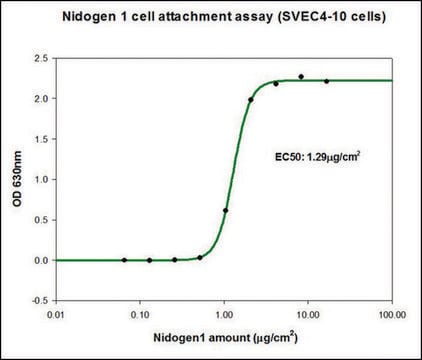
This recombinant human nidogen-1 product can be used as an attachment factor for cells adherence.
Biochem/physiol Actions
Nidogen-1 (NID-1) is thought to have an important role in the construction of basement membrane by linking between the networks of laminin and collagen IV. Genetic elimination of the nidogen-1 binding site on the mouse laminin γ1 chain leads to impaired deposition of basement membranes and hampers microvessel maturation. Nidogen 1 and 2 double knockout in mouse fibroblasts led to the loss of all major basal membrane components from the epidermal-collagen interface, and complete abolishment of hemidesmosomes. Supplementation by either recombinant nidogen-1 or -2 improved basal membrane formation. Mutations in NID1and laminin γ1 is implicated in pathogenesis of Dandy-Walker spectrum disorders.
1 of 1
This Item | |||
|---|---|---|---|
| recombinant expressed in HEK 293 cells | recombinant expressed in HEK 293 cells | recombinant expressed in HEK 293 cells | recombinant expressed in HEK 293 cells |
| assay 95% (SDS-PAGE) | assay ≥95% (HPLC), ≥95% (SDS-PAGE) | assay ≥95% (SDS-PAGE) | assay ≥95% (SDS-PAGE) |
| technique(s) cell culture | mammalian: suitable | technique(s) cell culture | mammalian: suitable | technique(s) cell culture | mammalian: suitable | technique(s) cell culture | mammalian: suitable |
| form lyophilized powder | form lyophilized | form lyophilized powder | form lyophilized powder |
| storage temp. −20°C | storage temp. −20°C | storage temp. −20°C | storage temp. −20°C |
Storage Class
13 - Non Combustible Solids
wgk
WGK 1
flash_point_f
Not applicable
flash_point_c
Not applicable
Choose from one of the most recent versions:
Already Own This Product?
Find documentation for the products that you have recently purchased in the Document Library.
Related Content
Instructions
Mutations in Extracellular Matrix Genes NID1 and LAMC1 Cause Autosomal Dominant D andy-W alker Malformation and Occipital Cephaloceles
Darbro BW, et al.
Human Mutation, 34(8), 1075-1079 (2013)
Basement Membrane Type IV Collagen and Laminin: An Overview of Their Biology and Value as Fibrosis Biomarkers of Liver Disease
Mak KM, et al.
The Anatomical Record, 300(8), 1371-1390 (2017)
Lack of nidogen-1 and-2 prevents basement membrane assembly in skin-organotypic coculture
Nischt R, et al.
The Journal of Investigative Dermatology, 127(3), 545-554 (2007)
Global Trade Item Number
| SKU | GTIN |
|---|---|
| D8935-50UG | 04054839917141 |
-
What is the solubility of this protein in water and PBS?
1 answer-
Helpful?
-