Przejdź do zawartości
Merck

Przejdź do

15971

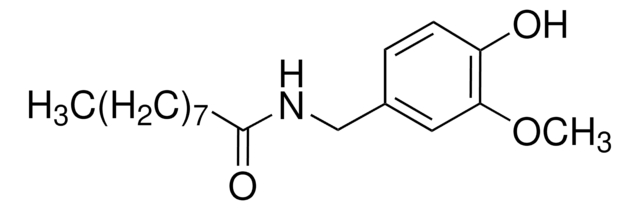
N-Vanillylnonanamide

analytical standard

Synonim(y):

Nonivamide, Capsaicin synthetic, N-(4-Hydroxy-3-methoxybenzyl)nonanamide, N-Vanillylpelargonamide, Nonanoic acid vanillylamide, Nonylvanylamide, Pelargonic acid vanillylamide, Pseudocapsaicin

Zaloguj się, aby wyświetlić ceny organizacyjne i kontraktowe.

Wybierz wielkość

Zmień widok
Gabaryty przesyłkiSKUDostępnośćCena netto
50 mg
Skontaktuj się z Obsługą Klienta, aby uzyskać informacje na temat dostępności
430,00 zł

Informacje o tej pozycji

Wzór empiryczny (zapis Hilla):
C17H27NO3
Numer CAS:
Masa cząsteczkowa:
293.40
UNSPSC Code:
41116107
NACRES:
NA.24
PubChem Substance ID:
EC Number:
219-484-1
Beilstein/REAXYS Number:
2144300
MDL number:

430,00 zł


Skontaktuj się z Obsługą Klienta, aby uzyskać informacje na temat dostępności

Zamów zamówienie zbiorcze
Pomoc techniczna
Potrzebujesz pomocy? Nasz zespół doświadczonych naukowców chętnie Ci pomoże.
Pozwól nam pomóc


grade

analytical standard

Quality Level

assay

≥98.0% (HPLC)

shelf life

limited shelf life, expiry date on the label

technique(s)

HPLC: suitable, gas chromatography (GC): suitable

impurities

≤1.0% water

application(s)

cleaning products
cosmetics
flavors and fragrances
food and beverages
personal care

format

neat

storage temp.

2-8°C

SMILES string

CCCCCCCCC(=O)NCc1ccc(O)c(OC)c1

InChI

1S/C17H27NO3/c1-3-4-5-6-7-8-9-17(20)18-13-14-10-11-15(19)16(12-14)21-2/h10-12,19H,3-9,13H2,1-2H3,(H,18,20)

InChI key

RGOVYLWUIBMPGK-UHFFFAOYSA-N

General description

N-Vanillylnonanamide has antifouling properties. It acts as an nicotinamide adenine dinucleotide phosphate (NADPH) inhibitor.

Application

Refer to the product′s Certificate of Analysis for more information on a suitable instrument technique. Contact Technical Service for further support.
Ta strona może zawierać tekst przetłumaczony maszynowo.

Porównaj podobne pozycje

Wyświetl pełne porównanie

Pokaż różnice

1 of 1

Ta pozycja
V9130PHL8982012084
Capsaicin analytical standard

Supelco

12084

Capsaicin

technique(s)

HPLC: suitable, gas chromatography (GC): suitable

technique(s)

-

technique(s)

-

technique(s)

HPLC: suitable, gas chromatography (GC): suitable

application(s)

cleaning products
cosmetics
flavors and fragrances
food and beverages
personal care

application(s)

-

application(s)

-

application(s)

cleaning products
cosmetics
flavors and fragrances
food and beverages
forensics and toxicology
personal care
pharmaceutical (small molecule)

format

neat

format

-

format

-

format

neat

Quality Level

100

Quality Level

200

Quality Level

-

Quality Level

100

grade

analytical standard

grade

-

grade

primary reference standard

grade

analytical standard

storage temp.

2-8°C

storage temp.

2-8°C

storage temp.

2-8°C

storage temp.

2-8°C


Still not finding the right product?

Explore all of our products under


signalword

Danger

Hazard Classifications

Eye Dam. 1 - Resp. Sens. 1 - Skin Irrit. 2 - Skin Sens. 1 - STOT SE 3

target_organs

Respiratory system

Klasa składowania

11 - Combustible Solids

wgk

WGK 2

flash_point_f

Not applicable

flash_point_c

Not applicable


Wybierz jedną z najnowszych wersji:

Certyfikaty analizy (CoA)

Lot/Batch Number

Nie widzisz odpowiedniej wersji?

Jeśli potrzebujesz konkretnej wersji, możesz wyszukać konkretny certyfikat według numeru partii lub serii.

Masz już ten produkt?

Dokumenty związane z niedawno zakupionymi produktami zostały zamieszczone w Bibliotece dokumentów.

Odwiedź Bibliotekę dokumentów


Katalin Horváth et al.
Neuropeptides, 48(6), 371-378 (2014-12-03)
The aim of the present study was to evaluate the therapeutic potential of local capsaicinoid (EMSPOMA(®) cream) treatment on chronic low back pain in patients with degenerative spine diseases and to investigate the possible mechanism of action of the therapy.
Ina Callebaut et al.
American journal of rhinology & allergy, 28(4), 290-296 (2014-09-10)
The naso-ocular interaction in allergic rhinoconjunctivitis is well recognized from epidemiological, clinical, and experimental observations. The precise mechanisms remain incompletely understood. A new mouse model of allergic rhinoconjunctivitis was used to investigate the contribution of mast cells and trigeminal ganglia
Josef Yayan
Medicine, 93(27), e199-e199 (2014-12-17)
Current uses of culture-independent tools in previous studies have shown a significant relationship between microbiota and asthma. Although these studies are relatively new, there is also evidence of the possibility of new therapeutic strategies for the treatment or prevention of


Numer pozycji handlu globalnego

SKUNUMER GTIN
15971-100MG04061838744715
15971-50MG04061838744722

Questions

Reviews

No rating value

Active Filters