
Przejdź do
B304-05

Bovine Aortic Endothelial Cells: BAOEC (Cryovial)
Synonim(y):
BAOEC cells
Wybierz wielkość
| Gabaryty przesyłki | SKU | Dostępność | Cena netto |
|---|
Informacje o tej pozycji
biological source
bovine aorta (USDA-inspected cattle)
form
solid
packaging
pkg of 500,000 cells
manufacturer/tradename
Cell Applications, Inc
growth mode
Adherent
karyotype
2n = 60
morphology
Endothelial
technique(s)
cell culture | mammalian: suitable
relevant disease(s)
diabetes; cardiovascular diseases
shipped in
dry ice
1 of 1
Ta pozycja | |||
|---|---|---|---|
| biological source bovine aorta (USDA-inspected cattle) | biological source Porcine coronary artery | biological source bovine endometrium | biological source human umbilicus (normal veins) |
| relevant disease(s) diabetes; cardiovascular diseases | relevant disease(s) cardiovascular diseases | relevant disease(s) infectious diseases | relevant disease(s) arthritis; diabetes; cancer; cardiovascular diseases |
| technique(s) cell culture | mammalian: suitable | technique(s) cell culture | mammalian: suitable | technique(s) cell culture | mammalian: suitable | technique(s) cell culture | mammalian: suitable |
| growth mode Adherent | growth mode Adherent | growth mode Adherent | growth mode Adherent |
| karyotype 2n = 60 | karyotype 2n = 38 | karyotype 2n = 60 | karyotype 2n = 46 |
| morphology Endothelial | morphology Endothelial | morphology epithelial | morphology Endothelial |

General description
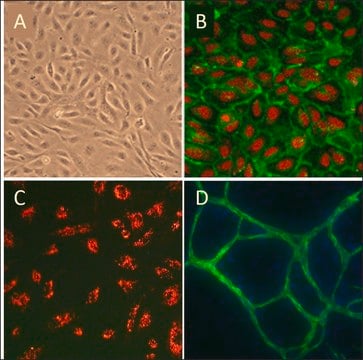
Bovine large artery endothelial cells (BAOEC) provide an excellent model system to study all aspects of cardiovascular function and disease, such as critical signaling pathways and mechanisms relevant to proper function of endothelia, including angiogenesis, permeability, flow adaptation, NO production, diabetes-related complications, etc., and search for beneficial modulators and delivery systems for therapeutic use, and to design scaffolds, surfaces and materials for tissue engineering and 3D modeling.
Application
Biochem/physiol Actions
Preparation Note
- 2nd passage, >500,000 cells in Bovine Endothelial Cell Growth Medium containing 10% FBS & 10% DMSO
- Can be cultured at least 16 doublings
Other Notes
Klasa składowania
11 - Combustible Solids
wgk
WGK 3
flash_point_f
Not applicable
flash_point_c
Not applicable
Wybierz jedną z najnowszych wersji:
Masz już ten produkt?
Dokumenty związane z niedawno zakupionymi produktami zostały zamieszczone w Bibliotece dokumentów.
Numer pozycji handlu globalnego
| SKU | NUMER GTIN |
|---|---|
| B304-05 | 04061833427286 |
Active Filters
Nasz zespół naukowców ma doświadczenie we wszystkich obszarach badań, w tym w naukach przyrodniczych, materiałoznawstwie, syntezie chemicznej, chromatografii, analityce i wielu innych dziedzinach.
Skontaktuj się z zespołem ds. pomocy technicznej