Przejdź do zawartości
Merck

A0310

Monoclonal Anti-GABA antibody produced in mouse

clone GB-69, ascites fluid

Monoclonal Anti-GABA antibody produced in mouse

Synonim(y):

GABA Antibody - Monoclonal Anti-GABA antibody produced in mouse, Gaba Antibody Sigma, Anti-γ-Aminobutyric acid

Zaloguj się, aby wyświetlić ceny organizacyjne i kontraktowe.

Wybierz wielkość

100 μL

2190,00 zł

0.2 ML

2890,00 zł

2190,00 zł


Skontaktuj się z Obsługą Klienta, aby uzyskać informacje na temat dostępności

Zamów zamówienie zbiorcze

Informacje o tej pozycji

UNSPSC Code:
12352203
NACRES:
NA.41
MDL number:
Conjugate:
unconjugated
Clone:
GB-69, monoclonal
Application:
DB, ELISA (i), IF, IHC
Citations:
75

Przejdź do

Pomoc techniczna
Potrzebujesz pomocy? Nasz zespół doświadczonych naukowców chętnie Ci pomoże.
Pozwól nam pomóc

biological source

mouse

conjugate

unconjugated

antibody form

ascites fluid

antibody product type

primary antibodies

clone

GB-69, monoclonal

contains

15 mM sodium azide

species reactivity

wide range

technique(s)

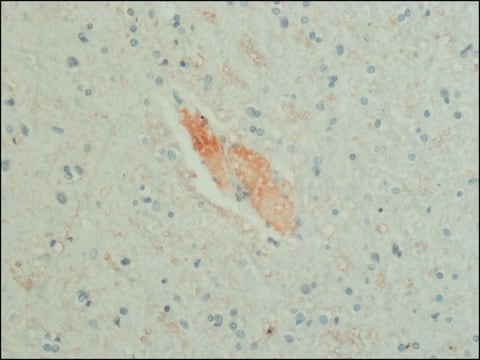
dot blot: suitable, immunofluorescence: suitable, immunohistochemistry: 1:100-1:200 (Using heat-retrieved formalin-fixed, paraffin-embedded human brain and/or cerebellum sections.), indirect ELISA: suitable

isotype

IgG1

shipped in

dry ice

storage temp.

−20°C

target post-translational modification

unmodified

Quality Level

Gene Information

mouse ... Gabra1(14394)

Porównaj podobne pozycje

Wyświetl pełne porównanie

Pokaż różnice

1 of 4

Ta pozycja
SAB4200721S5768M4403
biological source

mouse

biological source

mouse

biological source

mouse

biological source

mouse

species reactivity

wide range

species reactivity

rat, monkey, frog, mouse, human, gerbil

species reactivity

pig, rat, human, guinea pig

species reactivity

rat, chicken, human, mouse, bovine, quail

antibody form

ascites fluid

antibody form

purified from hybridoma cell culture

antibody form

ascites fluid

antibody form

ascites fluid

conjugate

unconjugated

conjugate

-

conjugate

unconjugated

conjugate

unconjugated

clone

GB-69, monoclonal

clone

GB-69, monoclonal

clone

SVP-38, monoclonal

clone

HM-2, monoclonal

Gene Information

mouse ... Gabra1(14394)

Gene Information

human ... GABRA1(2554)
mouse ... Gabra1(14394)
rat ... Gabra1(29705)
rhesus monkey ... Gabra1(574302)

Gene Information

human ... SYP(6855)
rat ... Syp(24804)

Gene Information

human ... MAP2(4133)
mouse ... Mtap2(17756)
rat ... Map2(25595)

General description

γ-Aminobutyric acid (GABA) functions as an inhibitory neurotransmitter in the central nervous system. It also functions as a neuromodulator in some peripheral tissues. Additionally, GABA is present in non-nervous tissues and regulates blood pressure, heart rate, respiration, immunomodulation, cell proliferation, protein synthesis and metabolism.
Monoclonal Anti-GABA (mouse IgG1 isotype) is derived from the hybridoma produced by the fusion of mouse myeloma cells and splenocytes from an immunized mouse. The antibody does not cross react with L-α-aminobutyric acid, L-glutamic acid, L-aspartic acid, glycine, δ-aminovaleric acid, L-threonine, L-glutamine, taurine, putrescine, L-alanine and carnosine. However, weak cross-reaction is observed with β-alanine and ε-aminocaproic acid.
Monoclonal Anti-GABA (mouse IgG1 isotype) is derived from the hybridoma produced by the fusion of mouse myeloma cells and splenocytes from an immunized mouse. γ-Aminobutyric acid (GABA) is the major inhibitory neurotransmitter in the central nervous system and a neuromodulator in certain peripheral tissues. GABA is also present in non-nervous structures.

Immunogen

GABA (γ-aminobutyric acid) conjugated to BSA

Application

Monoclonal Anti-GABA antibody produced in mouse has been used in immunohistochemistry and immunocytochemistry.[1]

Biochem/physiol Actions

γ-Aminobutyric acid (GABA) mediates neuronal inhibition by binding to the GABA/benzodiazepine receptor and opening an integral chloride channel.

Physical form

Supplied as ascites fluid with 15 mM sodium azide as preservative.

Disclaimer

Unless otherwise stated in our catalog or other company documentation accompanying the product(s), our products are intended for research use only and are not to be used for any other purpose, which includes but is not limited to, unauthorized commercial uses, in vitro diagnostic uses, ex vivo or in vivo therapeutic uses or any type of consumption or application to humans or animals.
Ta strona może zawierać tekst przetłumaczony maszynowo.

Nie możesz znaleźć właściwego produktu?  

Wypróbuj nasz Narzędzie selektora produktów.

Klasa składowania

10 - Combustible liquids

wgk

WGK 3

flash_point_f

Not applicable

flash_point_c

Not applicable


Wybierz jedną z najnowszych wersji:

Certyfikaty analizy (CoA)

Lot/Batch Number

Nie widzisz odpowiedniej wersji?

Jeśli potrzebujesz konkretnej wersji, możesz wyszukać konkretny certyfikat według numeru partii lub serii.

Masz już ten produkt?

Dokumenty związane z niedawno zakupionymi produktami zostały zamieszczone w Bibliotece dokumentów.

Odwiedź Bibliotekę dokumentów

Newborn horizontal cells migrate bi-directionally across the neuroepithelium during retinal development
Edqvist PHD and Hallbook F
Development, 131(6), 1343-1351 (2004)
Structure, function, and modulation of GABAA receptors
Sigel E and Steinmann ME
The Journal of Biological Chemistry, 287(48), 40224-40231 (2012)
Christine J Huh et al.
eLife, 5 (2016-10-18)
Aging is a major risk factor in many forms of late-onset neurodegenerative disorders. The ability to recapitulate age-related characteristics of human neurons in culture will offer unprecedented opportunities to study the biological processes underlying neuronal aging. Here, we show that
Teruyuki Fukushima et al.
Journal of neurophysiology, 102(3), 1459-1471 (2009-04-17)
Analgesic effects of serotonin (5-hydroxytryptamine [5-HT]) type 3 (5-HT3) receptors may involve the release of gamma-aminobutyric acid (GABA) in the spinal dorsal horn. However, the precise synaptic mechanisms for 5-HT3 receptor-mediated spinal analgesia are not clear. In this study, we
Per-Henrik D Edqvist et al.
Development (Cambridge, England), 131(6), 1343-1351 (2004-02-20)
Cell migration plays an important role during the development of the retina. In this work we have studied the migration of newborn horizontal cells in avian embryonic retina. Using the pattern of the early expressed transcription factors Lim1 and Prox1

Powiązane treści

Questions

Reviews

Active Filters

  1. 2 Ratings-only reviews

Nasz zespół naukowców ma doświadczenie we wszystkich obszarach badań, w tym w naukach przyrodniczych, materiałoznawstwie, syntezie chemicznej, chromatografii, analityce i wielu innych dziedzinach.

Skontaktuj się z zespołem ds. pomocy technicznej