Direkt zum Inhalt
Merck

J3455

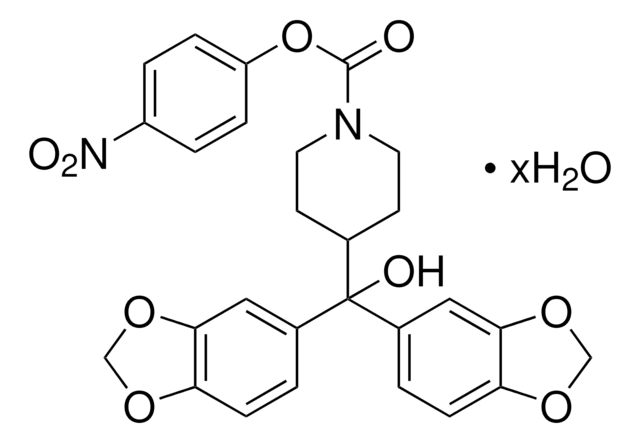
JZL 184 hydrate

≥97% (HPLC), monoacylglycerol lipase inhibitor, powder

Synonym(e):

JZL184 hydrate

Anmelden zur Ansicht der Organisations- und Vertragspreise.

Größe auswählen

5 MG

€ 172,00

€ 172,00


Warenkorb auf Verfügbarkeit prüfen

Großbestellung anfragen

Über diesen Artikel

Empirische Formel (Hill-System):
C27H24N2O9 · xH2O
CAS-Nummer:
Molekulargewicht:
520.49 (anhydrous basis)
UNSPSC Code:
12352200
PubChem Substance ID:
NACRES:
NA.77
MDL number:
Assay:
≥97% (HPLC)
Form:
powder
Quality level:

Fortfahren mit

Technischer Dienst
Benötigen Sie Hilfe? Unser Team von erfahrenen Wissenschaftlern ist für Sie da.
Unterstützung erhalten

Produktname

JZL 184 hydrate, ≥97% (HPLC)

SMILES string

O.OC(C1CCN(CC1)C(=O)Oc2ccc(cc2)[N+]([O-])=O)(c3ccc4OCOc4c3)c5ccc6OCOc6c5

InChI

1S/C27H24N2O9.H2O/c30-26(38-21-5-3-20(4-6-21)29(32)33)28-11-9-17(10-12-28)27(31,18-1-7-22-24(13-18)36-15-34-22)19-2-8-23-25(14-19)37-16-35-23;/h1-8,13-14,17,31H,9-12,15-16H2;1H2

InChI key

HNSBVGMOKGQJLT-UHFFFAOYSA-N

assay

≥97% (HPLC)

form

powder

color

, White to green-yellow to yellow

solubility

DMSO: >20 mg/mL

storage temp.

2-8°C

Quality Level

Ähnliche Artikel vergleichen

Vollständigen Vergleich anzeigen

Unterschiede anzeigen

1 of 4

Dieser Artikel
A9736SML0042O1016
assay

≥97% (HPLC)

assay

≥98% (HPLC)

assay

≥97% (HPLC)

assay

≥98% (HPLC)

form

powder

form

powder

form

powder

form

powder

Quality Level

100

Quality Level

100

Quality Level

100

Quality Level

100

storage temp.

2-8°C

storage temp.

2-8°C

storage temp.

room temp

storage temp.

2-8°C

solubility

DMSO: >20 mg/mL

solubility

DMSO: 20 mg/mL, clear

solubility

DMSO: ≥22 mg/mL

solubility

DMSO: ≥20 mg/mL

color

light yellow to yellow-green

color

white to beige

color

white to tan

color

white to off-white

Application

JZL 184 hydrate has been used as an inhibitor of monoacylglycerol lipase to study its effect on human osteoblast differentiation and proliferation[1] and postsynaptic neurons.[2]

Biochem/physiol Actions

JZL184 selectively inhibits MAGL, the enzyme predominantly responsible for the degradation of the endocannabinoid 2-arachidonoylglycerol (2-AG).
JZL184 selectively inhibits MAGL, the enzyme predominantly responsible for the degradation of the endocannabinoid 2-arachidonoylglycerol (2-AG). Anandamide and 2-AG are the two endogenous endocannabinoids that activate the cannabinoid receptors CB1 and CB2. Anandamide is predominantly metabolized by fatty acid amide hydrolase (FAAH), whereas monoacylglycerol lipase (MAGL) is thought to be the enzyme primarily responsible for the degradation of 2-AG. It is difficult to separate the activities of the two because most currently available inhibitors of MAGL are not selective, and also inhibit FAAH or other enzymes. JZL 184 is the first selective inhibitor of MAGL with nanomolar portency and over 200-fold selectivity for MAGL vs FAAH. When administered to mice, JZL184 increased levels of 2-arachidonoylglycerol in the brain by about 8-fold, with no effect on levels of anandamide.

Features and Benefits

This compound is featured on the Cannabinoid Receptors page of the Handbook of Receptor Classification and Signal Transduction. To browse other handbook pages, click here.

pictograms

Skull and crossbones

signalword

Danger

hcodes

Hazard Classifications

Acute Tox. 3 Oral

Lagerklasse

6.1C - Combustible acute toxic Cat.3 / toxic compounds or compounds which causing chronic effects

wgk

WGK 3

flash_point_f

Not applicable

flash_point_c

Not applicable


Hier finden Sie alle aktuellen Versionen:

Analysenzertifikate (COA)

Lot/Batch Number

Die passende Version wird nicht angezeigt?

Wenn Sie eine bestimmte Version benötigen, können Sie anhand der Lot- oder Chargennummer nach einem spezifischen Zertifikat suchen.

Besitzen Sie dieses Produkt bereits?

In der Dokumentenbibliothek finden Sie die Dokumentation zu den Produkten, die Sie kürzlich erworben haben.

Die Dokumentenbibliothek aufrufen

Yihui Cui et al.
eLife, 5, e13185-e13185 (2016-02-28)
Synaptic plasticity is a cardinal cellular mechanism for learning and memory. The endocannabinoid (eCB) system has emerged as a pivotal pathway for synaptic plasticity because of its widely characterized ability to depress synaptic transmission on short- and long-term scales. Recent
Marie Smith et al.
PloS one, 10(9), e0136546-e0136546 (2015-09-29)
The endocannabinoid system is expressed in bone, although its role in the regulation of bone growth is controversial. Many studies have examined the effect of endocannabinoids directly on osteoclast function, but few have examined their role in human osteoblast function
Olga Karpińska et al.
American journal of physiology. Regulatory, integrative and comparative physiology, 312(6), R883-R893 (2017-03-31)
Recent evidence suggests that endocannabinoids acting via cannabinoid CB

Artikel

We offer many products related to cannabinoid receptors for your research needs.

Fatty acid synthesis supports cancer cell proliferation, essential for membrane generation, protein modification, and bioenergetics.

Questions

Reviews

No rating value

Active Filters

Unser Team von Wissenschaftlern verfügt über Erfahrung in allen Forschungsbereichen einschließlich Life Science, Materialwissenschaften, chemischer Synthese, Chromatographie, Analytik und vielen mehr..

Setzen Sie sich mit dem technischen Dienst in Verbindung