


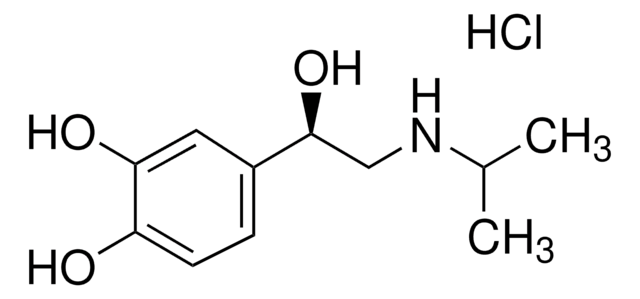


The stability of this product when prepared in DMSO has not been determined. In general, solutions in DMSO should be prepared fresh and used promptly. Epinephrine is most stable in acidic aqueous solutions at pH 3.6, when stored tightly sealed under nitrogen or argon. Solutions prepared in basic buffers are unstable and turn red in color due to degradation. Published literature indicates solutions are stable for at least 1 month when stored at 4°C or 25°C. Commercial solutions are often assigned a shelf life of greater than 1 year.
E4250

(−)-Epinephrin
≥99% (HPLC), powder, adrenoceptor agonist
Synonym(e):
(−)-Adrenalin, (R)-(−)-3,4-Dihydroxy-α-(methylaminomethyl)-benzylalkohol, L-Adrenalin, L-Epinephrin
Anmelden zur Ansicht der Organisations- und Vertragspreise.
Größe auswählen
1 G
€ 37,90
5 G
€ 152,00
10 G
€ 237,00
Über diesen Artikel
Lineare Formel:
(HO)2C6H3CH(OH)CH2NHCH3
CAS-Nummer:
Molekulargewicht:
183.20
NACRES:
NA.77
PubChem Substance ID:
UNSPSC Code:
12352200
EC Number:
200-098-7
MDL number:
Beilstein/REAXYS Number:
2368277
Quality level:
Fortfahren mit
Technischer Dienst
Benötigen Sie Hilfe? Unser Team von erfahrenen Wissenschaftlern ist für Sie da.
Unterstützung erhaltenProduktname
(−)-Epinephrin,
InChI
1S/C9H13NO3/c1-10-5-9(13)6-2-3-7(11)8(12)4-6/h2-4,9-13H,5H2,1H3/t9-/m0/s1
InChI key
UCTWMZQNUQWSLP-VIFPVBQESA-N
SMILES string
CNC[C@H](O)c1ccc(O)c(O)c1
mp
215 °C (dec.) (lit.)
storage temp.
2-8°C
Quality Level
Gene Information
human ... ADRA1A(148), ADRA1B(147), ADRA1D(146), ADRA2A(150), ADRA2B(151), ADRA2C(152), ADRB1(153), ADRB2(154), ADRB3(155)
rat ... Adra1a(29412), Adra2a(25083), Adrb1(24925), Adrb2(24176), Drd1a(24316), Drd2(24318)
Verwandte Kategorien
1 of 4
Dieser Artikel | |||
|---|---|---|---|
| Quality Level 200 | Quality Level 200 | Quality Level 200 | Quality Level 100 |
| storage temp. 2-8°C | storage temp. 2-8°C | storage temp. −20°C | storage temp. 2-8°C |
| mp 215 °C (dec.) (lit.) | mp - | mp 175 °C (dec.) (lit.) | mp - |
| Gene Information human ... ADRA1A(148), ADRA1B(147), ADRA1D(146), ADRA2A(150), ADRA2B(151), ADRA2C(152), ADRB1(153), ADRB2(154), ADRB3(155) | Gene Information human ... ADRA1A(148), ADRA1B(147), ADRA1D(146), ADRA2A(150), ADRA2B(151), ADRA2C(152), ADRB1(153), ADRB2(154), ADRB3(155) | Gene Information human ... ADRB2(154) | Gene Information - |
Biochem/physiol Actions
Adrenoceptor-Agonist
Features and Benefits
This compound is featured on the α1-Adrenoceptors, α2-Adrenoceptors and β-Adrenoceptors pages of the Handbook of Receptor Classification and Signal Transduction. To browse other handbook pages, click here.
Preparation Note
This product is only slightly soluble in water. Other sources state that it is soluble at 2 mg/mL in DMSO. The product solubility is tested at 50 mg/mL in 0.5 M HCl. This stock concentration can be diluted further in a buffer or medium to the required final concentration. In general, culture medium is buffered such that the final pH is not effected. The compound will remain in solution.
signalword
Danger
Lagerklasse
6.1A - Combustible acute toxic Cat. 1 and 2 / very toxic hazardous materials
flash_point_f
Not applicable
flash_point_c
Not applicable
ppe
Eyeshields, Faceshields, Gloves, type P2 (EN 143) respirator cartridges
hcodes
Hazard Classifications
Acute Tox. 2 Dermal
Hier finden Sie alle aktuellen Versionen:
Besitzen Sie dieses Produkt bereits?
In der Dokumentenbibliothek finden Sie die Dokumentation zu den Produkten, die Sie kürzlich erworben haben.
Anastasia Eskova et al.
Current biology : CB, 30(2), 298-303 (2020-01-07)
Color patterns are prominent features of many animals and are of high evolutionary relevance. In basal vertebrates, color patterns are composed of specialized pigment cells that arrange in multilayered mosaics in the skin. Zebrafish (Danio rerio), the preeminent model system
Eun-Min Kim et al.
PLoS neglected tropical diseases, 13(4), e0006843-e0006843 (2019-04-04)
Clonorchis sinensis is a group I bio-carcinogen responsible for cholangiocarcinoma (CHCA) in humans. However, the mechanism by which C. sinensis promotes carcinogenesis is unclear. Using the human cholangiocyte line H69, we investigated cell proliferation and gap junction protein expression after
Heat stress affects some physiological and productive variables and alters metabolism in dairy ewes.
Nabil Mehaba et al.
Journal of dairy science, 104(1), 1099-1110 (2020-11-10)
Heat stress (HS) has a significant economic impact on the global dairy industry. However, the mechanisms by which HS negatively affects metabolism and milk synthesis in dairy ewes are not well defined. This study evaluated the production and metabolic variables
Mohit Kumar et al.
The Journal of biological chemistry, 295(32), 11275-11291 (2020-06-20)
Cardiac myosin-binding protein-C (cMyBP-C) is highly phosphorylated under basal conditions. However, its phosphorylation level is decreased in individuals with heart failure. The necessity of cMyBP-C phosphorylation for proper contractile function is well-established, but the physiological and pathological consequences of decreased
Popchai Ngamskulrungroj et al.
PloS one, 6(1), e16076-e16076 (2011-01-21)
Human and animal cryptococcosis due to an unusual molecular type of Cryptococcus gattii (VGII) emerged recently on Vancouver Island, Canada. Unlike C. neoformans, C. gattii causes disease mainly in immunocompetent hosts, despite producing a similar suite of virulence determinants. To
-
When this product is reconstituted in DMSO, at what temperature should it be stored?
1 answer-
Helpful?
-
-
Hi, Is it possible to reconstitute the epinephrine solution in something less aggressive than 0.5 M HCl ? Sincerely, Alex
1 answer-
This product is only slightly soluble in water. Other sources state that it is soluble at 2 mg/mL in DMSO. The product solubility is tested at 50mg/mL in 0.5 M HCl. This stock concentration can be diluted further in a buffer or medium to the required final concentration. In general, culture medium is buffered such that the final pH is not effected. The compound will remain in solution.
Helpful?
-
Active Filters
Unser Team von Wissenschaftlern verfügt über Erfahrung in allen Forschungsbereichen einschließlich Life Science, Materialwissenschaften, chemischer Synthese, Chromatographie, Analytik und vielen mehr..
Setzen Sie sich mit dem technischen Dienst in Verbindung