



If this product has an expiration or retest date, it will be shown on the Certificate of Analysis (COA, CofA). If there is no retest or expiration date listed on the product's COA, we do not have suitable stability data to determine a shelf life. For these products, the only date on the COA will be the release date; a retest, expiration, or use-by-date will not be displayed.
For all products, we recommend handling per defined conditions as printed in our product literature and website product descriptions. We recommend that products should be routinely inspected by customers to ensure they perform as expected.
For products without retest or expiration dates, our standard warranty of 1 year from the date of shipment is applicable.
For more information, please refer to the Product Dating Information document: https://www.sigmaaldrich.com/deepweb/assets/sigmaaldrich/marketing/global/documents/418/501/product-dating-information-06-25-mk.pdf
Fortfahren mit
110205

(±)-Propylenoxid
ReagentPlus®, ≥99%
Synonym(e):
(±)-Methyloxiran, 1,2-Epoxypropan
Größe auswählen
| Größe/SKU | Verfügbarkeit | Preis |
|---|
Über diesen Artikel
vapor density
2 (vs air)
Quality Segment
vapor pressure
29.43 psi ( 55 °C), 8.59 psi ( 20 °C)
product line
ReagentPlus®
assay
≥99%
autoignition temp.
1378 °F
expl. lim.
37 %
refractive index
n20/D 1.366 (lit.)
bp
34 °C (lit.)
mp
−112 °C (lit.)
density
0.83 g/mL at 25 °C (lit.)
shipped in
wet ice
storage temp.
2-8°C
SMILES string
CC1CO1
InChI
1S/C3H6O/c1-3-2-4-3/h3H,2H2,1H3
InChI key
GOOHAUXETOMSMM-UHFFFAOYSA-N
General description
Application
Packaging
Other Notes
Legal Information
1 of 1
Dieser Artikel | |||
|---|---|---|---|
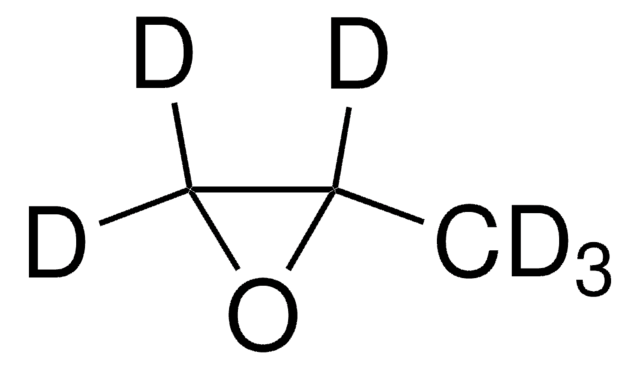
| description ReagentPlus®, ≥99% | description puriss. p.a., ≥99.5% (GC) | description analytical standard | description ≥98 atom % D, 98% (CP), contains hydroquinone as stabilizer |
| assay ≥99% | assay ≥99.5% (GC) | assay ≥99.7% (GC) | assay 98% (CP) |
| storage temp. 2-8°C | storage temp. 2-8°C | storage temp. 2-8°C | storage temp. 2-8°C |
| density 0.83 g/mL at 25 °C (lit.) | density 0.83 g/mL at 25 °C (lit.) | density 0.83 g/mL at 25 °C (lit.) | density 0.916 g/mL at 25 °C |
| bp 34 °C (lit.) | bp 34 °C (lit.) | bp 34 °C (lit.) | bp 34 °C (lit.) |
| refractive index n20/D 1.366 (lit.) | refractive index n20/D 1.366 | refractive index n20/D 1.366 | refractive index n20/D 1.365 (lit.) |
| mp −112 °C (lit.) | mp −112 °C (lit.) | mp −112 °C (lit.) | mp −112 °C (lit.) |
Still not finding the right product?
Explore all of our products under (±)-Propylenoxid
Signalwort
Danger
Gefahrencodes
Sicherheitshinweise
Hazard Classifications
Acute Tox. 3 Dermal - Acute Tox. 3 Inhalation - Acute Tox. 4 Oral - Carc. 1B - Eye Irrit. 2 - Flam. Liq. 1 - Muta. 1B - STOT SE 3
Zielorgane
Respiratory system
Lagerklasse
3 - Flammable liquids
Was ist los?
WGK 3
Flammpunkt (°F)
-36.4 °F - Equilibrium method
Flammpunkt (°C)
-38 °C - Equilibrium method
PSA (Persönliche Schutzausrüstung)
Faceshields, Gloves, Goggles
Zulassungslistungen
Zulassungslistungen werden hauptsächlich für chemische Produkte erstellt. Für nicht-chemische Produkte können hier nur begrenzte Angaben gemacht werden. Kein Eintrag bedeutet, dass keine der Komponenten gelistet ist. Es liegt in der Verantwortung des Benutzers, die sichere und legale Verwendung des Produkts zu gewährleisten.
75-56-9
75-56-9
Hier finden Sie alle aktuellen Versionen:
Besitzen Sie dieses Produkt bereits?
In der Dokumentenbibliothek finden Sie die Dokumentation zu den Produkten, die Sie kürzlich erworben haben.
-
How can I determine the shelf life / expiration / retest date of this product?
1 answer-
Helpful?
-
-
How is shipping temperature determined? And how is it related to the product storage temperature?
1 answer-
Products may be shipped at a different temperature than the recommended long-term storage temperature. If the product quality is sensitive to short-term exposure to conditions other than the recommended long-term storage, it will be shipped on wet or dry-ice. If the product quality is NOT affected by short-term exposure to conditions other than the recommended long-term storage, it will be shipped at ambient temperature. As shipping routes are configured for minimum transit times, shipping at ambient temperature helps control shipping costs for our customers. For more information, please refer to the Storage and Transport Conditions document: https://www.sigmaaldrich.com/deepweb/assets/sigmaaldrich/marketing/global/documents/316/622/storage-transport-conditions-mk.pdf
Helpful?
-
-
Is it suitable for electron microscopy processing?
1 answer-
Suitability of this product with electron microscopy is not tested. It may be suitable, but the customer would need to ensure suitability. A propylene oxide which is tested with electron microscopy is not offered.
Helpful?
-