Skip to Content
MilliporeSigma

Skip To

PRS2099

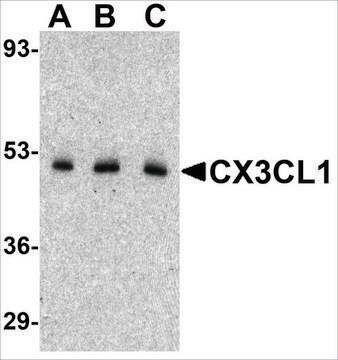
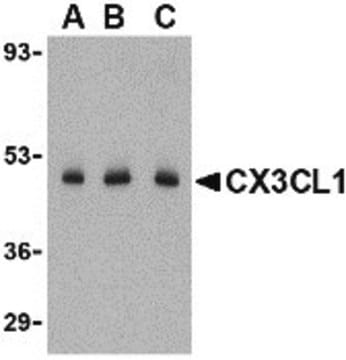
Anti-CX3CL1 antibody produced in rabbit

affinity isolated antibody, buffered aqueous solution

Synonym(s):

Anti-CX3C, Anti-Chemokine (C-X3-C motif) ligand 1

Sign In to View Organizational & Contract Pricing.

About This Item

UNSPSC Code:
12352203
NACRES:
NA.41
MDL number:
Conjugate:
unconjugated
Clone:
polyclonal
Application:
ELISA (i), IP, WB
Citations:
2


biological source

rabbit

conjugate

unconjugated

antibody form

affinity isolated antibody

antibody product type

primary antibodies

clone

polyclonal

form

buffered aqueous solution

species reactivity

mouse, human

technique(s)

immunoprecipitation (IP): suitable, indirect ELISA: suitable, western blot: suitable

UniProt accession no.

shipped in

dry ice

storage temp.

−20°C

target post-translational modification

unmodified

Gene Information

human ... CX3CL1(6376)

General description

Chemokine (C-X3-C motif) ligand 1 (CX3CL1) or fractalkine is a membrane protein and part of the CXC3 family. Its chemokine domain (CKD) anchors it to the cell membrane through its mucin-like stalk. The protein acts as a ligand for the G-protein coupled receptor CX3CR1. Fractalkine is expressed on epithelial, endothelial and smooth muscle cells and in neurons. The gene encoding it is localized on human chromosome 16q21.

Immunogen

a peptide corresponding to 18 amino acids near the amino-terminus of human CX3CL1.

Biochem/physiol Actions

CX3CL1 (chemokine (C-X3-C motif) ligand 1) or fractalkine is involved in various disorders such as atherosclerosis, multiple sclerosis, neuropathic pain and rheumatic disorders. It facilitates the proliferation and survival of primary human vascular smooth muscle cells in an epidermal growth factor receptor (EGR)–dependent manner. The protein plays an essential role in cell survival and promotes the survival of cells such as monocytes, T-cells and microglia. In humans, it may be involved in atherogenesis.

Physical form

Solution in phosphate buffered saline containing 0.02% sodium azide

Other Notes

The action of this antibody can be blocked using blocking peptide SBP2099.

Disclaimer

Unless otherwise stated in our catalog or other company documentation accompanying the product(s), our products are intended for research use only and are not to be used for any other purpose, which includes but is not limited to, unauthorized commercial uses, in vitro diagnostic uses, ex vivo or in vivo therapeutic uses or any type of consumption or application to humans or animals.

Compare Similar Items

View Full Comparison

Show Differences

1 of 1

This Item
SAB3501185WH0006376M1HPA046587
antibody form

affinity isolated antibody

antibody form

affinity isolated antibody

antibody form

purified immunoglobulin

antibody form

affinity isolated antibody

biological source

rabbit

biological source

rabbit

biological source

mouse

biological source

rabbit

conjugate

unconjugated

conjugate

unconjugated

conjugate

unconjugated

conjugate

unconjugated

Gene Information

human ... CX3CL1(6376)

Gene Information

human ... CX3CL1(6376)

Gene Information

human ... CX3CL1(6376)

Gene Information

human ... CX3CR1(1524)

technique(s)

immunoprecipitation (IP): suitable, western blot: suitable, indirect ELISA: suitable

technique(s)

western blot: suitable

technique(s)

indirect ELISA: suitable, western blot: 1-5 μg/mL

technique(s)

immunohistochemistry: 1:50- 1:200

storage temp.

−20°C

storage temp.

−20°C

storage temp.

−20°C

storage temp.

−20°C


Still not finding the right product?

or

Try our Product Selector Tool to narrow your options


Storage Class

10 - Combustible liquids

wgk

WGK 2

flash_point_f

Not applicable

flash_point_c

Not applicable


Choose from one of the most recent versions:

Certificates of Analysis (COA)

Lot/Batch Number

Don't see the Right Version?

If you require a particular version, you can look up a specific certificate by the Lot or Batch number.

Already Own This Product?

Find documentation for the products that you have recently purchased in the Document Library.

Visit the Document Library


Gladys Morrison et al.
Stem cell research, 16(1), 140-148 (2016-01-17)
Differentiated cells retain the genetic information of the donor but the extent to which phenotypic differences between donors or batches of differentiated cells are explained by variation introduced during the differentiation process is not fully understood. In this study, we
Fractalkine Promotes Human Monocyte Survival via a Reduction in Oxidative Stress
Gemma E White
Arteriosclerosis, Thrombosis, and Vascular Biology, 34(12), 2554?2562-2554?2562 (2014)


Global Trade Item Number

SKUGTIN
SBP2099-0.05MG04061832165417
PRS2099-100UG04061832509181

Questions

Reviews

No rating value

Active Filters