Direkt zum Inhalt
Merck

917192

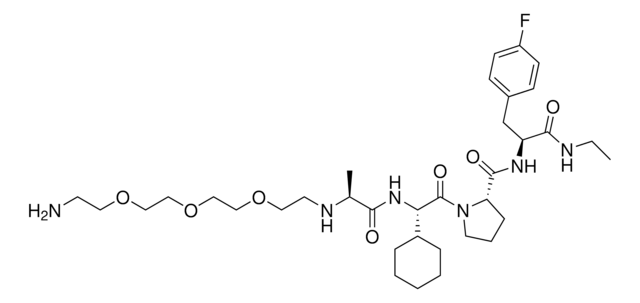
A1V2PF2-NHEt-PEG3-NH2

≥95%

Synonym(e):

(S)-1-((2S,5S)-17-Amino-2-cyclohexyl-5-methyl-4-oxo-9,12,15-trioxa-3,6-diazaheptadecanoyl)-N-((S)-1-(ethylamino)-3-(4-fluorophenyl)-1-oxopropan-2-yl)pyrrolidine-2-carboxamide, AVP conjugate for IAP-mediated protein degrader development, SNIPER building block

Anmelden zur Ansicht der Organisations- und Vertragspreise.

Größe auswählen

917192-50MG

386,00 €

386,00 €


Warenkorb auf Verfügbarkeit prüfen

Großbestellung anfragen

Über diesen Artikel

Empirische Formel (Hill-System):
C35H57FN6O7
Molekulargewicht:
692.86
MDL number:
UNSPSC Code:
41116105
NACRES:
NA.22

Fortfahren mit

Technischer Dienst
Benötigen Sie Hilfe? Unser Team von erfahrenen Wissenschaftlern ist für Sie da.
Unterstützung erhalten

ligand

A1V2PF2

Quality Level

assay

≥95%

form

crystals

reaction suitability

reactivity: carboxyl reactive, reagent type: ligand-linker conjugate

functional group

amine

storage temp.

2-8°C

SMILES string

C[C@H](NCCOCCOCCOCCN)C(N[C@H](C(N1CCC[C@H]1C(N[C@H](C(NCC)=O)CC2=CC=C(C=C2)F)=O)=O)C3CCCCC3)=O

InChI

1S/C35H57FN6O7/c1-3-38-33(44)29(24-26-11-13-28(36)14-12-26)40-34(45)30-10-7-17-42(30)35(46)31(27-8-5-4-6-9-27)41-32(43)25(2)39-16-19-48-21-23-49-22-20-47-18-15-37/h11-14,25,27,29-31,39H,3-10,15-24,37H2,1-2H3,(H,38,44)(H,40,45)(H,41,43)/t25-,29-,30-,31-/m0

InChI key

BUVZIAAEQPEKLD-OVOJMXFRSA-N

Ähnliche Artikel vergleichen

Vollständigen Vergleich anzeigen

Unterschiede anzeigen

1 of 4

Dieser Artikel
916935917931917702
functional group

amine

functional group

amine

functional group

amine

functional group

amine

assay

≥95%

assay

-

assay

-

assay

-

reaction suitability

reactivity: carboxyl reactive, reagent type: ligand-linker conjugate

reaction suitability

reactivity: carboxyl reactive, reagent type: ligand-linker conjugate

reaction suitability

reactivity: carboxyl reactive, reagent type: ligand-linker conjugate

reaction suitability

reactivity: carboxyl reactive, reagent type: ligand-linker conjugate

Quality Level

100

Quality Level

100

Quality Level

100

Quality Level

100

storage temp.

2-8°C

storage temp.

2-8°C

storage temp.

2-8°C

storage temp.

2-8°C

form

crystals

form

powder

form

powder

form

solid

Application

Protein degrader building block A1V2PF2-NHEt-PEG3-NH2 enables the synthesis of molecules for targeted protein degradation and SNIPER (specific and non-genetic inhibitor of apoptosis protein (IAP)-dependent protein erasers) technology. Developed in partnership with ComInnex, this conjugate contains an in silico-derived IAP-recruiting ligand, an alkyl-chain crosslinker, and a pendant amine for reactivity with an acid on a target warhead. Because even slight alterations in ligands and crosslinkers can affect ternary complex formation between the target, E3 ligase, and protein degrader, many analogs are prepared to screen for optimal target degradation. When used with other protein degrader building blocks with a terminal amine, including CRBN and VHL targeted, parallel synthesis can be used to more quickly generate SNIPER and PROTAC® degrader libraries that feature variation in crosslinker length, composition, and E3 ligase ligand. Learn more about the novel IAP ligands generated through virtual screening of AVP mimetics in our Technology Spotlight.

Building blocks in this series:
916714 A1V2PF2-NHEt
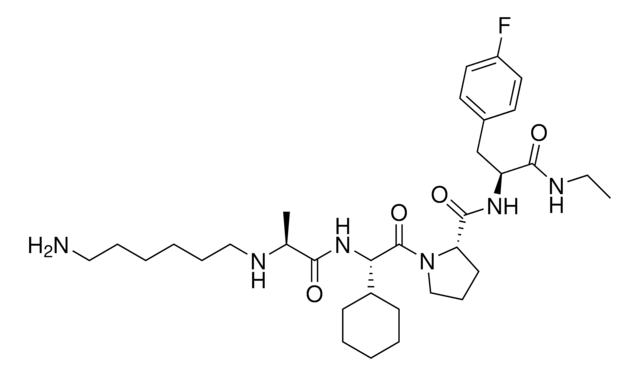
917931 A1V2PF2-NHEt-C6-NH2
916684 A1V2PF2-NHEt-C10-NH2
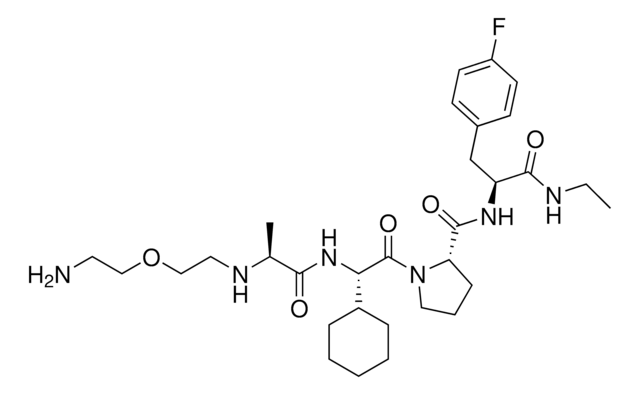
916935 A1V2PF2-NHEt-PEG1-NH2
917192 A1V2PF2-NHEt-PEG3-NH2

Technology Spotlight: Degrader Building Blocks with Inhibitor of Apoptosis Protein (IAP) In Silico-Derived Ligands

Legal Information

PROTAC is a registered trademark of Arvinas Operations, Inc., and is used under license

related product

Produkt-Nr.
Beschreibung
Preisangaben

Lagerklasse

11 - Combustible Solids

wgk

WGK 3

flash_point_f

Not applicable

flash_point_c

Not applicable


Hier finden Sie alle aktuellen Versionen:

Analysenzertifikate (COA)

Lot/Batch Number

It looks like we've run into a problem, but you can still download Certificates of Analysis from our Dokumente section.

Wenn Sie Hilfe benötigen, wenden Sie sich bitte an Kundensupport

Besitzen Sie dieses Produkt bereits?

In der Dokumentenbibliothek finden Sie die Dokumentation zu den Produkten, die Sie kürzlich erworben haben.

Die Dokumentenbibliothek aufrufen

Mikihiko Naito et al.
Drug discovery today. Technologies, 31, 35-42 (2019-06-16)
The induction of protein degradation by chimeric small molecules represented by proteolysis-targeting chimeras (PROTACs) is an emerging approach for novel drug development. We have developed a series of chimeric molecules termed specific and non-genetic inhibitor of apoptosis protein (IAP)-dependent protein
Nobumichi Ohoka et al.
The Journal of biological chemistry, 292(11), 4556-4570 (2017-02-06)
Many diseases, especially cancers, result from aberrant or overexpression of pathogenic proteins. Specific inhibitors against these proteins have shown remarkable therapeutic effects, but these are limited mainly to enzymes. An alternative approach that may have utility in drug development relies
Tasuku Ishida et al.
SLAS discovery : advancing life sciences R & D, 26(4), 484-502 (2020-11-05)
Bifunctional degrader molecules, also called proteolysis-targeting chimeras (PROTACs), are a new modality of chemical tools and potential therapeutics to understand and treat human disease. A required PROTAC component is a ligand binding to an E3 ubiquitin ligase, which is then joined to another ligand binding to a protein to

Artikel

Plate of 80 ligands against E3 ligase IAP designed by ComInnex; allows creation of bifunctional targeted protein degraders or molecular glues.

Targeted protein degradation reduces disease-relevant proteins in cells using small molecules, hijacking endogenous proteolysis systems.

Protein Degrader Building Blocks are a collection of crosslinker-E3 ligand conjugates with a pendant functional group for covalent linkage to a target ligand.

Fragen

Bewertungen

Kein Beurteilungswert

Aktive Filter

Unser Team von Wissenschaftlern verfügt über Erfahrung in allen Forschungsbereichen einschließlich Life Science, Materialwissenschaften, chemischer Synthese, Chromatographie, Analytik und vielen mehr..

Setzen Sie sich mit dem technischen Dienst in Verbindung