


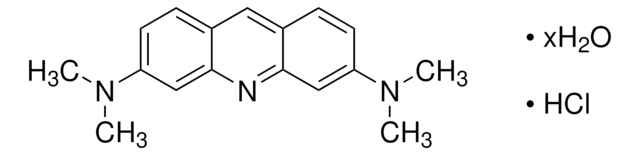

This product has not been specifically tested for suitability in SCSA and sperm DNA structure assays. However, there are a number of publications that have used this product for such applications. A thorough review of the literature is recommended. Please see the link below to review one such publication:
https://www.sciencedirect.com/science/article/pii/S0188440901003289
A6014

Acridine Orange hemi(zinc chloride) salt
For nucleic acid staining in cells or gels
Synonim(y):
3,6-Bis(dimethylamino)acridine hydrochloride zinc chloride double salt, 3,6-Bis(dimethylamino)acridinium chloride hemi(zinc chloride salt), Basic Orange 14
Zaloguj się, aby wyświetlić ceny organizacyjne i kontraktowe.
Wybierz wielkość
A6014-10G
503,00 zł
A6014-25G
1110,00 zł
A6014-100G
6859,50 zł
503,00 zł
Skontaktuj się z Obsługą Klienta, aby uzyskać informacje na temat dostępności
Informacje o tej pozycji
Wzór liniowy:
C17H20ClN3 · HCl · 1/2ZnCl2
Numer CAS:
Masa cząsteczkowa:
369.96
EC Number:
233-353-6
UNSPSC Code:
12171500
NACRES:
NA.52
PubChem Substance ID:
MDL number:
Colour Index Number:
46005
Beilstein/REAXYS Number:
3734978
Przejdź do
Pomoc techniczna
Potrzebujesz pomocy? Nasz zespół doświadczonych naukowców chętnie Ci pomoże.
Pozwól nam pomócQuality Level
product line
BioReagent
form
powder
composition
Dye content, ~80%
technique(s)
nucleic acid detection: suitable
solubility
ethanol: 2 mg/mL, 4 mg/mL (2-methoxyethanol (EGME)), water: 6 mg/mL (Forms a clear, dark orange or amber solution at 1mg/mL.)
suitability
suitable for flow cytometry, suitable for microscopy
storage temp.
room temp
SMILES string
Cl[H].Cl[H].Cl[Zn]Cl.CN(C)c1ccc2cc3ccc(cc3nc2c1)N(C)C.CN(C)c4ccc5cc6ccc(cc6nc5c4)N(C)C
InChI
1S/2C17H19N3.4ClH.Zn/c2*1-19(2)14-7-5-12-9-13-6-8-15(20(3)4)11-17(13)18-16(12)10-14;;;;;/h2*5-11H,1-4H3;4*1H;/q;;;;;;+2/p-2
InChI key
RAHGLSRJKRXOSY-UHFFFAOYSA-L
Szukasz podobnych produktów? Odwiedź Przewodnik dotyczący porównywania produktów
1 of 4
Ta pozycja | |||
|---|---|---|---|
| suitability suitable for flow cytometry, suitable for microscopy | suitability - | suitability - | suitability - |
| technique(s) nucleic acid detection: suitable | technique(s) microbe id | staining: suitable | technique(s) - | technique(s) microbe id | staining: suitable |
| solubility ethanol: 2 mg/mL, water: 6 mg/mL (Forms a clear, dark orange or amber solution at 1mg/mL.), 4 mg/mL (2-methoxyethanol (EGME)) | solubility 1 M HCl: 1 mg/mL, clear | solubility H2O: 1 mg/mL, clear, orange to very deep orange | solubility H2O: 0.1%, clear, orange to red |
| form powder | form powder | form powder | form powder |
| storage temp. room temp | storage temp. room temp | storage temp. room temp | storage temp. room temp |
| Quality Level 200 | Quality Level 200 | Quality Level 200 | Quality Level 200 |
General description
Acridine orange is a metachromatic fluorescent cationic dye that permeates the cell membrane and intercalates DNA and RNA. It allows for visual detection of nucleic acids on agarose and polyacrylamide gels.
Application
Acridine Orange, a cell-permeable metachromatic fluorescent cationic dye that intercalates DNA and RNA, is used in fluorescence and epiflouresence microscopy. Acridine Orange dye has been used to analyze mitochondria and lysosomal content by flow cytometry, characterize multidrug resistance, and measure changes in mitochondrial mass during apoptosis in rat thymocytes.
Suitable for
- detection of nucleic acids separated by gel electrophoresis
- fluorescence and epifluorescence microscopy
- analysis of mitochondria and lysosomes by flow cytometry
- DNA staining in apoptosis studies
Biochem/physiol Actions
Acridine orange intercalates into the nucleic acids of double helix and is detectable as green fluorescence at 530 nm. It binds electrostatically to the phosphate groups in single stranded nucleic acids and is detectable at red fluorescence at 640 nm.[1]
Features and Benefits
- 120 microM of acridine orange detects 25-50 ng of purified DNA per band in gels
- differential staining of single- and double-stranded polynucleotides
Ta strona może zawierać tekst przetłumaczony maszynowo.
related product
Numer produktu
Opis
Cennik
signalword
Warning
hcodes
Hazard Classifications
Muta. 2
Klasa składowania
11 - Combustible Solids
wgk
WGK 3
flash_point_f
Not applicable
flash_point_c
Not applicable
ppe
Eyeshields, Gloves, type N95 (US)
Wybierz jedną z najnowszych wersji:
Masz już ten produkt?
Dokumenty związane z niedawno zakupionymi produktami zostały zamieszczone w Bibliotece dokumentów.
Z Darzynkiewicz et al.
Cytometry, 13(8), 795-808 (1992-01-01)
The present review describes several methods to characterize and differentiate between two different mechanisms of cell death, apoptosis and necrosis. Most of these methods were applied to studies of apoptosis triggered in the human leukemic HL-60 cell line by DNA
G K McMaster et al.
Proceedings of the National Academy of Sciences of the United States of America, 74(11), 4835-4838 (1977-11-01)
We have developed a simple and rapid system for the denaturation of nucleic acids and their subsequent analysis by gel electrophoresis. RNA and DNA are denatured in 1 M glyoxal (ethanedial) and 50% (vol/vol) dimethyl sulfoxide, at 50 degrees. The
F Durrieu et al.
Cytometry, 36(2), 140-149 (1999-11-30)
Some forms of chemoresistance in leukemia may start from failure of tumour cells to successfully undergo apoptosis and Bcl-2 may play a role in this defect. Therefore, we evaluated the Bcl-2 content and synthesis in relation with the apoptotic potential
Yu Sato et al.
Anatomical science international, 94(2), 199-208 (2019-01-03)
Neurons are classified into several morphological types according to the locations of their somata and the branching patterns of their axons and dendrites. Recent studies suggest that these morphological features are related to their physiological properties, including firing characteristics, responses
A B Borisov et al.
Tsitologiia, 24(10), 1233-1237 (1982-10-01)
Using supravital fluorescent staining of lysosomes with Euchrysine 3R, the morphology of these organelles was studied in L cells examined from cultures being at different growth phases in the course of cell cycle and after adipocyte conversion of L cells
Produkty
Pomiar czasu życia fluorescencji ma przewagę nad pomiarami opartymi na intensywności. Zastosowania obejmują testy czasu życia fluorescencji, wykrywanie i FLI.
Fluorescence lifetime measurement is advantageous over intensity-based measurements. Applications include fluorescence lifetime assays, sensing and FLI.
Powiązane treści
Product Information Sheet
-
Is product A6014, Acridine Orange hemi(zinc chloride) salt, used for sperm chromatin structure assay (SCSA) and sperm DNA structure assay?
1 answer-
Helpful?
-
Active Filters
Nasz zespół naukowców ma doświadczenie we wszystkich obszarach badań, w tym w naukach przyrodniczych, materiałoznawstwie, syntezie chemicznej, chromatografii, analityce i wielu innych dziedzinach.
Skontaktuj się z zespołem ds. pomocy technicznej