Przejdź do zawartości
Merck

C6152

Carmine

Dye content: minimum not established , certified by the Biological Stain Commission, powder

Synonim(y):

Alum lake of carminic acid, Cochineal, Nacarat, Natural Red 4

Zaloguj się, aby wyświetlić ceny organizacyjne i kontraktowe.

Wybierz wielkość

C6152-25G

2620,00 zł

2620,00 zł


Skontaktuj się z Obsługą Klienta, aby uzyskać informacje na temat dostępności

Zamów zamówienie zbiorcze

Informacje o tej pozycji

Numer CAS:
MDL number:
UNSPSC Code:
12171500
NACRES:
NA.47
EC Number:
215-724-4
Colour Index Number:
75470

Przejdź do

Pomoc techniczna
Potrzebujesz pomocy? Nasz zespół doświadczonych naukowców chętnie Ci pomoże.
Pozwól nam pomóc

Nazwa produktu

Carmine, certified by the BSC

agency

certified by the BSC

Quality Level

form

powder

composition

Dye content: minimum has not been established

color

red

solubility

1 mg/mL, red (2 N NH4OH)

application(s)

diagnostic assay manufacturing
hematology
histology

storage temp.

room temp

SMILES string

O1C(C(C(C(C1c2c(c3c(c(c2O)O)C(=O)c4c(c(c(c(c4)O)C(=O)O)C)C3=O)O)O)O)O)CO

InChI

1S/C22H20O13/c1-4-8-5(2-6(24)9(4)22(33)34)13(25)10-11(15(8)27)16(28)12(18(30)17(10)29)21-20(32)19(31)14(26)7(3-23)35-21/h2,7,14,19-21,23-24,26,28-32H,3H2,1H3,(H,33,34)

InChI key

DGQLVPJVXFOQEV-UHFFFAOYSA-N

Szukasz podobnych produktów? Odwiedź Przewodnik dotyczący porównywania produktów

Porównaj podobne pozycje

Wyświetl pełne porównanie

Pokaż różnice

1 of 4

Ta pozycja
286044C1022PHL89702
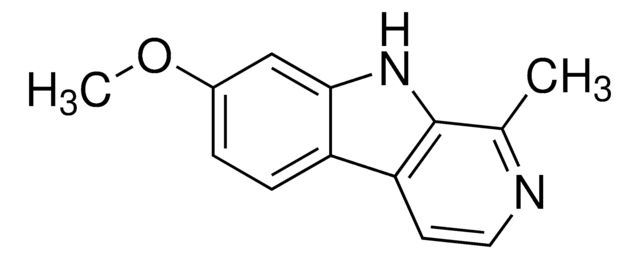
Harmine 98%

286044

Harmine

Carmine powder, ≥42.0% (UV-vis)

C1022

Carmine

Harmine phyproof® Reference Substance

PHL89702

Harmine

grade

certified by the Biological Stain Commission

grade

-

grade

-

grade

primary reference standard

color

red

color

-

color

red

color

-

solubility

1 mg/mL, red (2 N NH4OH)

solubility

-

solubility

ammonium hydroxide: 1 mg/mL

solubility

-

form

powder

form

-

form

powder

form

-

application(s)

diagnostic assay manufacturing
hematology
histology

application(s)

-

application(s)

diagnostic assay manufacturing
hematology
histology

application(s)

food and beverages

Quality Level

200

Quality Level

100

Quality Level

200

Quality Level

-

General description

Carmine is a red compound and is commonly used with aluminum, iron or other metal salts to enhance its activity. During smear preparation, carmine is required for chromatin staining in fresh material. In presence of aluminum chloride, it is required for the staining of glycogen.

Application

Certified for use in Orth′s lithium carbonate technique, Southgate′s mucicarmine method, and Best′s carmine for glycogen
Carmine has been used for the staining of mammary glands. It has also been used for the staining of chromosomes.[1]
Ta strona może zawierać tekst przetłumaczony maszynowo.

Klasa składowania

11 - Combustible Solids

wgk

WGK 1

flash_point_f

Not applicable

flash_point_c

Not applicable

ppe

Eyeshields, Gloves, type N95 (US)


Wybierz jedną z najnowszych wersji:

Certyfikaty analizy (CoA)

Lot/Batch Number

Nie widzisz odpowiedniej wersji?

Jeśli potrzebujesz konkretnej wersji, możesz wyszukać konkretny certyfikat według numeru partii lub serii.

Masz już ten produkt?

Dokumenty związane z niedawno zakupionymi produktami zostały zamieszczone w Bibliotece dokumentów.

Odwiedź Bibliotekę dokumentów

Genetic background affects susceptibility to mammary hyperplasias and carcinomas in Apc(min)/+ mice.
Moser AR, et al.
Cancer Research, 61, 3480-3480 (2001)
Precocious differentiation of the virgin Wistar-Kyoto rat mammary gland.
Benton ME, et al.
Endocrinology, 140, 2659-2659 (1999)
Florence Charlot et al.
Nucleic acids research, 42(19), 11965-11978 (2014-09-28)
The eukaryotic RecA homologue Rad51 is a key factor in homologous recombination and recombinational repair. Rad51-like proteins have been identified in yeast (Rad55, Rad57 and Dmc1), plants and vertebrates (RAD51B, RAD51C, RAD51D, XRCC2, XRCC3 and DMC1). RAD51 and DMC1 are
Methods in Mammary Gland Biology and Breast Cancer Research (2000)
Sonia de Assis et al.
Journal of visualized experiments : JoVE, (44), DOI: 10-DOI: 10 (2010-10-26)
Studies in rodent models of breast cancer show that exposures to dietary/hormonal factors during the in utero and pubertal periods, when the mammary gland undergoes extensive modeling and re-modeling, alter susceptibility to carcinogen-induced mammary tumors. Similar findings have been described

Questions

Reviews

No rating value

Active Filters

Nasz zespół naukowców ma doświadczenie we wszystkich obszarach badań, w tym w naukach przyrodniczych, materiałoznawstwie, syntezie chemicznej, chromatografii, analityce i wielu innych dziedzinach.

Skontaktuj się z zespołem ds. pomocy technicznej