
Przejdź do
37520

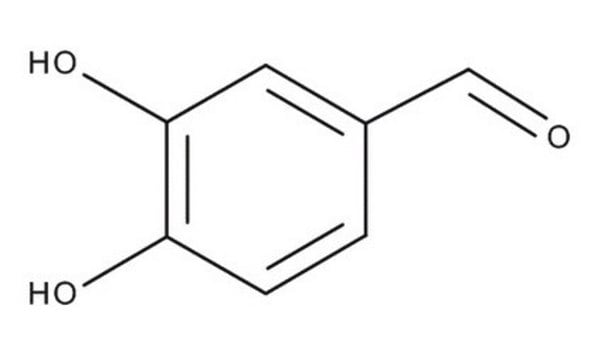
3,4-Dihydroxybenzaldehyde
purum, ≥97.0% (HPLC)
Synonim(y):
Protocatechualdehyde
Zaloguj się, aby wyświetlić ceny organizacyjne i kontraktowe.
Wybierz wielkość
Zmień widok
| Do Państwa/SKU | Dostępność | Cena netto |
|---|---|---|
25 g | Skontaktuj się z Obsługą Klienta, aby uzyskać informacje na temat dostępności | 270,00 zł |
100 g | Skontaktuj się z Obsługą Klienta, aby uzyskać informacje na temat dostępności | 524,00 zł |
Informacje o tej pozycji
Wzór liniowy:
(HO)2C6H3CHO
Numer CAS:
Masa cząsteczkowa:
138.12
UNSPSC Code:
12352100
NACRES:
NA.22
PubChem Substance ID:
EC Number:
205-377-7
Beilstein/REAXYS Number:
774381
MDL number:
Assay:
≥97.0% (HPLC)
Form:
powder
270,00 zł
Skontaktuj się z Obsługą Klienta, aby uzyskać informacje na temat dostępności
Pomoc techniczna
Potrzebujesz pomocy? Nasz zespół doświadczonych naukowców chętnie Ci pomoże.
Pozwól nam pomócgrade
purum
Quality Segment
assay
≥97.0% (HPLC)
form
powder
mp
150-155 °C, 150-157 °C (lit.)
functional group
aldehyde
SMILES string
Oc1ccc(C=O)cc1O
InChI
1S/C7H6O3/c8-4-5-1-2-6(9)7(10)3-5/h1-4,9-10H
InChI key
IBGBGRVKPALMCQ-UHFFFAOYSA-N
General description
3,4-Dihydroxybenzaldehyde has been recognized as one of the antifungal compound extracted from the outer skin of green Cavendish bananas. It can be synthesized from catechol via Fries rearrangement.
3,4-Dihydroxybenzaldehyde is reported as bioactive compound which inhibits the H2O2-induced apoptosis of granulosa cells.[1] Oxidation of 3,4-dihydroxybenzaldehyde on glassy carbon electrodes is reported to afford stable redox-active electropolymerized films containing a quinone moity.
Application
3,4-Dihydroxybenzaldehyde may be used for the surface modification of nanocrystalline TiO2 particles.[2] Electrodeposited layer of 3,4-dihydroxybenzaldehyde may be used as effective redox mediator during oxidation of NADH at graphene.[3] It may be used in the preparation of new diSchiff base ligands, which forms di-, tri- and tetranuclear Co(II) and Cu(II) complexes.[4]
3,4-Dihydroxybenzaldehyde (Protocatechualdehyde) may be employed as starting reagent for the synthesis of 4-vinylbenzocrown ether.
Ta strona może zawierać tekst przetłumaczony maszynowo.
1 of 1
Ta pozycja | |||
|---|---|---|---|
| assay ≥97.0% (HPLC) | assay 97% | assay ≥98.0% (HPLC) | assay ≥95.0% (HPLC) |
| Quality Level 100 | Quality Level 100 | Quality Level 200, 300 | Quality Level 100 |
| form powder | form powder | form powder | form - |
| mp 150-155 °C, 150-157 °C (lit.) | mp 150-157 °C (lit.) | mp 152-156 °C | mp 150-155 °C, 150-157 °C (lit.) |
| grade purum | grade - | grade - | grade - |
| functional group aldehyde | functional group - | functional group - | functional group - |

Still not finding the right product?
Explore all of our products under 3,4-Dihydroxybenzaldehyde

signalword
Warning
hcodes
Hazard Classifications
Eye Irrit. 2 - Skin Irrit. 2 - STOT SE 3
target_organs
Respiratory system
Klasa składowania
11 - Combustible Solids
wgk
WGK 3
flash_point_f
Not applicable
flash_point_c
Not applicable
ppe
dust mask type N95 (US), Eyeshields, Gloves
Wybierz jedną z najnowszych wersji:
Masz już ten produkt?
Dokumenty związane z niedawno zakupionymi produktami zostały zamieszczone w Bibliotece dokumentów.